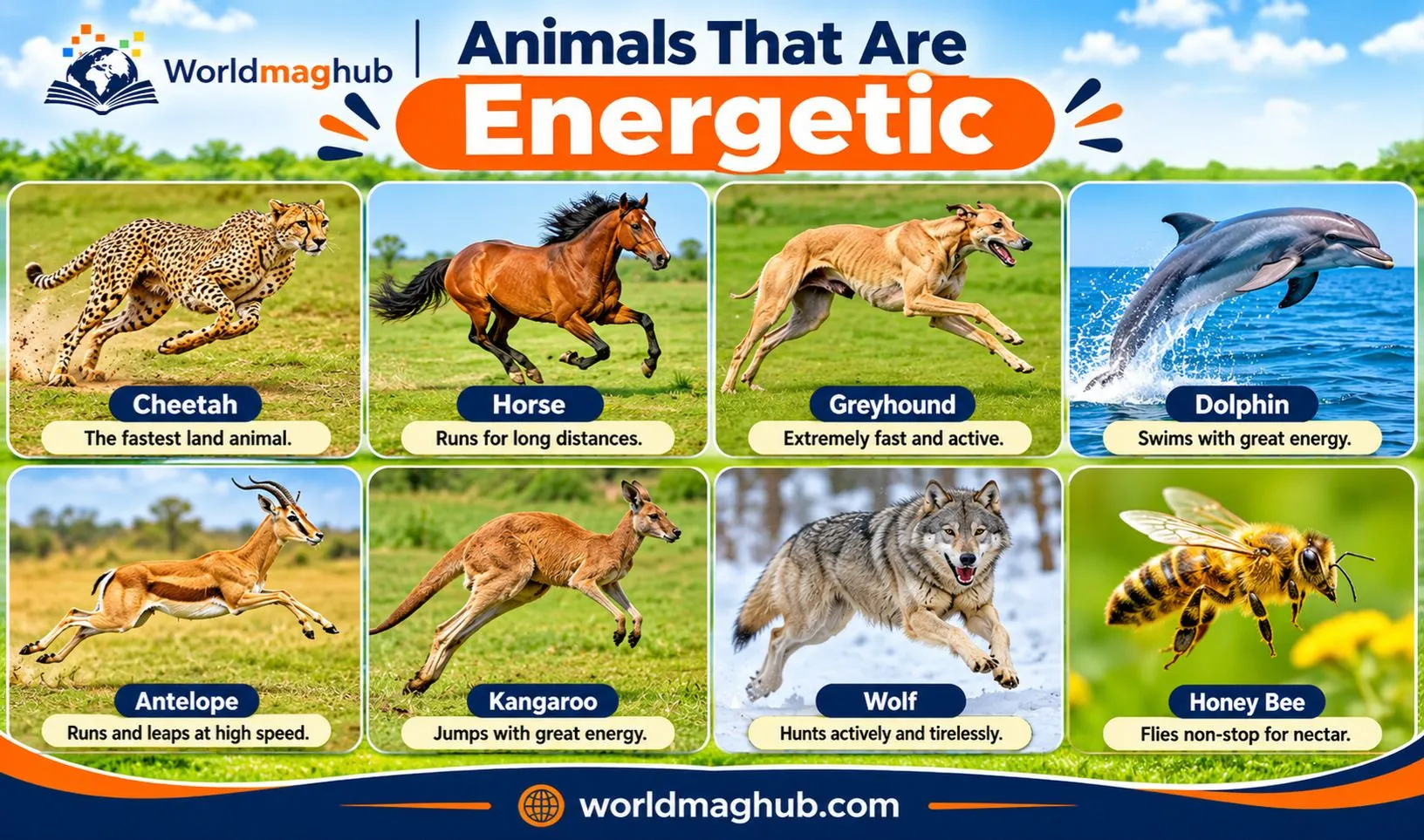
Some animals seem constantly busy. Squirrels race through trees, hummingbirds hover between flowers, and African wild dogs travel across open landscapes in search of prey. Others, such as cheetahs and pronghorns, demonstrate extraordinary speed and physical endurance.
Energetic animals include hummingbirds, shrews, squirrels, cheetahs, pronghorns, African wild dogs, dolphins, and Border Collies. These animals are known for different kinds of activity, from rapid movement and frequent feeding to high metabolic demands and long-distance travel.
Being energetic doesn’t always mean moving nonstop. A hummingbird needs a rapid metabolism to power its flight, while a cheetah uses explosive bursts of speed. Other animals demonstrate energy through endurance, repeated foraging, or social activity.
Not every animal survives by staying highly active. Some species, including three-toed sloths, conserve energy through slow, deliberate movement. Our guide to the world’s slowest animals explores how different species survive without relying on speed.
Here are 15 examples of high-energy animals and the biological adaptations or behaviors that make each one remarkable.
15 Energetic Animals Around the World
The following animals demonstrate different forms of energy use and physical activity. This is a selection of documented examples, not a ranking from most to least energetic.
| Animal | What Makes It Energetic |
|---|---|
| Hummingbird | Rapid wingbeats and high metabolic demands |
| Shrew | Fast metabolism and frequent feeding |
| Pronghorn | Exceptional running speed and endurance |
| Cheetah | Explosive speed during short hunting sprints |
| African Wild Dog | Coordinated hunting and sustained movement |
| Arctic Tern | Extraordinary long-distance migration |
| Dolphin | Swimming, hunting, and social activity |
| Squirrel | Frequent climbing, jumping, and foraging |
| Sea Otter | High energy requirements and repeated feeding |
| Squirrel Monkey | Active climbing and daytime foraging |
| Border Collie | High exercise and mental stimulation needs |
| Honeybee | Repeated foraging flights and colony work |
| Dragonfly | Agile flight and aerial hunting |
| Kangaroo | Powerful, energy-efficient hopping |
| Ant | Repeated foraging and coordinated colony activity |
1. Hummingbird
Hummingbirds are remarkable examples of animals with extremely high energy demands relative to their small size.
Their rapidly beating wings allow them to hover while feeding on nectar, fly backward, and change direction with exceptional precision.
According to the Smithsonian’s National Zoo, a Ruby-throated Hummingbird’s heart rate can exceed 1,200 beats per minute during flight. Maintaining this activity requires regular access to energy-rich food.
Hummingbirds can also enter torpor, a temporary state in which their metabolism slows significantly to conserve energy.
What makes them energetic? Exceptionally rapid wingbeats, demanding metabolism, and precise hovering flight.
2. Shrew
Shrews are tiny mammals with unusually demanding metabolisms. Many species must feed frequently to maintain their body temperature and energy levels.
They actively search for insects, worms, spiders, and other small invertebrates, often moving through vegetation, leaf litter, or underground spaces.
Animal Diversity Web identifies high metabolic rates and frequent feeding as characteristic features of shrews. Their small size contributes to rapid heat loss, increasing their energy requirements.
However, feeding patterns and activity levels differ among shrew species.
What makes them energetic? High metabolic demands and frequent searching for food.
3. Pronghorn
The Pronghorn is one of North America’s most impressive endurance runners.
Found across western grasslands and open landscapes, it uses exceptional speed to escape predators.
According to the U.S. National Park Service, pronghorns can reach approximately 55 mph (89 km/h) and sustain high running speeds over considerable distances.
Their long legs, lightweight bodies, and efficient respiratory adaptations support fast movement through open terrain.
Unlike cheetahs, which specialize in brief bursts of acceleration, pronghorns are particularly notable for combining speed with endurance.
What makes them energetic? Exceptional running speed and the ability to sustain fast movement.
4. Cheetah
The Cheetah is famous for its explosive acceleration during hunts.
Its flexible spine, long limbs, powerful muscles, and specialized claws allow it to reach extremely high speeds while pursuing prey.
However, these efforts are brief. High-speed sprinting is physically demanding, and cheetahs require recovery between intense pursuits.
A cheetah is therefore an example of an animal capable of extraordinary energy output during a short activity rather than one that remains constantly active.
What makes them energetic? Powerful acceleration and intense short-distance sprints.
5. African Wild Dog
African Wild Dogs are highly social predators that hunt in coordinated packs.
Their activity includes traveling across large areas, locating prey, pursuing animals, and interacting with pack members.
Instead of depending entirely on one explosive sprint, they use coordinated movement and sustained pursuit during hunts.
Their long legs and lean bodies are suited to traveling through open habitats.
Although hunting can be physically demanding, pack members also spend substantial time resting and recovering.
What makes them energetic? Cooperative hunting, sustained movement, and active social behavior.
6. Arctic Tern
The Arctic Tern demonstrates extraordinary endurance through one of the longest migrations in the bird world.
These seabirds travel between northern breeding regions and southern ocean waters, including areas near Antarctica.
Cornell Lab of Ornithology reports that Arctic Terns breeding in North America can travel approximately 25,000 miles (40,000 km) annually.
Their journeys involve long-distance flight, feeding along the route, and adapting to seasonal changes in food availability.
Unlike an animal that demonstrates energy through short bursts of speed, the Arctic Tern’s remarkable ability lies in sustained migratory travel.
What makes them energetic? Exceptional long-distance migration and endurance flight.
7. Dolphin
Dolphins are active marine mammals known for swimming, hunting, exploration, and complex social behavior.
Bottlenose Dolphins, for example, frequently travel in groups, pursue fish, and participate in coordinated feeding activities.
Their streamlined bodies and powerful tail flukes allow efficient movement through water.
Play, social interactions, and exploration can also involve considerable physical activity.
However, dolphins rest and have different activity patterns depending on their species, habitat, and available food.
What makes them energetic? Active swimming, hunting, exploration, and social interaction.
8. Squirrel
Squirrels are familiar examples of energetic animals, especially when climbing, jumping between branches, or gathering food.
Tree squirrels move through complex environments while searching for nuts, seeds, fruits, and other foods.
Their strong hind legs, sharp claws, and long tails help them climb, leap, and maintain balance.
Many appear particularly active while collecting and storing food, although their routines vary with season, weather, and species.
What makes them energetic? Frequent climbing, jumping, foraging, and food storage.
9. Sea Otter
Sea Otters have exceptionally high metabolic demands because they live in cold water and depend on dense fur for insulation.
To maintain body temperature, they must consume substantial quantities of food.
Sea otters demonstrate how demanding temperature regulation can be, but other mammals survive cold environments by storing substantial fat beneath their skin. Explore our guide to fat animals to learn how seals, walruses, and whales use blubber for insulation and energy storage.
According to NOAA, sea otters may eat approximately 20–30% of their body weight each day.
They repeatedly dive to collect sea urchins, crabs, clams, and other marine invertebrates.
Their energy requirements are especially interesting because much of their food intake supports temperature regulation rather than constant high-speed movement.
What makes them energetic? High metabolic demands, repeated diving, and frequent feeding.
10. Squirrel Monkey
Squirrel Monkeys are small, agile primates that spend much of their active time moving through tropical forest vegetation.
They travel between branches, search for insects and fruit, and interact with other members of their social groups.
Their relatively small bodies and agile limbs allow quick movement through the forest canopy.
Squirrel Monkeys are generally active during daylight hours, with time spent foraging, exploring, grooming, and resting.
Animal Diversity Web documents extensive daytime foraging and social activity in studied squirrel monkey species.
What makes them energetic? Frequent movement, climbing, foraging, and social interaction.
11. Border Collie
Border Collies are among the best-known high-energy domestic dog breeds.
Originally developed for herding livestock, they are athletic, intelligent, and highly responsive to physical and mental challenges.
The American Kennel Club describes Border Collies as extremely energetic dogs that generally require substantial daily exercise beyond a brief walk.
Running, herding, agility activities, training, and interactive games can help meet their needs.
Unlike many wild animals on this list, Border Collies provide a familiar example of high energy involving both physical activity and sustained mental engagement.
What makes them energetic? Strong exercise requirements, herding instincts, and a need for mental stimulation.
12. Honeybee
Honeybees demonstrate energetic activity through repeated foraging flights and coordinated colony work.
Worker bees collect nectar, pollen, water, and other resources needed to support the colony.
Their tasks change with age and colony requirements. Some workers care for developing bees, while others clean, defend, or maintain the hive.
Foraging flights require energy, especially when flowers are located far from the colony.
Although individual honeybees do not work continuously, the combined activity of many workers keeps the colony functioning.
What makes them energetic? Repeated foraging flights and coordinated work within the colony.
13. Dragonfly
Dragonflies are highly agile aerial predators.
Their four wings allow them to accelerate, hover, turn sharply, and change direction while pursuing insects.
Large compound eyes help dragonflies detect movement, while their specialized flight control allows them to intercept flying prey.
Adult dragonflies frequently hunt mosquitoes, flies, and other small insects around wetlands and open areas.
Their energetic behavior is most apparent during aerial hunting rather than through long-distance endurance.
What makes them energetic? Fast reactions, precise flight control, and repeated aerial hunting.
14. Kangaroo
Kangaroos are known for powerful hopping, supported by strong hind legs and elastic tendons.
These tendons store and release energy during movement, allowing larger kangaroos to travel efficiently across open landscapes.
Although hopping involves substantial physical activity, kangaroos do not remain constantly active. They often rest during hot weather and become more active when temperatures are cooler.
Their movement provides an example of how animals can travel considerable distances while using energy efficiently.
What makes them remarkable? Powerful hopping and specialized adaptations for efficient movement, rather than unusually high continuous activity.
15. Ant
Ants are active social insects whose colonies depend on workers performing many different tasks.
Depending on the species and their role, workers may collect food, transport materials, care for young, defend the colony, or maintain nests.
Individual ants have periods of rest, but colony activity can appear almost continuous because different workers perform tasks at different times.
Their repeated movements and coordinated behavior make ants familiar examples of busy, active animals.
What makes them energetic? Frequent foraging, carrying materials, and coordinated colony activity.
What Makes an Animal Energetic?
An animal may be described as energetic because of frequent movement, high metabolic demands, exceptional speed, or endurance.
- High metabolism: Hummingbirds and shrews require frequent feeding to meet demanding energy needs.
- Speed: Cheetahs use intense bursts of energy during short hunting sprints.
- Endurance: Pronghorn sustain fast running, while Arctic Terns complete extraordinary migrations.
- Frequent activity: Squirrels, monkeys, and social insects repeatedly move while gathering food or performing daily tasks.
- Temperature regulation: Sea Otters need substantial food energy to maintain body temperature in cold water.
These qualities are not interchangeable. An animal that moves quickly is not necessarily the one with the highest daily energy expenditure.
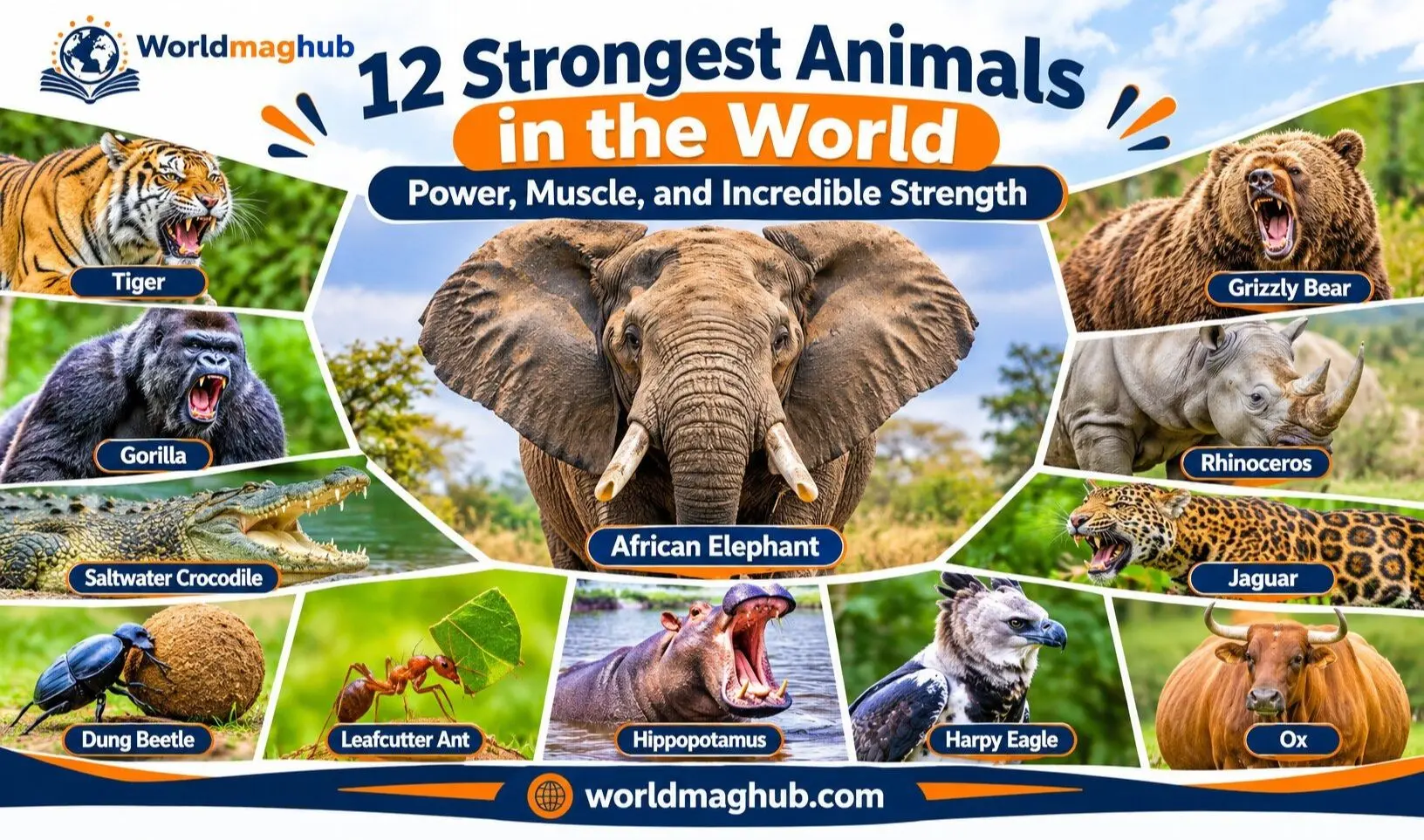
Some animals are not just energetic but exceptionally powerful, with strength adapted for lifting, carrying, hunting, and defending themselves. See our guide to the strongest animals in the world for remarkable examples of animal strength.
Are Energetic Animals Always Active?
No. Even animals with high metabolic demands or impressive physical abilities need periods of rest, recovery, or reduced activity.
Cheetahs cannot maintain maximum sprinting speed for long distances. Hummingbirds can enter torpor to reduce energy consumption, while many animals adjust their activity according to temperature, feeding opportunities, and threats.
Being highly active doesn’t mean an animal spends the entire day moving. Some species alternate intense activity with long periods of rest, while others remain inactive for most of the day. Looking at animals that sleep a lot reveals how dramatically daily sleep patterns can differ between species.
There’s much more to discover beyond this list, and the World Mag Hub animal generator can help you explore different species.
Sources and Further Reading
This guide uses documented examples of animal metabolism, speed, endurance, and natural activity. The animals are not scientifically ranked because these characteristics are measured differently.
The following sources support the principal biological facts and selected numerical claims:
- Smithsonian’s National Zoo — Hummingbirds — Hummingbird heart rate, hovering flight, metabolism, and torpor.
- Animal Diversity Web — Shrews (Soricidae) — High metabolic demands, feeding frequency, and natural behavior.
- U.S. National Park Service — Pronghorn — Running speed, endurance, and physical adaptations.
- Cornell Lab of Ornithology — Arctic Tern — Migration distance, habitat, and behavior.
- NOAA Ocean Today — Sea Otters 101 — Sea Otter food requirements and metabolism.
- Animal Diversity Web — Black Squirrel Monkey — A species-specific example of squirrel monkey activity and foraging behavior.
- American Kennel Club — Border Collie — Exercise requirements, high energy, and mental stimulation.
Frequently Asked Questions
What Is the Most Energetic Animal in the World?
There is no single scientifically recognized most energetic animal because energy can refer to metabolism, speed, endurance, or daily activity. Hummingbirds and shrews have exceptionally high metabolic demands relative to their size, while cheetahs and pronghorns demonstrate remarkable running abilities.
What Animal Has a Lot of Energy?
Hummingbirds, squirrels, shrews, Border Collies, and African Wild Dogs are examples of animals with demanding energy needs or active behavior. The type of energy involved differs by species, from rapid metabolism to frequent movement and exercise.
What Animal Is the Most Hyperactive?
There is no scientifically established most hyperactive animal. Squirrels, squirrel monkeys, and high-energy dog breeds such as Border Collies are often described as hyperactive because of their frequent movement. However, naturally active behavior does not necessarily indicate a behavioral disorder.
Which Animals Have the Highest Stamina?
Pronghorns and Arctic Terns are notable examples of endurance. Pronghorns sustain fast running across open landscapes, while Arctic Terns complete exceptionally long seasonal migrations. These represent different forms of stamina and cannot be directly compared using one measurement.
Do Small Animals Have More Energy Than Large Animals?
Many small warm-blooded animals have higher metabolic rates relative to their body weight than larger animals. However, this does not necessarily mean they are more physically active or expend more total energy.