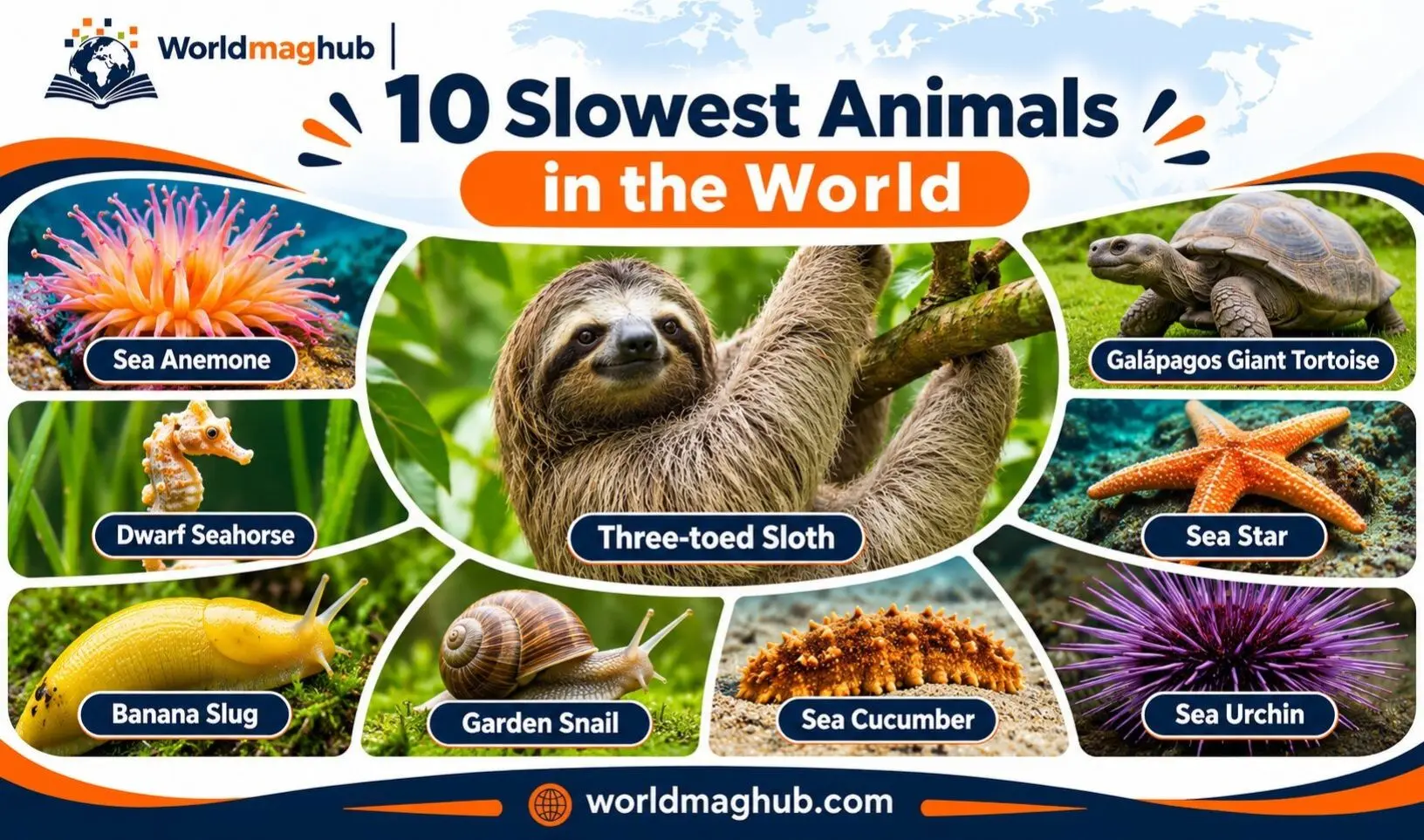
Sea anemones, dwarf seahorses, banana slugs, garden snails, and three-toed sloths are among the slowest-moving animals in the world. Some creep along surfaces at extremely low speeds, while others swim, climb, or walk slowly as part of their natural behavior.
What is the slowest animal in the world?
Some sea anemones are strong candidates when comparing active movement. They may creep only about 10–25 centimeters (4–10 inches) per hour when relocating, according to a report published by Live Science.
However, there is no universally accepted ranking covering every animal and type of movement. A sea anemone crawling across a rock, a seahorse swimming through water, and a sloth climbing a tree move in very different ways.
For many species, slow movement helps conserve energy, obtain food, or survive in environments where speed is not essential.
Here are 10 research-supported examples of slow-moving animals, including their habitats, movement methods, and the adaptations behind their unusual pace.
10 Slowest Animals in the World
The following animals are known for slow movement, although not all have scientifically established maximum speeds.
| Animal | Movement or Reported Speed | Main Habitat |
|---|---|---|
| Sea Anemone | Some relocate at approximately 10–25 cm/hour | Marine habitats |
| Dwarf Seahorse | Approximately 1.5 m/hour, according to Florida Aquarium | Western Atlantic seagrass beds |
| Banana Slug | Reported maximum around 16.5 cm/minute | Pacific coastal forests of North America |
| Garden Snail | Slow muscular crawling | Gardens and terrestrial habitats |
| Sea Cucumber | Gradual crawling or body contractions | Ocean floors worldwide |
| Sea Star | Crawling with tube feet; varies by species | Marine habitats worldwide |
| Three-toed Sloth | Exceptionally slow climbing and ground movement | Central and South American forests |
| Galápagos Giant Tortoise | Slow, deliberate walking | Galápagos Islands |
| Slow Loris | Careful, controlled climbing | South and Southeast Asia |
| Sea Urchin | Gradual movement using tube feet and spines | Marine habitats worldwide |
Important: This is a selection of 10 documented slow-moving animals, not a scientifically verified ranking from slowest to fastest. Reported speeds vary with species, environmental conditions, and measurement methods.
1. Sea Anemone — An Extremely Slow-Moving Animal
Scientific group: Order Actiniaria
Movement: Some species creep approximately 10–25 cm (4–10 inches) per hour when relocating.
Sea anemones are marine invertebrates that resemble colorful underwater flowers, but they are actually animals related to corals and jellyfish.
Most spend much of their lives attached to rocks or other firm surfaces. A muscular structure called the pedal disc allows many species to remain anchored.
Some sea anemones can slowly creep to a different location when environmental conditions change.
Live Science reports that certain anemones may travel only about 10–25 centimeters per hour during relocation.
Their tentacles capture small prey or suspended food, so they do not need to chase animals over long distances.
Not all sea anemones move at the same rate, and some can detach or move in other ways.
Why they’re slow: Their mostly attached lifestyle allows them to capture food without frequent travel.
2. Dwarf Seahorse — One of the Slowest Swimming Fish
Scientific name: Hippocampus zosterae
Reported swimming speed: Approximately 1.5 meters (5 feet) per hour, according to Florida Aquarium.
The Dwarf Seahorse is a tiny marine fish found in shallow seagrass habitats around parts of the western Atlantic Ocean.
Unlike most fish, it swims upright and uses rapid movements of a small dorsal fin for propulsion.
Its curled tail helps it grip seagrass or other underwater vegetation, allowing it to remain in position while searching for food.
Dwarf seahorses feed on tiny crustaceans and other small aquatic organisms that pass within reach.
Florida Aquarium identifies the species as the slowest-moving fish, reporting a top speed of about five feet per hour.
However, Guinness World Records provides a different estimate of 0.016 km/h (16 meters per hour). These figures are inconsistent, so neither should be presented as a universally verified maximum speed.
Why it’s slow: Its small fins, upright swimming posture, and sit-and-wait feeding behavior are suited to controlled movement rather than speed.
3. Banana Slug — A Very Slow Land Animal
Scientific group: Ariolimax spp.
Reported maximum speed: Approximately 16.5 cm (6.5 inches) per minute.
Banana slugs are large terrestrial mollusks that inhabit moist forests along the Pacific coast of North America.
Many have yellowish bodies resembling bananas, although their coloration can vary.
Instead of walking with legs, banana slugs move through muscular waves along the underside of their bodies.
A layer of mucus helps them glide across uneven surfaces while reducing friction.
National Geographic describes banana slugs as among the slowest creatures on Earth and reports a maximum movement rate of approximately 6.5 inches per minute.
They feed on fungi, decaying vegetation, and other organic matter, contributing to nutrient recycling in forest ecosystems.
Why they’re slow: Their muscular crawling system allows steady movement across damp surfaces without the need for rapid travel.
4. Garden Snail — A Slow Animal With a Protective Shell
Scientific name: Cornu aspersum
Movement: Slow gliding using a muscular foot.
The Common Garden Snail is one of the most familiar examples of an animal that moves slowly.
It travels by producing muscular contractions along a broad foot beneath its body.
Mucus helps it move over soil, leaves, rocks, and other surfaces while reducing friction.
Unlike slugs, garden snails carry an external shell that protects their soft bodies and helps reduce moisture loss.
Snails are generally more active in moist conditions because drying out can be dangerous.
Although their movement is slow compared with most walking vertebrates, it allows them to find food, shelter, and mates.
Why it’s slow: Its muscular gliding method supports gradual movement while maintaining contact with the surface.
5. Sea Cucumber — A Slow-Moving Ocean Animal
Scientific group: Class Holothuroidea
Movement: Gradual crawling using tube feet or body contractions.
Sea cucumbers are marine invertebrates with elongated bodies that often live on or near the seafloor.
They belong to the echinoderm group, making them relatives of sea stars and sea urchins.
Many species move gradually across sediment, using tube feet or contractions of their bodies.
Numerous sea cucumbers feed on organic particles in sediment or water rather than chasing fast-moving prey.
The Smithsonian Institution describes sea cucumber feeding and movement as part of the broader biology of echinoderms.
Their actual speeds differ considerably among species. Some remain close to the seafloor, while others are capable of swimming.
Why they’re slow: Many species can collect food while moving gradually through suitable seafloor habitats.
6. Sea Star — Slow Movement With Tube Feet
Scientific group: Class Asteroidea
Movement: Crawling using numerous small tube feet.
Sea stars, commonly called starfish, are marine invertebrates found throughout the world’s oceans.
They move with small structures called tube feet, located along the undersides of their arms.
These structures help sea stars grip surfaces and travel across rocks, sand, and other underwater habitats.
Many species appear to move very slowly because their progress is gradual and difficult to notice.
However, sea stars are not equally slow. Some species, including sunflower sea stars, can move considerably faster than others.
Sea stars feed on different organisms depending on the species, including mollusks and other marine invertebrates.
Why they’re often slow: Their movement depends on coordinated tube-foot activity rather than rapid swimming or leg-powered running.
7. Three-toed Sloth — One of the Slowest Mammals
Scientific group: Bradypus spp.
Movement: Exceptionally slow climbing and ground movement.
Three-toed sloths are well known for their slow movements and tree-dwelling lifestyles.
They inhabit tropical forests of Central and South America, where they spend much of their lives hanging from branches.
Their long, curved claws help them maintain a secure grip while climbing and feeding.
Sloths have unusually low metabolic rates for mammals of their size. Their primarily leafy diet provides relatively little usable energy, making conservation important.
Smithsonian’s National Zoo explains that sloths’ specialized metabolism helps account for their slow movements.
Their deliberate pace can also reduce conspicuous movement in forest vegetation.
Despite their reputation, sloths are capable swimmers and can move more quickly under certain circumstances.
Why they’re slow: Their low-energy diet, specialized metabolism, and tree-dwelling anatomy favor deliberate movement.
8. Galápagos Giant Tortoise — A Big, Slow-Walking Animal
Scientific group: Chelonoidis niger species complex
Movement: Slow, steady walking.
Galápagos Giant Tortoises are among the largest living land tortoises.
Native to the Galápagos Islands, they have massive bodies, sturdy legs, and protective bony shells.
Their movement is generally deliberate and relatively slow compared with that of many other land animals.
They feed on vegetation, including grasses, leaves, and cacti, depending on the island and available habitat.
San Diego Zoo Wildlife Alliance describes their characteristic slow, ambling movement.
Their large size and strong limbs allow them to travel across suitable terrain without relying on high-speed movement.
Why they’re slow: Their heavy bodies and sturdy walking anatomy are suited to steady terrestrial movement rather than sprinting.
9. Slow Loris — A Deliberate Tree-Climbing Primate
Scientific group: Nycticebus spp.
Movement: Slow, controlled climbing through vegetation.
Slow lorises are nocturnal primates found in parts of South and Southeast Asia.
Unlike many monkeys that leap rapidly between branches, slow lorises typically move carefully through trees while maintaining a strong grip.
Their hands and feet are adapted for secure grasping, allowing them to travel along branches without sudden movements.
They search for insects, tree gums, nectar, and other foods depending on the species.
Slow lorises also possess a rare defensive adaptation among primates: a venomous bite.
Although their typical climbing behavior is deliberate, their name does not establish that they have the lowest maximum speed among primates.
Why they’re slow: Controlled climbing helps them navigate branches securely and move inconspicuously.
10. Sea Urchin — A Slow-Moving Marine Invertebrate
Scientific group: Class Echinoidea
Movement: Gradual movement using tube feet and movable spines.
Sea urchins are marine invertebrates recognized by their rounded bodies and numerous spines.
Beneath the spines is a rigid internal structure called the test, made from mineral plates.
Sea urchins move using small tube feet operated through a water vascular system. Their spines can also assist with movement and maintaining position.
Many species slowly travel across rocks or other underwater surfaces while grazing on algae and organic material.
Smithsonian Institution educational resources describe sea urchins as slow-moving grazers that use rows of tube feet for locomotion.
However, their speeds vary by species, and no single measurement represents every sea urchin.
Why they’re slow: Their tube-foot locomotion and grazing lifestyle allow them to move gradually while feeding.
Why Do Some Animals Move So Slowly?
Slow movement can be an adaptation that helps animals survive when speed is not essential.
- Energy conservation: Sloths have specialized metabolisms that allow them to function on relatively low-energy diets.
- Feeding behavior: Sea anemones and sea cucumbers can obtain food without rapidly chasing prey.
- Body structure: Snails and slugs move through muscular contractions, while tortoises use sturdy legs to support large bodies.
- Avoiding detection: Slow, quiet movement can make some animals less noticeable to predators or prey.
- Habitat adaptation: Dwarf seahorses use their tails to grip underwater vegetation while capturing nearby prey.
These examples show that moving slowly is not necessarily a disadvantage. Different animals have evolved movement patterns suited to their anatomy, food sources, and environments.
For your next animal-related discovery, try finding an unfamiliar animal through World Mag Hub’s generator.
Frequently Asked Questions
What Is the Slowest Animal in the World?
Some sea anemones are among the slowest-moving animals, creeping approximately 10–25 cm (4–10 inches) per hour when relocating. However, there is no universally accepted ranking across every animal because crawling, swimming, climbing, and remaining attached to surfaces are difficult to compare.
What Is the Slowest Animal on Land?
Banana slugs and garden snails are notable examples of very slow-moving land animals. National Geographic reports that banana slugs can reach approximately 16.5 cm (6.5 inches) per minute, although actual speeds vary. There is no universally established slowest land animal across every form of movement.
What Animal Is Big and Slow?
The Galápagos Giant Tortoise is a familiar example of a large, slow-walking animal. Its heavy body, sturdy legs, and protective shell contribute to deliberate movement. Some large aquatic animals, including manatees, also move calmly during normal activity, although they can swim much faster than the slowest crawling species.
What Is the Slowest Animal in the Sky?
The American Woodcock (Scolopax minor) and Eurasian Woodcock (Scolopax rusticola) have been recorded flying at approximately 8 km/h (5 mph) during courtship displays. Guinness World Records recognizes this exceptionally slow flight, although these birds can fly faster in other circumstances.
Are Slow-Moving Animals Lazy?
No. Slow movement is often a normal biological adaptation rather than laziness. Sloths conserve energy through specialized metabolism, while snails, sea stars, and tortoises use movement methods suited to their environments. Moving slowly does not necessarily mean an animal is sleeping.
How Is the Speed of Slow-Moving Animals Measured?
Animal speed is usually measured as distance traveled over time. Researchers may compare average speed, maximum speed, or movement during a particular activity. However, comparing animals that crawl, swim, climb, or remain attached to surfaces is difficult because their movement conditions differ.
Sources and Further Reading
This guide presents 10 documented examples of slow-moving animals based on zoological references, institutional species information, and published reports.
These examples are verified as animals exhibiting slow or deliberate movement, not as a scientifically established ranking of the ten slowest species on Earth. Some have reported numerical speeds, while others are included because of their characteristic movement patterns.
- Florida Aquarium — Dwarf Seahorse — Approximately five feet per hour and specialized swimming.
- Smithsonian Ocean — Sea Stars, Urchins, and Relatives — Tube-foot movement and echinoderm anatomy.
- Smithsonian Ocean — Sea Cucumber — An example of slow seafloor movement.
- San Diego Zoo Wildlife Alliance — Galápagos Giant Tortoise — Slow walking, body structure, and natural history.
- San Diego Zoo Wildlife Alliance — Pygmy Slow Loris — Slow loris behavior and defensive adaptations.
- Smithsonian Institution — Sea Urchin — Slow grazing and tube-foot locomotion.
- Guinness World Records — Slowest Flying Bird — Slow woodcock courtship flight.