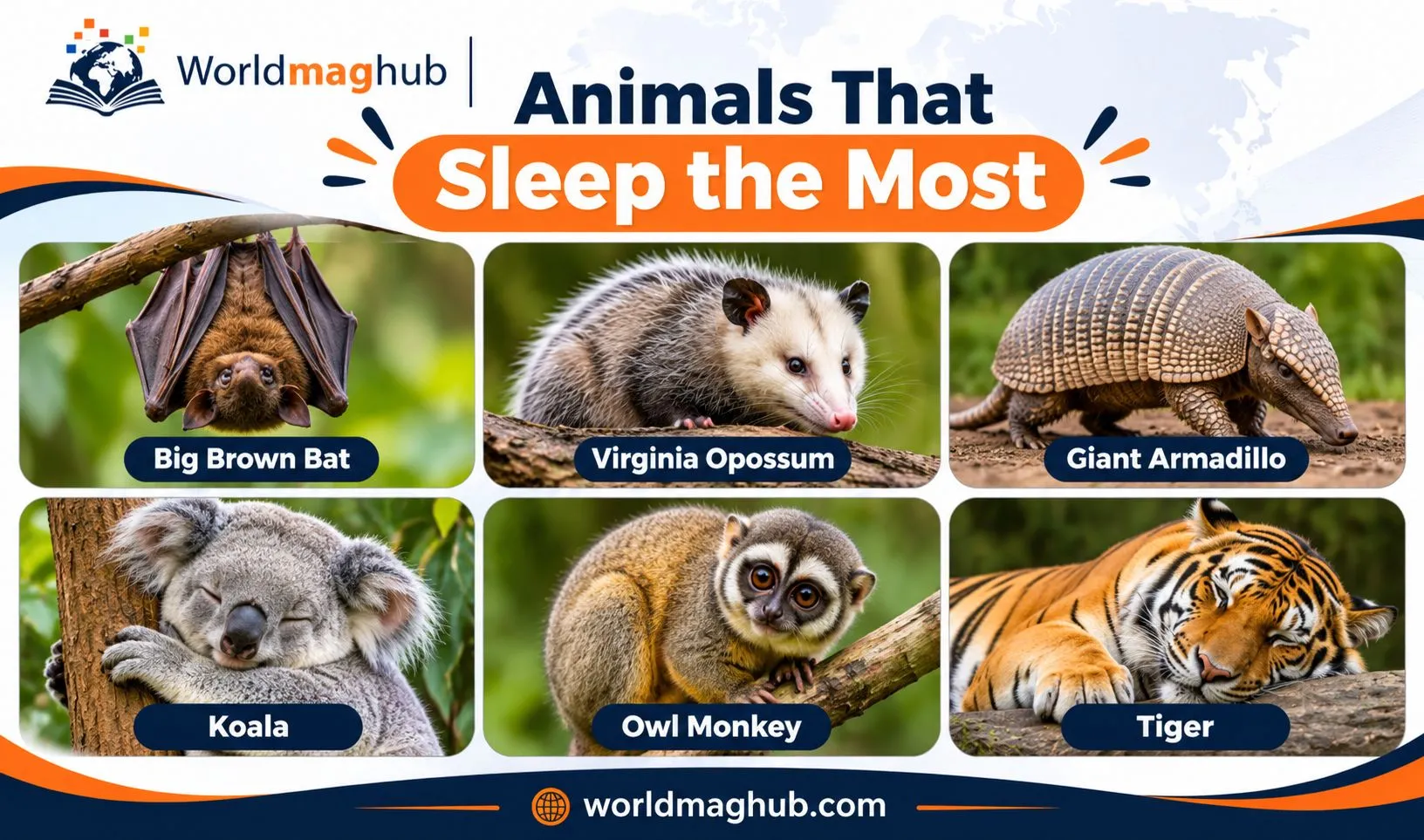
Some animals spend much of their lives sleeping. Bats rest in sheltered roosts, koalas remain inactive for long periods in eucalyptus trees, and big cats sleep between hunting activities.
The Little Brown Bat is widely cited as the animal that sleeps the most, with a recorded average of 19.9 hours per day in a historical captive study. Other animals known for long reported sleep periods include Big Brown Bats, opossums, giant armadillos, koalas, owl monkeys, and tigers.
However, the answer depends on how sleep is measured. Some figures come from older studies of captive animals, while others include resting or drowsiness. Hibernation and torpor are also different from ordinary sleep.
Here are 12 animals that sleep a lot, including their reported sleep durations, habitats, and the behaviors associated with their sleeping patterns.
12 Animals That Sleep a Lot
The following sleep durations come from published research, historical comparative datasets, and wildlife references. They are not universal daily averages for every individual or wild population.
| Animal | Reported Daily Sleep | Important Context |
|---|---|---|
| Little Brown Bat | 19.9 hours | Historical captive record; conditions questioned |
| Big Brown Bat | 19.7 hours | Historical comparative sleep data |
| Virginia Opossum | Approximately 18 hours | Older species-specific estimate |
| Giant Armadillo | 18.1 hours | Historical comparative sleep data |
| Koala | 18–20 hours | Includes both resting and sleeping |
| Nine-banded Armadillo | 17.4 hours | Historical comparative sleep data |
| Owl Monkey | 17 hours | Historical measurement for a named owl monkey species |
| Arctic Ground Squirrel | Approximately 16.6 hours | Older estimate; distinct from hibernation |
| Tiger | 15.8 hours | Published comparative sleep estimate |
| Tailless Tenrec | 15.6 hours | Historical estimate; drowsiness may be included |
| European Polecat | 14.5 hours | Comparative sleep measurement |
| Lion | 13.5 hours | Historical comparative sleep estimate |
Important: This is a selection of animals with notable reported sleep durations, not a scientifically verified ranking of the world’s 12 longest-sleeping species. Differences in measurement methods make direct comparisons difficult.
1. Little Brown Bat
Scientific name: Myotis lucifugus
Reported sleep: 19.9 hours per day — historical captive record.
The Little Brown Bat is a small insect-eating mammal native to North America. It generally hunts after sunset and spends much of the daytime sheltered in protected roosts.
According to Guinness World Records, a 1969 observation reported an average of 19.9 hours of daily sleep, making it the most widely cited mammalian sleep-duration record.
However, the experimental conditions have been questioned because the bat was not roosting naturally, and the surrounding temperature was altered.
Little Brown Bats also enter torpor and seasonal hibernation, which should not automatically be counted as ordinary daily sleep.
Why it’s notable: It holds a widely cited historical sleep record, although its typical sleep duration in the wild remains uncertain.
2. Big Brown Bat
Scientific name: Eptesicus fuscus
Reported sleep: 19.7 hours per day — historical comparative estimate.
The Big Brown Bat is another North American mammal associated with exceptionally long reported sleeping periods.
It feeds mainly on flying insects, including beetles and moths, and usually searches for food after dark.
During the day, these bats shelter in buildings, trees, rock crevices, and other protected locations.
Published comparative mammalian sleep data list approximately 19.7 hours of daily sleep for the species.
However, this figure should not be interpreted as the exact amount every Big Brown Bat sleeps in its natural environment.
Why it’s notable: It has one of the longest reported sleep durations among mammals in historical datasets.
3. Virginia Opossum
Scientific name: Didelphis virginiana
Reported sleep: Approximately 18 hours per day — historical estimate.
The Virginia Opossum is a nocturnal marsupial found across parts of North and Central America.
It spends much of its active time searching for insects, fruit, small animals, and other available food.
During daylight hours, opossums commonly shelter in protected locations, becoming more active after dark.
Historical comparative sleep research lists approximately 18 hours of daily sleep for the Virginia Opossum.
Some sources report longer figures for other opossum species, but those measurements should not be combined into a single species average.
Why it’s notable: Its nocturnal lifestyle and historical sleep measurements place it among mammals associated with long sleeping periods.
4. Giant Armadillo
Scientific name: Priodontes maximus
Reported sleep: 18.1 hours per day — historical comparative estimate.
The Giant Armadillo is a large, heavily armored mammal native to South America.
It spends considerable time underground and uses powerful claws to dig extensive burrows.
These animals are mostly nocturnal, emerging to search for food such as ants and termites.
Comparative mammalian sleep data report approximately 18.1 hours of daily sleep.
However, time spent inside a burrow is not necessarily equivalent to sleeping. The reported duration comes from historical research and should not be assumed to describe every wild individual.
Why it’s notable: It has one of the longest reported sleep durations among armadillos and other mammals.
5. Koala
Scientific name: Phascolarctos cinereus
Reported resting or sleeping: Approximately 18–20 hours per day.
Koalas are among the most recognizable sleepy animals in the world.
Native to Australia, they spend much of their lives in eucalyptus trees, feeding primarily on leaves that provide relatively little usable energy.
To conserve energy, koalas remain inactive for much of the day.
A South Australian government fact sheet reports that koalas spend approximately 18–20 hours each day resting or sleeping.
Because this estimate combines resting and sleeping, it should not be treated as a precise measurement of physiological sleep alone.
Why it’s notable: Its low-energy diet is associated with prolonged resting and sleeping periods.
6. Nine-banded Armadillo
Scientific name: Dasypus novemcinctus
Reported sleep: 17.4 hours per day — historical comparative estimate.
The Nine-banded Armadillo is a burrowing mammal found across parts of the Americas.
It uses strong claws to dig shelters and search for insects, worms, and other small invertebrates.
Its daily activity varies with temperature, season, and habitat. It commonly spends considerable time inside protected burrows.
Comparative mammalian sleep data report approximately 17.4 hours of daily sleep.
The figure is a historical estimate rather than a universal measurement for wild populations.
Why it’s notable: It provides another documented example of an armadillo with a long reported sleep duration.
7. Owl Monkey
Scientific group: Aotus spp.
Reported sleep: Approximately 17 hours per day in historical research.
Owl monkeys, also known as night monkeys, are small primates native to Central and South America.
Most species are predominantly active at night, using their large eyes to navigate and search for food in low-light conditions.
During daylight hours, they often remain sheltered among branches, tree cavities, or dense vegetation.
Historical comparative research reports approximately 17 hours of daily sleep for an owl monkey identified as Aotus trivirgatus.
Because owl monkey taxonomy and species classifications have changed, this figure should not automatically be applied to every species in the genus.
Why it’s notable: Historical research associates some owl monkeys with unusually long sleep periods.
8. Arctic Ground Squirrel
Scientific name: Urocitellus parryii
Historical sleep estimate: Approximately 16.6 hours per day.
Arctic Ground Squirrels inhabit cold northern environments, including Alaska, northern Canada, and parts of Russia.
These small rodents are best known for their remarkable ability to hibernate during harsh winters.
Older comparative sleep research reports approximately 16.6 hours of daily sleep.
However, an important distinction is necessary: hibernation is not the same as ordinary sleep.
During hibernation, Arctic Ground Squirrels experience dramatic reductions in body temperature and metabolic activity. Their daily sleeping patterns during active seasons should be considered separately from seasonal dormancy.
Why it’s notable: Historical sleep estimates and unusual seasonal physiology make this species particularly interesting for sleep research.
9. Tiger
Scientific name: Panthera tigris
Reported sleep: 15.8 hours per day — comparative estimate.
Tigers are powerful solitary predators native to parts of Asia.
Although capable of intense physical effort during hunting, they also spend substantial time sleeping or resting.
Hunting involves stalking, concentration, and explosive bursts of movement. Between these activities, tigers commonly remain inactive in sheltered locations.
Published comparative mammalian sleep data report approximately 15.8 hours of daily sleep.
Actual sleeping patterns can vary with age, prey availability, environmental conditions, and whether the animal lives in captivity or the wild.
Why it’s notable: Tigers combine demanding hunting behavior with relatively long reported sleeping periods.
10. Tailless Tenrec
Scientific name: Tenrec ecaudatus
Historical sleep estimate: 15.6 hours per day, with measurement limitations.
The Tailless Tenrec is a small mammal native to Madagascar.
It has a distinctive body shape and feeds on insects, worms, and other available foods.
Older comparative sleep datasets report approximately 15.6 hours of daily sleep for the species.
However, the underlying historical measurement included drowsiness, making it less directly comparable with studies that distinguish sleep using physiological recordings.
Some tenrecs also experience periods of torpor or seasonal dormancy.
Why it’s notable: Its reported sleeping duration illustrates why researchers must distinguish sleep from other inactive states.
11. European Polecat
Scientific name: Mustela putorius
Reported sleep: 14.5 hours per day — comparative estimate.
The European Polecat is a small carnivorous mammal found across parts of Europe.
It is closely related to the domestic ferret and commonly hunts small mammals, amphibians, and other available prey.
Polecats are often active during darker hours and spend much of their inactive time in sheltered locations.
Published comparative mammalian sleep data report approximately 14.5 hours of daily sleep for the European Polecat.
This measurement applies to the named species and should not automatically be treated as the daily sleeping average of every domestic ferret.
Why it’s notable: It is a documented example of a small carnivore with substantial reported sleep time.
12. Lion
Scientific name: Panthera leo
Reported sleep: Approximately 13.5 hours per day — historical comparative estimate.
Lions are large social cats found mainly in sub-Saharan Africa, with a small remaining wild population in India.
They are known for spending substantial time resting between periods of movement, hunting, feeding, and social interaction.
A historical mammalian sleep dataset lists approximately 13.5 hours of daily sleep for lions.
However, wildlife observations often describe combined resting and sleeping time, which can be considerably longer than measured sleep alone.
Lions therefore provide a useful example of why inactivity should not automatically be counted as sleep.
Why it’s notable: Lions can spend much of the day inactive, although their actual sleep duration differs from total resting time.
Why Do Some Animals Sleep So Much?
Animals have different sleep requirements depending on their biology, feeding habits, activity schedules, and environment.
- Feeding patterns: Animals that hunt or forage during particular periods may sleep during much of the remaining day.
- Protected sleeping locations: Species resting in caves, burrows, or sheltered areas may face fewer disturbances from predators.
- Energy conservation: Koalas spend long periods resting or sleeping while surviving on a relatively low-energy eucalyptus diet.
- Activity schedules: Nocturnal animals are generally more active at night and may sleep during daylight hours.
Sleep duration can also vary with age, temperature, season, and environmental conditions.
No single explanation accounts for the sleeping patterns of every animal. The amount of sleep an animal needs depends on several interacting biological and ecological factors.
If you’re curious about species you haven’t encountered before, try exploring random animals with pictures from different groups.
Frequently Asked Questions
Which Animal Sleeps the Most in the World?
The Little Brown Bat has a widely cited mammalian sleep record of 19.9 hours per day, based on a historical captive observation from 1969. However, Guinness World Records notes that the experimental conditions may not represent natural sleep, and no definitive ranking covers every animal species under comparable wild conditions.
Do Koalas Sleep 22 Hours a Day?
Koalas are sometimes described as sleeping up to 22 hours daily. However, a South Australian government fact sheet reports approximately 18–20 hours spent resting or sleeping. Since resting and sleeping are combined, 22 hours should not be treated as a precisely established daily sleep average for all koalas.
Do Sloths Sleep All Day?
No. A 2008 study using brain-activity recordings found that wild Brown-throated Three-toed Sloths slept an average of 9.63 hours per day.
Sloths are famous for moving slowly, but their slow movements should not be confused with sleeping. Their low metabolic rate and energy-saving behavior help explain their deliberate pace. Explore our guide to the slowest animals in the world to discover other species known for exceptionally slow movement.
Why Do Bats Sleep So Much?
Many bats feed mainly at night and spend daylight hours in protected roosts. Their sleeping patterns are influenced by food availability, temperature, and physiology. Some bats also enter torpor or hibernation, which should not automatically be counted as ordinary sleep.
Is Sleeping the Same as Resting or Hibernating?
No. Sleep, quiet resting, torpor, and hibernation are different physiological states. An animal may remain motionless while awake, while torpor and hibernation involve substantial reductions in metabolic activity. Time spent inactive should therefore not automatically be counted as sleep.
Do Animals Sleep More in Captivity Than in the Wild?
Some animals may sleep longer in captivity, but the difference varies by species and environment. A 2008 study found that wild Brown-throated Three-toed Sloths slept approximately 9.63 hours daily, considerably less than earlier captive estimates. This does not establish that captivity increases sleep for every animal.
Sources and Further Reading
This article uses documented examples of animal sleep durations from historical comparative datasets, scientific research, and institutional wildlife references.
The figures are not presented as a definitive worldwide ranking because research methods, study conditions, and the distinction between resting and sleeping vary.
- Guinness World Records — Most Sleep for a Mammal — Little Brown Bat’s 19.9-hour historical record and the limitations of its experimental conditions.
- UCLA — Comparative Mammalian Sleep Data — Published sleep-duration measurements for bats, armadillos, tigers, polecats, and other mammals.
- UCLA — Sleep Across Mammalian Species — Comparative sleep research, including historical measurements for opossums, ground squirrels, and lions.
- South Australian Government — Koala Life Fact Sheet — Koala diet, activity, and 18–20 hours of daily resting or sleeping.
- Rattenborg et al. (2008) — Sleeping Outside the Box — Peer-reviewed EEG study reporting 9.63 hours of sleep in wild Brown-throated Three-toed Sloths.
- Smithsonian Research Repository — Sleep in Wild Sloths — Research details and differences between captive and wild sleep measurements.