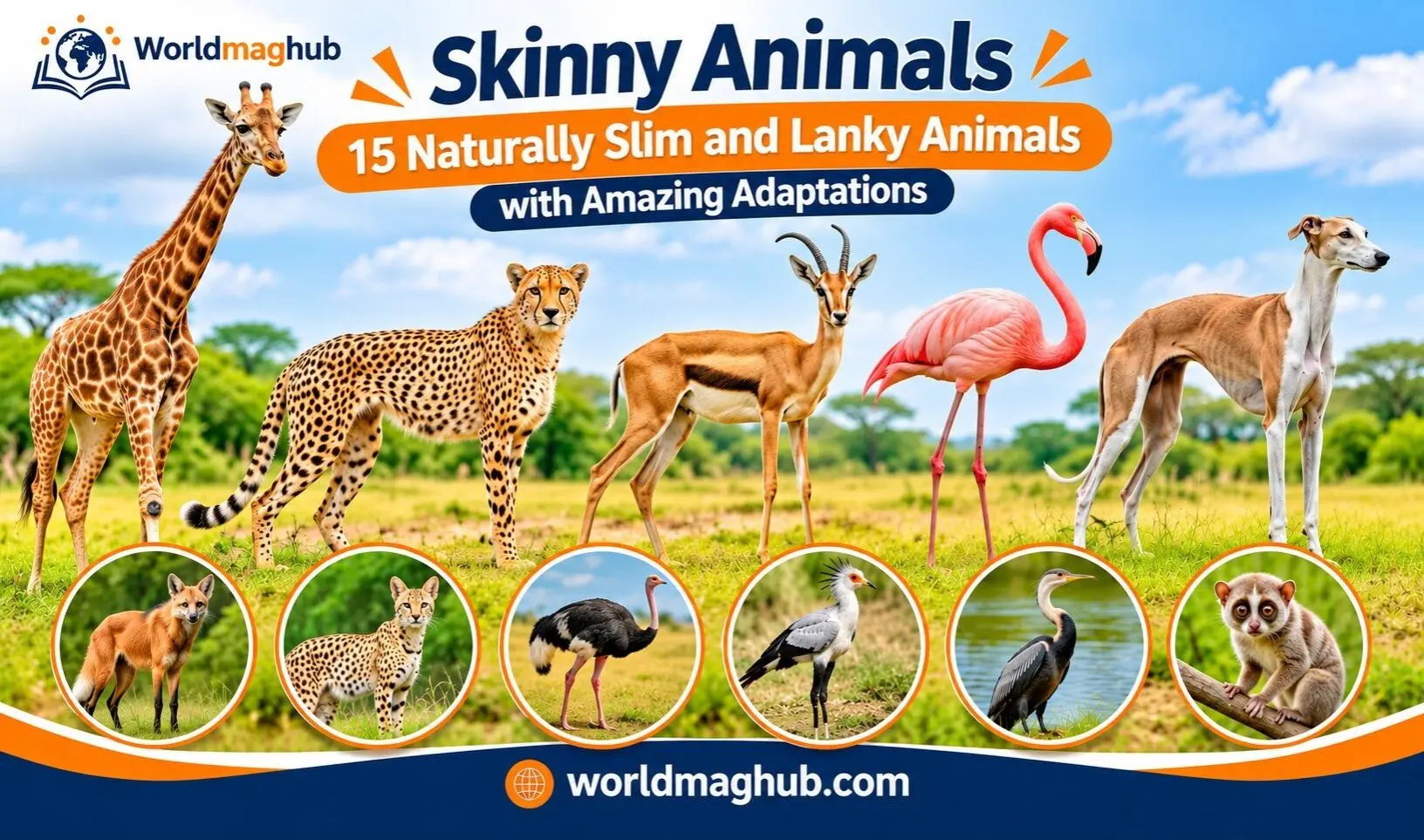
Some animals are so skinny that their bodies look almost impossible. A stick insect can resemble a twig, a ribbon eel looks like a moving strip of fabric, and a maned wolf stands on legs that appear unusually long for its body.
These are examples of naturally skinny animals. Their slender appearance comes from body features such as narrow torsos, long necks, thin legs, or lean, muscular frames. Being skinny does not automatically mean an animal is unhealthy.
Below are 15 real, scientifically documented animals known for their thin, slender, or lanky appearance, along with the physical features that make each one distinctive.
Skinny Animals at a Glance: Body Shapes and Adaptations
Not all skinny-looking animals have the same body shape. Some have narrow torsos, others have unusually long legs, and some have lean, muscular frames.
The following comparison highlights what makes each animal look slender.
| Animal | Type of slender appearance | Notable adaptation |
|---|---|---|
| Gerenuk | Long neck, thin legs | Reaching high vegetation |
| Maned wolf | Tall, long-legged | Moving through grasslands |
| Stick insect | Long, narrow body | Camouflage |
| Greyhound | Lean, athletic body | High-speed running |
| Giraffe | Tall, long-necked | Reaching tree foliage |
| Whippet | Slim, muscular frame | Sprinting |
| Flamingo | Long neck, thin legs | Wading and feeding |
| Secretary bird | Long-legged | Walking and hunting |
| Black-winged stilt | Extremely thin legs | Shallow-water foraging |
| Slender mongoose | Elongated torso | Agile movement |
| Slender loris | Narrow body, thin limbs | Moving through branches |
| Ribbon eel | Ribbon-like body | Occupying narrow spaces |
| Ostrich | Long neck and legs | Running |
| Cheetah | Lean, muscular frame | Fast pursuit |
| Praying mantis | Elongated body and limbs | Ambush hunting |
Long, Skinny Animals vs. Tall, Lanky Animals
Although people often use skinny, thin, slender, and lanky interchangeably, these words can describe different animal proportions.
Long, skinny animals have elongated, narrow bodies. Ribbon eels, many stick insects, and slender mongooses are clear examples.
Tall, lanky animals appear unusually tall because of their long legs, necks, or both. Maned wolves, giraffes, gerenuks, and ostriches fit this description.
Lean, athletic animals have relatively narrow waists and muscular bodies. Greyhounds, Whippets, and cheetahs are examples.
These categories describe visible appearance rather than formal zoological groups. An animal can also fit more than one description.
15 Naturally Skinny Animals Around the World
1. Gerenuk – The Long-Necked Antelope
The gerenuk (Litocranius walleri) is an African antelope with a remarkably narrow head, long neck, and thin legs. Its delicate proportions make it one of the most recognizable naturally slender mammals.
Found in dry shrublands and bushlands of East Africa, the gerenuk is particularly unusual because it can stand upright on its hind legs while feeding. This allows it to reach leaves and shoots higher in bushes than many smaller antelopes can.
Its slim appearance is a normal part of its anatomy. A healthy gerenuk is not necessarily underweight simply because it has a narrow body and long limbs.
Distinctive feature: Long neck, narrow head, and slender legs.
2. Maned Wolf – The Long-Legged Wild Canid
The maned wolf (Chrysocyon brachyurus) looks somewhat like a reddish fox standing on unusually long black legs.
Native to South America, this wild canid inhabits grasslands, savannas, and scrubby environments. Its tall, narrow appearance is especially noticeable when it stands among grasses.
Despite its name, the maned wolf is not a true wolf. It belongs to the dog family but has its own distinctive evolutionary lineage.
Its legs are adapted to moving through grassland environments, while its diet includes small animals and fruit.
Distinctive feature: Exceptionally long legs relative to its body.
3. Stick Insect – The Twig-Like Creature
Few creatures illustrate the meaning of a thin animal as clearly as a stick insect.
Stick insects belong to the order Phasmatodea. Many species have elongated, cylindrical bodies and narrow legs that help them resemble twigs, branches, or stems.
Their appearance provides camouflage. Predators searching among vegetation may have difficulty distinguishing an insect from the plant material around it.
Some stick insects also sway gently, enhancing their resemblance to moving vegetation.
Not every stick insect is extremely thin, however. The group includes species with broader, leaf-like bodies and other unusual shapes.
Distinctive feature: A narrow body that resembles a twig or stem.
4. Greyhound – The Naturally Lean Racing Dog
The Greyhound is a domestic dog breed known for its streamlined, athletic build.
Its deep chest, narrow waist, long legs, and developed muscles create a noticeably lean silhouette. These proportions are associated with the breed’s history as a fast-running sighthound.
A healthy Greyhound may look thinner than a stockier dog breed because of its natural body structure. However, being a naturally lean breed does not mean that every visibly thin Greyhound is healthy.
The American Kennel Club specifically recognizes the Greyhound’s deep chest and tucked waist as defining physical characteristics.
Distinctive feature: Narrow waist, deep chest, and athletic legs.
5. Giraffe – The Tallest Living Land Animal
The giraffe is best known for its extraordinary height, elongated neck, and long legs.
Although giraffes are large, heavy mammals rather than lightweight animals, their proportions give them a tall, slender appearance.
Their long necks help them reach leaves and other vegetation high in trees. Their long legs contribute to their height and distinctive walking movements.
A giraffe is therefore better described as a tall, lanky-looking animal than an animal with an extremely thin torso.
Despite having such a long neck, a giraffe has seven cervical vertebrae, the same number found in humans, although its neck bones are greatly elongated.
Distinctive feature: Extremely long neck and legs.
6. Whippet – The Slim, Athletic Dog
The Whippet resembles a smaller Greyhound, sharing its narrow waist, deep chest, and slender legs.
These dogs have an athletic build developed for sprinting. Their bodies combine a relatively light frame with powerful muscles, particularly in the hindquarters.
Because their coats are short and their waists are noticeably tucked, Whippets can look unusually thin compared with other dogs of similar height.
However, their natural appearance should not be confused with excessive weight loss or poor muscle condition.
Distinctive feature: A slim, muscular body with a deeply tucked waist.
7. Flamingo – The Bird With Thin Legs
Flamingos are among the most recognizable long-legged birds.
Their slender necks, narrow legs, and upright posture create an elegant appearance, although their bodies are fuller than those of many truly thin-bodied animals.
Flamingos inhabit wetlands, lagoons, and shallow lakes. Their long legs allow them to wade through water while searching for food.
They use specialized bills to filter food particles and small organisms from water and sediment.
Their thin-looking limbs are functional adaptations rather than evidence that the birds are underfed.
Distinctive feature: Long, slender legs and a curved neck.
8. Secretary Bird – The Long-Legged Hunter
The secretary bird (Sagittarius serpentarius) is an African bird of prey with unusually long legs and an upright stance.
Unlike many birds of prey that primarily search for food from the air, secretary birds spend considerable time walking across open grasslands.
They hunt insects, reptiles, rodents, and other small animals. Their powerful legs are especially important when striking prey.
The bird’s relatively compact body, long limbs, and distinctive head feathers make it one of the more unusual examples of a lanky animal.
Distinctive feature: Long hunting legs and an upright posture.
9. Black-Winged Stilt – The Bird With Remarkably Thin Legs
The black-winged stilt (Himantopus himantopus) is a wetland bird known for its exceptionally long, slender legs.
It has black-and-white plumage, a thin pointed bill, and pinkish-red legs that look almost disproportionately long compared with its body.
Black-winged stilts forage in shallow wetlands, where their extended legs help them reach feeding areas while keeping their bodies above the water.
Unlike a ribbon eel or stick insect, the stilt does not have an extremely narrow torso. Its distinctive skinny appearance comes primarily from the length and proportions of its legs.
Distinctive feature: Extremely slender, pinkish-red legs.
10. Slender Mongoose – The Narrow-Bodied Carnivore
The slender mongoose (Galerella sanguinea) is a small African mammal with an elongated body, relatively short legs, and a long tail.
Its narrow, flexible build allows it to move through vegetation, rocky environments, and other areas where agility is useful.
Slender mongooses hunt a variety of small animals, including insects, rodents, and reptiles.
Unlike the tall maned wolf, the slender mongoose looks thin mainly because of its elongated torso.
This makes it a particularly relevant example for people searching for long, skinny animals rather than simply tall ones.
Distinctive feature: Long, narrow torso and tail.
11. Slender Loris – The Thin-Limbed Nocturnal Primate
Slender lorises are small, nocturnal primates native to India and Sri Lanka.
Their relatively narrow bodies, elongated limbs, and large forward-facing eyes give them a distinctive appearance.
They move carefully through branches, gripping vegetation with their hands and feet while searching for food, including insects.
Their slow, deliberate movements contrast with those of fast-running slender animals such as cheetahs and Greyhounds.
The name “slender loris” refers to a group of closely related primates rather than one single animal species.
Distinctive features: Narrow body, delicate limbs, and large eyes.
12. Ribbon Eel – The Extremely Thin Ocean Animal
The ribbon eel (Rhinomuraena quaesita) is one of the clearest examples of a long, skinny marine animal.
This fish belongs to the moray eel family and has an elongated, ribbon-like body that looks very different from the shape of most familiar fish.
Ribbon eels inhabit tropical Indo-Pacific waters, where they often shelter in burrows or crevices.
Their narrow bodies allow them to occupy confined spaces, while their distinctive nostril structures and coloration make them recognizable.
Unlike birds that appear skinny because of long legs, ribbon eels are slender along nearly their entire bodies.
Distinctive feature: Long, flexible, ribbon-shaped body.
13. Ostrich – The Giant Bird With a Long Neck and Legs
The ostrich is the largest living bird and another example of an animal with tall, lanky proportions.
Although ostriches have large, muscular bodies, their long necks and extended legs create a distinctly elongated silhouette.
Their strong legs are adapted for running across open ground and can also deliver powerful defensive kicks.
An ostrich is not thin-bodied in the same sense as a ribbon eel or stick insect. Its appearance is better described as long-necked and long-legged.
This distinction helps explain why animals of very different sizes may all be described as skinny or lanky.
Distinctive feature: Long neck and powerful, elongated legs.
14. Cheetah – The Lean, Fast-Running Big Cat
The cheetah (Acinonyx jubatus) has a slender body, long legs, and a relatively small head compared with many heavier big cats.
Its lean, muscular physique is part of a collection of adaptations for high-speed running.
A flexible spine, powerful limbs, and long tail support rapid acceleration and changes of direction while pursuing prey.
Unlike a stick insect, a cheetah is not slender for camouflage. Its proportions are closely associated with its specialized hunting abilities.
A healthy cheetah still needs appropriate muscle mass and body condition despite its naturally lean appearance.
Distinctive feature: Streamlined, muscular body built for speed.
15. Praying Mantis – The Thin Ambush Predator
Praying mantises belong to the insect order Mantodea and include many species with elongated bodies and narrow limbs.
Their most recognizable feature is a pair of enlarged front legs adapted for catching and holding prey.
Many mantises use camouflage to blend into leaves, branches, or flowers while waiting for insects to approach.
Some species are particularly thin and twig-like, while others have broader or more elaborate body shapes.
Their slender appearance is therefore useful for some species, but not a feature shared equally by every praying mantis.
Distinctive feature: Elongated body and specialized grasping forelegs.
Why Are Some Animals Naturally Skinny?
An animal’s body shape is influenced by its evolutionary history, inherited anatomy, and the environment in which it lives.
Different slender body shapes provide different advantages.
Camouflage: Stick insects use narrow bodies and twig-like appearances to become less noticeable among plants.
Reaching food: Gerenuks and giraffes have long necks that help them access vegetation above the ground.
Movement and speed: Cheetahs, Greyhounds, and Whippets have specialized muscular and skeletal features that support fast running.
Moving through particular habitats: Maned wolves have long legs suited to grassland environments, while stilts and flamingos use theirs when wading.
Hunting: Secretary birds use powerful legs to strike prey, while praying mantises catch insects with specialized front legs.
However, thinness alone does not explain an animal’s abilities. Muscles, bones, behavior, and other physiological features also contribute to how it survives.
There are countless fascinating creatures beyond this list, and you can discover more animals at random to continue exploring wildlife.
Fact-checking note: The species and animal groups featured here are documented in zoological records, museum collections, wildlife organizations, or recognized breed standards. Their body characteristics have been cross-checked against sources such as the Smithsonian’s National Zoo, Australian Museum, Animal Diversity Web, and American Kennel Club. Describing an animal as “skinny” is based on its visible body proportions, not an official scientific classification.
Frequently Asked Questions About Skinny Animals
What is the skinniest animal in the world?
There is no universally recognized skinniest animal because thinness can be measured in different ways.
Certain stick insects are among the most striking examples of narrow-bodied land animals, while ribbon eels have remarkably long, thin aquatic bodies.
Naming one species as the absolute skinniest would require a defined measurement and a systematic comparison.
What animals are naturally skinny?
Examples include gerenuks, maned wolves, stick insects, slender mongooses, slender lorises, ribbon eels, Greyhounds, and Whippets.
These animals have naturally slender body proportions, although their shapes and sizes vary considerably.
What are some tall, skinny animals?
Giraffes, maned wolves, gerenuks, ostriches, flamingos, and secretary birds are examples of tall, lanky-looking animals.
Their height and appearance come mainly from elongated legs, necks, or both.
Which animals have very thin legs?
Black-winged stilts and flamingos are particularly recognizable for their long, narrow legs.
Maned wolves and secretary birds also have unusually long legs, although the proportions and functions differ.
What are some long, skinny animals?
Ribbon eels, stick insects, and slender mongooses are good examples of animals with long, narrow bodies.
Their elongated shapes contrast with those of giraffes or ostriches, which appear lanky primarily because of their necks and legs.
Is a naturally skinny animal always underweight?
No. Some animals naturally have slender physiques.
However, unexpected weight loss, muscle wasting, weakness, or unusual changes in appearance may indicate a health problem.
An animal’s body condition should be judged according to its species, breed, and individual health rather than appearance alone.
Are skinny animals faster than other animals?
Not necessarily.
Cheetahs, Greyhounds, and Whippets have lean, athletic bodies associated with speed. In contrast, stick insects and slender lorises are not adapted for high-speed running.
Being skinny does not automatically make an animal faster.
Sources and Fact-Checking
The animal names, biological characteristics, and adaptations in this article were cross-checked against established wildlife and zoological references, including:
- Animal Diversity Web — Species accounts, natural history, anatomy, and behavior.
- Smithsonian’s National Zoo and Conservation Biology Institute — Wildlife descriptions and biological adaptations.
- Australian Museum — Insect and marine animal identification.
- San Diego Zoo Wildlife Alliance — Animal anatomy, habitats, and feeding behavior.
- American Kennel Club — Recognized dog-breed characteristics.
- British Trust for Ornithology — Bird identification and species information.
- Duke Lemur Center — Slender loris information.
Individual animal entries link to supporting references. The term “skinny animals” is used descriptively and is not a recognized scientific taxonomic category.