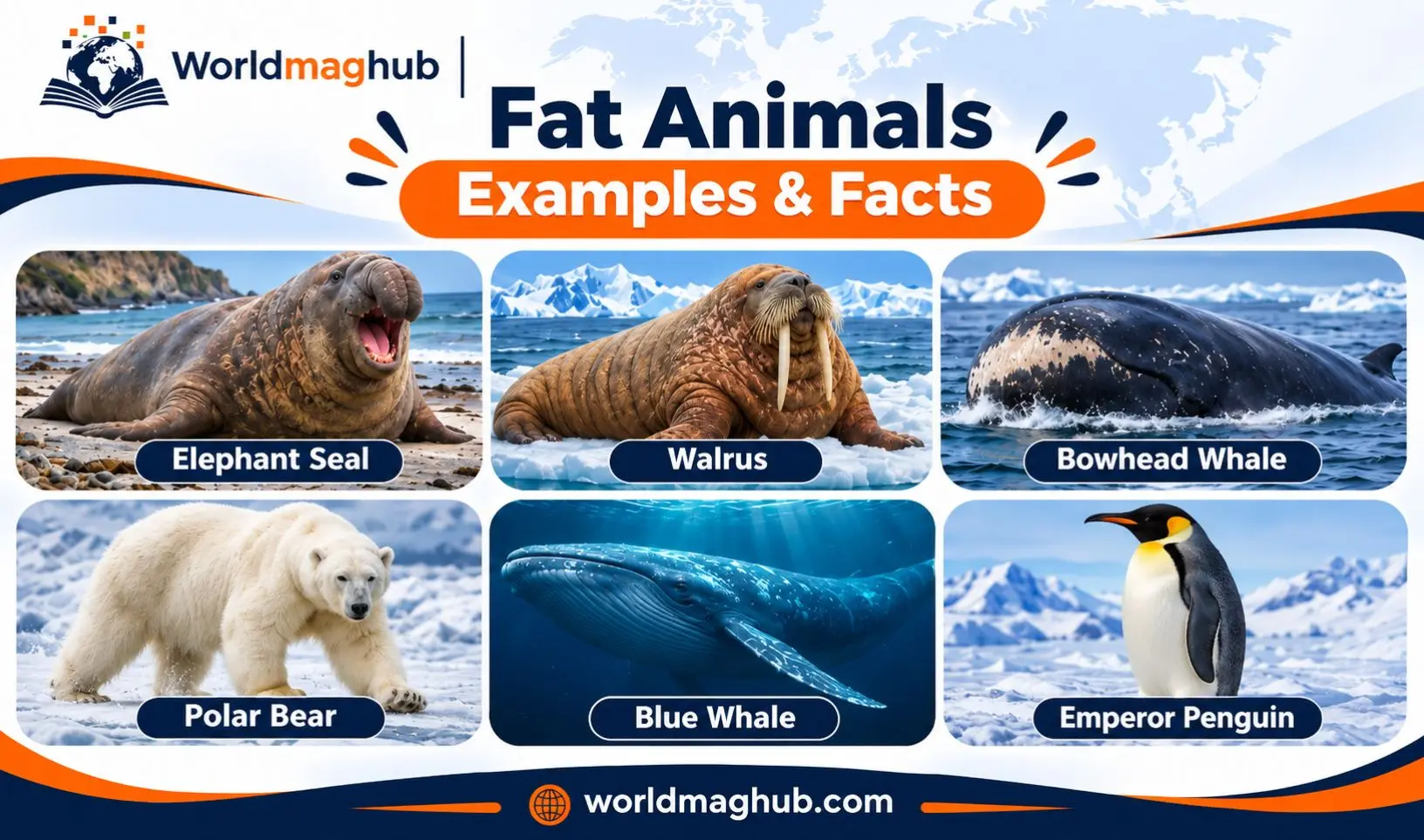
Some of the world’s most noticeably fat or chubby-looking animals include elephant seals, walruses, bowhead whales, polar bears, hippopotamuses, and manatees. Their thick, rounded bodies can make them appear unusually heavy, but not all of them carry exceptionally high amounts of fat.
Fat animals come in different forms. Seals and whales store blubber for warmth, bears build seasonal fat reserves, and camels concentrate fat in their humps. Other animals, such as hippopotamuses and manatees, have naturally large, rounded bodies that do not necessarily indicate obesity.
Here are 12 remarkable animals known for substantial fat storage, thick bodies, or chubby appearances, along with the biological explanations behind their size.
12 Animals That Look Fat or Chubby — and Why
These research-checked examples include animals with naturally high fat reserves and others that simply appear round or bulky. They are not ranked by body-fat percentage.
| Animal | Why It Looks Fat or Stores Fat | Where It Lives |
|---|---|---|
| Elephant Seal | Thick blubber and massive body | Southern Ocean and North Pacific |
| Walrus | Blubber, thick skin, and heavy build | Arctic seas |
| Bowhead Whale | Exceptionally thick insulating blubber | Arctic Ocean |
| Polar Bear | Substantial seasonal fat reserves | Arctic regions |
| Brown Bear | Seasonal fat accumulation before winter | North America, Europe, and Asia |
| Harp Seal | Rapid blubber development in pups | North Atlantic and Arctic |
| Blue Whale | Enormous body and insulating blubber | Oceans worldwide |
| Emperor Penguin | Seasonal fat reserves and rounded body | Antarctica |
| Camel | Concentrated fat stored in humps | Deserts and dry regions |
| Hippopotamus | Naturally massive, barrel-shaped body | Sub-Saharan Africa |
| Manatee | Rounded body with limited insulating fat | Tropical and subtropical waters |
| Domestic Pig | Variable body fat depending on breed and condition | Worldwide |
Animal body shapes vary considerably, from naturally stocky species to animals with exceptionally narrow and slender frames. You can also explore our guide to skinny animals for examples of animals with naturally lean body proportions.
1. Elephant Seal
Elephant seals are among the most recognizable fat-looking marine animals. Their enormous bodies, rounded bellies, and substantial blubber reserves give them a bulky appearance, especially when resting on beaches.
Blubber is a specialized layer of fatty tissue beneath the skin. It helps elephant seals retain body heat and store energy.
These reserves are particularly important during breeding and molting, when elephant seals may remain on land for extended periods without feeding.
Adult males are considerably larger than females, adding to their massive appearance.
What makes them look fat? Their thick blubber, large bodies, and energy reserves used during fasting.
2. Walrus
Walruses are large Arctic marine mammals known for their rounded bodies, long tusks, thick necks, and whiskered faces.
Their substantial blubber helps reduce heat loss while swimming and diving in cold water. Their thick skin and large body mass also contribute to their bulky appearance.
Despite looking awkward on land, walruses are capable swimmers that search the seafloor for clams and other bottom-dwelling animals.
Their heavy build and blubber are normal adaptations to life in Arctic environments.
What makes them look fat? A thick insulating blubber layer combined with their naturally massive body structure.
3. Bowhead Whale
Bowhead whales are among the most heavily insulated animals on Earth.
These Arctic whales have enormous heads, broad bodies, and exceptionally thick blubber that helps them survive in freezing northern waters.
According to NOAA Fisheries, a Bowhead Whale’s blubber can reach approximately 17–19 inches (43–48 cm) in thickness, making it thicker than that of any other whale species.
This fatty layer provides insulation and stored energy when food availability changes.
Unlike animals that accumulate fat only before a short fasting period, bowhead whales depend on extensive insulation throughout life in the Arctic.
What makes them fat? Their exceptionally thick blubber, which provides insulation and energy storage.
4. Polar Bear
Polar bears naturally accumulate substantial fat reserves, particularly when seal hunting is successful.
Their preferred prey includes seals, whose energy-rich blubber provides the calories needed for survival in the Arctic.
Research summarized by the U.S. Geological Survey indicates that some polar bears, especially females preparing for prolonged fasting, can approach 49% body fat under favorable feeding conditions.
These reserves help bears survive periods when seals are difficult to catch. Pregnant females also depend on stored energy while fasting in maternity dens.
Such seasonal fat accumulation is a normal survival adaptation rather than automatic evidence of obesity.
What makes them fat? Seasonal fat reserves accumulated from energy-rich prey and used during food shortages or fasting.
5. Brown Bear
Brown bears can undergo dramatic seasonal changes in body weight.
Before winter, many enter a period called hyperphagia, when they consume large quantities of food to build fat reserves.
According to the U.S. National Park Service, bears use this stored fat as an energy source during winter denning.
A brown bear may look exceptionally round during autumn, but that weight gain can be an important part of its natural annual cycle.
Bears living in different climates may show different feeding and denning patterns.
What makes them fat? Seasonal fat accumulation that provides energy during winter and periods of limited feeding.
6. Harp Seal
Harp seals develop substantial fat reserves that help them survive in cold northern seas.
Their pups are especially notable because they build blubber rapidly while nursing on their mothers’ energy-rich milk.
NOAA Fisheries reports that harp seal pups can gain approximately 5 pounds (2.3 kg) per day during their short nursing period.
This rapid growth helps develop the insulation and energy reserves needed for their early survival.
After weaning, pups may remain without food for several weeks before beginning independent feeding.
What makes them fat? Rapid blubber accumulation, particularly in young pups preparing for life in cold water.
7. Blue Whale
The Blue Whale is the largest animal known to have lived on Earth.
Its enormous body contains blubber beneath the skin, providing insulation and stored energy.
Despite its extraordinary size, the Blue Whale feeds mainly on small crustaceans called krill, consuming large quantities when food is abundant.
However, being the world’s heaviest animal does not automatically mean having the highest body-fat percentage.
Its total mass includes muscles, organs, bones, water, and other tissues in addition to fat.
What makes it relevant? Its exceptional body size and insulating blubber, not evidence that it is the world’s most obese animal.
8. Emperor Penguin
Emperor Penguins are large Antarctic birds with rounded bodies and important seasonal fat reserves.
Their appearance comes partly from dense insulating feathers, compact body proportions, and stored energy.
Male Emperor Penguins incubate eggs during the Antarctic winter while fasting for extended periods.
According to the Australian Antarctic Program, males can lose nearly half their body mass during the prolonged breeding fast.
Stored fat provides the energy needed to survive this demanding period. Adults also build reserves before molting, when they cannot feed normally at sea.
What makes them look fat? Seasonal energy reserves, dense feathers, and a naturally rounded body shape.
9. Camel
Camels are unusual among fat-storing animals because they concentrate much of their reserve fat in their humps.
Dromedary camels have one hump, while Bactrian camels have two.
Contrary to a common misconception, camel humps store fat, not water.
The Natural History Museum explains that camels can use this stored fat for energy when food becomes scarce.
As fat reserves are depleted, a hump may shrink or droop.
Unlike seals and walruses, which carry extensive insulating blubber, camels store concentrated fat reserves along their backs.
What makes them different? Their distinctive humps contain stored fat that helps them survive in environments where food may be scarce.
10. Hippopotamus
Hippopotamuses are enormous African mammals recognized by their barrel-shaped torsos, short legs, and broad mouths.
Their rounded bodies can make them appear exceptionally fat, particularly when resting or standing on land.
However, their enormous size does not establish that they have unusually high body-fat percentages.
Hippos possess substantial body mass, thick skin, and powerful anatomy suited to their semiaquatic lifestyle.
Their appearance is therefore better understood as a naturally massive body structure rather than evidence of obesity.
What makes them look fat? Their huge, barrel-shaped bodies and heavy build.
11. Manatee
Manatees, often called sea cows, are aquatic mammals with large, rounded bodies and broad tails.
Their chubby appearance can be misleading.
Unlike cold-water whales and seals, manatees do not have the same substantial insulating blubber layer.
According to the University of Florida, manatees lack thick blubber insulation and are vulnerable to prolonged exposure to cold water.
This explains why Florida manatees seek warmer waterways during colder months.
Their naturally rounded shape should not be confused with clinically excessive body fat.
What makes them look fat? Their large, rounded bodies rather than unusually thick insulating blubber.
12. Domestic Pig
Domestic pigs are often associated with fatness because of their broad bodies and the ability of some breeds to accumulate substantial body fat.
However, pigs vary considerably in body composition.
Some breeds have been selected for lean meat production, while others naturally carry more fat.
An individual pig’s condition also depends on genetics, diet, age, and physical activity.
Unlike seasonal fat accumulation in bears, excessive fat gain in a domestic pig may sometimes indicate an unhealthy body condition.
A pig’s appearance should therefore be assessed in relation to its breed, size, and health rather than automatically labeling every pig obese.
What makes them look fat? Their naturally broad bodies and variable fat accumulation depending on breed and individual condition.
Animal body shapes vary widely, from the rounded bodies of manatees to the lean builds of fast-running mammals. For a broader look at wildlife diversity, explore our random animal generator to discover different species and interesting facts about them.
Why Do Some Animals Have So Much Fat?
Animals store fat for different biological reasons, including insulation, energy storage, and survival during periods without food.
Fat storage and energy expenditure are closely connected, but animals manage them differently. While bears and seals store substantial energy reserves, other species depend on rapid metabolism or frequent feeding. Our guide to energetic animals explores these differences through examples such as hummingbirds, shrews, and sea otters.
- Insulation: Whales, walruses, and seals use blubber to reduce heat loss in cold water.
- Energy storage: Brown bears and polar bears accumulate fat that supports them when food becomes scarce.
- Breeding and fasting: Emperor Penguins and elephant seals depend on stored reserves during prolonged periods without feeding.
- Survival in dry environments: Camels store concentrated fat in their humps, providing energy when food is limited.
Blubber can also contribute to buoyancy in marine mammals.
However, a large or rounded body does not necessarily indicate an unusually high body-fat percentage. Each animal’s appearance must be understood in relation to its anatomy and natural adaptations.
Frequently Asked Questions
What Is the Fattest Animal in the World?
There is no universally accepted scientific ranking of animals by body-fat percentage. Bowhead whales have exceptionally thick blubber, reaching approximately 17–19 inches (43–48 cm), according to NOAA Fisheries. Elephant seals and some polar bears also carry substantial fat reserves, but total fat mass, body-fat percentage, and blubber thickness are different measurements.
Are Fat Animals and Obese Animals the Same?
No. Some animals naturally store substantial fat for insulation, energy, or survival. Obesity refers to excessive body fat that can negatively affect health. A polar bear building seasonal reserves is not automatically obese, while an overfed domestic animal may develop unhealthy excess body fat.
Can Wild Animals Become Obese?
Yes, wild animals can develop excessive body fat, but naturally gaining weight for winter or periods without food does not necessarily indicate obesity. Body condition must be assessed according to the species, its normal physiology, and potential health effects.
Why Are Seals So Fat?
Seals develop blubber that helps them stay warm in cold water, store energy, and survive periods when feeding is limited. In many species, these reserves are essential for normal growth, reproduction, and survival.
Are Hippos Fat or Just Big?
Hippopotamuses have enormous, barrel-shaped bodies, thick skin, and powerful anatomy. Their rounded appearance does not prove they have unusually high body-fat percentages or indicate obesity.
Do Fat Animals Move Slowly?
Not necessarily. Seals, walruses, polar bears, and other large animals can move effectively in environments to which they are adapted. Body fat alone does not determine an animal’s speed, agility, or endurance.
Sources and Further Reading
This article presents research-supported examples of animals with substantial fat reserves, insulating blubber, or naturally rounded bodies. The examples are not ranked by body-fat percentage, and a rounded appearance should not automatically be interpreted as obesity.
The following sources support the key biological explanations and numerical measurements:
- NOAA Fisheries — Bowhead Whale — Exceptional blubber thickness, body structure, and Arctic adaptations.
- U.S. Geological Survey — Polar Bear Foraging Behavior — Seasonal fat accumulation and documented body-fat levels in well-fed polar bears.
- Smithsonian Ocean — Seals, Sea Lions, and Walruses — Blubber, reproductive fasting, and marine mammal adaptations.
- U.S. National Park Service — When Bears Prepare for Winter — Hyperphagia and seasonal fat storage in bears.
- NOAA Fisheries — Harp Seal — Pup growth, nursing, and blubber development.
- Australian Antarctic Program — Emperor Penguin — Body fat, insulation, and survival during breeding.
- Natural History Museum — How Do Camels Survive in Deserts? — Fat stored in camel humps and desert adaptations.
- University of Florida — Florida Manatees and Warm-Water Habitats — Limited blubber insulation and cold sensitivity in manatees.