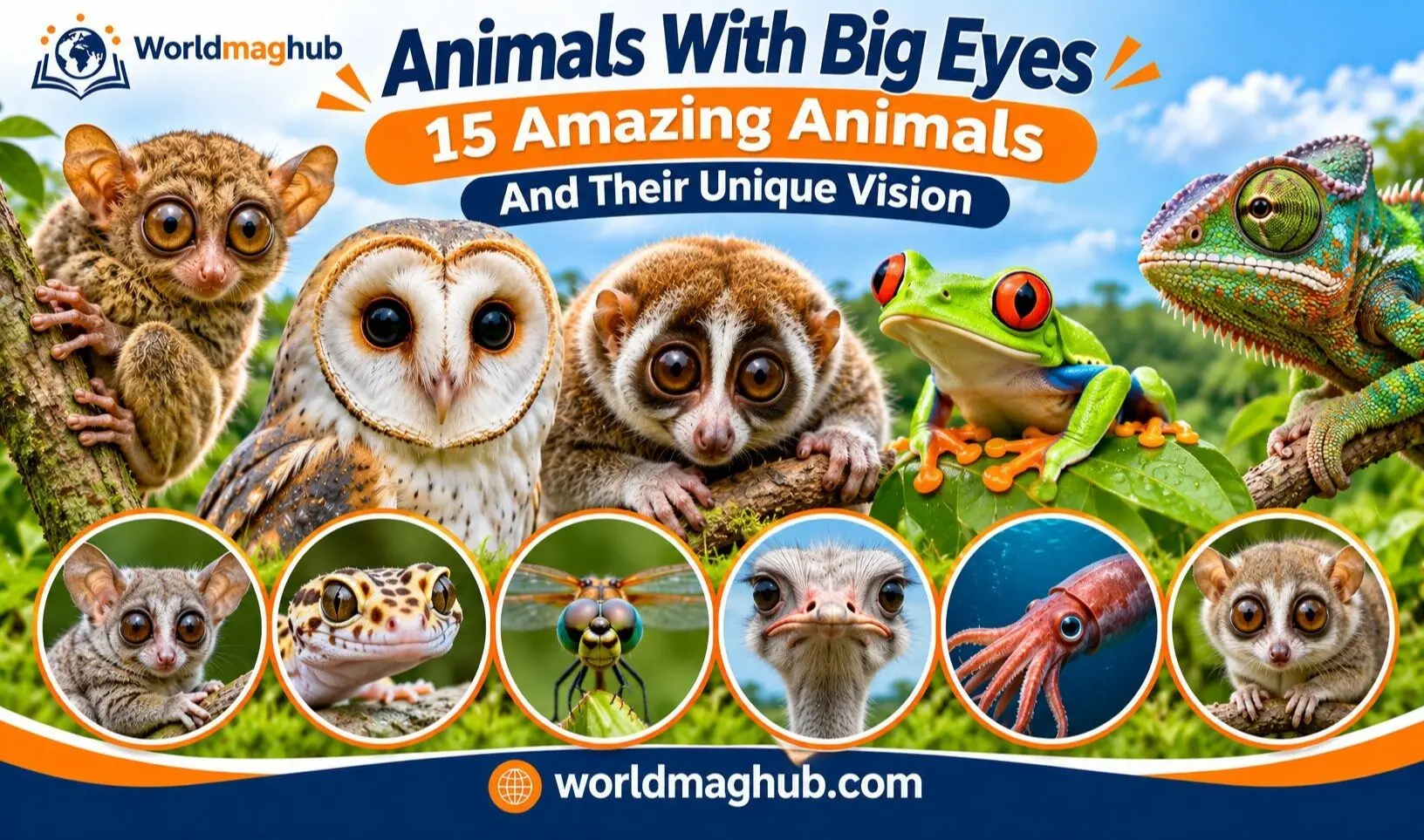
Some animals have eyes so large that they seem almost too big for their faces. A tiny tarsier has enormous eyes that help it see at night, while the colossal squid has eyes that can reach about 27 centimeters (11 inches) across.
Animals with big eyes include tarsiers, colossal squid, owls, bush babies, slow lorises, ostriches, dragonflies, and several other unusual creatures. Some have exceptionally large eyes compared with their heads, while others possess enormous eyes in absolute size.
These features serve different purposes. Large eyes can help animals gather light in darkness, detect movement, locate food, and recognize potential threats.
Among living animals, giant and colossal squid have some of the largest eyes ever measured. On land, the ostrich holds the recognized eye-size record.
Here are 15 scientifically documented animals with remarkably large or prominent eyes, along with the features that make their vision unusual.
Big-Eyed Animals Compared: Eye Size and Special Features
Not all big-eyed animals have the same type of eyes. Some have enlarged eyes for nighttime vision, others have prominent compound eyes, and a few have protruding eyes that developed through selective breeding.
The following table provides a quick overview.
| Animal | Distinctive eye feature | Main function or characteristic |
|---|---|---|
| Tarsier | Enormous eyes relative to head size | Low-light vision |
| Colossal squid | Eyes approximately 27 cm across | Detecting faint light in deep water |
| Slow loris | Large, round, forward-facing eyes | Nocturnal vision |
| Bush baby | Large eyes relative to its head | Nighttime navigation |
| Owl | Large, tubular eyes | Light gathering and depth perception |
| Ostrich | Eyes approximately 5 cm across | Detecting distant threats |
| Aye-aye | Large eyes adapted to darkness | Nocturnal foraging |
| Chameleon | Prominent, independently movable eyes | Scanning surroundings and targeting prey |
| Dragonfly | Large compound eyes | Tracking movement |
| Gecko | Large eyes in many nocturnal species | Vision in dim conditions |
| Red-eyed tree frog | Large, protruding eyes | Visual awareness and possible defensive display |
| Potoo | Large eyes, often with yellow irises | Nocturnal hunting |
| Gray mouse lemur | Large eyes relative to its small head | Low-light vision |
| Bigeye fish | Oversized eyes relative to head size | Vision in dim underwater environments |
| Telescope goldfish | Selectively bred protruding eyes | Ornamental appearance |
Note: Eye diameter, eye prominence, and eye size relative to the body are different characteristics. The animals above are not arranged in scientific eye-size order.
15 Fascinating Animals With Big Eyes
1. Tarsier – The Tiny Primate With Enormous Eyes
- Scientific example: Philippine tarsier (Carlito syrichta)
- Habitat: Forests of the Philippines
- Eye feature: Exceptionally large eyes relative to head size
Tarsiers are among the most recognizable small animals with big eyes. Their enormous, forward-facing eyes occupy much of their faces, giving them an unusual appearance.
These tiny primates are primarily nocturnal. Their large eyes help gather available light while they search for insects and other small prey in the forest.
A particularly remarkable feature is the size of their eyes compared with their brains. Anatomical research has documented that an individual tarsier eye can be larger than its brain.
Tarsiers also have limited eye movement within their sockets. Instead of moving their eyes extensively, they turn their heads to look in different directions.
Their visual system is particularly important for judging distances and locating prey during nighttime activity.
What makes them special: Their eyes are extraordinarily large relative to their small heads, making tarsiers one of the clearest examples of disproportionate eye size in mammals.
2. Colossal Squid – One of the Largest Eyes in the Animal Kingdom
- Scientific name: Mesonychoteuthis hamiltoni
- Habitat: Deep waters of the Southern Ocean
- Eye feature: Eyes approximately 27 centimeters across in documented specimens
The colossal squid possesses some of the largest eyes ever measured in a living animal.
Scientists studying specimens at the Museum of New Zealand Te Papa Tongarewa have documented eyes approximately 27 centimeters (11 inches) in diameter.
That is enormously larger than the eyes of most familiar animals.
These giant eyes are particularly useful in the deep ocean, where sunlight is extremely limited.
Researchers have suggested that such large eyes may help squid detect faint bioluminescent disturbances associated with approaching large predators, including sperm whales.
This is a scientific hypothesis about their function rather than a directly observed hunting or avoidance behavior.
Giant squid also have comparably enormous eyes, so the record should not be presented as belonging exclusively to the colossal squid without qualification.
What makes it special: Its eye diameter is among the largest reliably documented in the animal kingdom.
3. Slow Loris – The Nocturnal Primate With Round Eyes
- Scientific group: Genus Nycticebus
- Habitat: Forests of South and Southeast Asia
- Eye feature: Large, forward-facing eyes
Slow lorises are small, tree-dwelling primates recognizable by their round faces and prominent eyes.
They spend much of their active time moving slowly through branches at night.
Their large eyes help them use the limited light available beneath the forest canopy.
Slow lorises also have a reflective layer behind the retina called the tapetum lucidum, which helps improve light sensitivity.
Their vision works alongside their senses of smell and touch as they search for insects, tree gums, nectar, and other food.
Unlike highly active jumping primates, slow lorises often move carefully and deliberately through vegetation.
What makes them special: Large eyes and specialized visual anatomy help support their nocturnal lifestyle.
4. Bush Baby – A Small Animal With Huge Eyes
- Scientific group: Family Galagidae
- Habitat: Forests and woodlands of sub-Saharan Africa
- Eye feature: Large eyes relative to head size
Bush babies, also called galagos, are small African primates known for their large eyes, prominent ears, and powerful hind legs.
They are primarily active at night, when their eyes help them navigate branches and search for food.
Unlike slow lorises, many bush babies are energetic jumpers capable of moving rapidly between trees.
Their vision helps them judge distances while leaping, while their large ears assist with detecting sounds in their surroundings.
This combination of visual and auditory adaptations is particularly valuable for animals moving through forests after dark.
Readers interested in other animals with unusually prominent hearing structures can explore WorldMagHub’s guide to animals with big ears.
What makes them special: Their large eyes and excellent jumping abilities support nighttime movement through trees.
5. Owl – The Bird With Large, Forward-Facing Eyes
- Scientific group: Order Strigiformes
- Habitat: Forests, grasslands, deserts, and other environments
- Eye feature: Large, tubular eyes positioned toward the front of the head
Owls are among the most familiar birds with large eyes.
Their eyes face forward, creating overlapping visual fields that help them judge distances when hunting.
Unlike the spherical eyes found in many mammals, owl eyes have an elongated, tube-like shape supported by structures inside the skull.
They cannot move their eyes freely within their sockets. Instead, they turn their heads to change their direction of view.
Many owl species also have retinas rich in light-sensitive rod cells that help them function in dim conditions.
However, not every owl is exclusively nocturnal. Some species regularly hunt during daylight.
What makes them special: Large, tubular eyes combine light sensitivity with forward-facing vision useful for locating prey.
6. Ostrich – The Land Animal With the Largest Eyes
- Scientific example: Common ostrich (Struthio camelus)
- Habitat: African grasslands and open landscapes
- Eye feature: Eyes approximately 5 centimeters across
The ostrich has the largest eyes of any living land animal.
According to the Natural History Museum and Smithsonian’s National Zoo, an ostrich’s eye measures approximately 5 centimeters (2 inches) across.
Its eyes are even larger than its brain.
Unlike nocturnal animals that depend on large eyes to gather light in darkness, ostriches live mainly in open environments where detecting distant movement is particularly important.
Their large eyes and elevated viewpoint help them remain alert to potential threats.
Ostriches are also powerful runners, so vision plays an important role in identifying danger before they move away.
Their long necks are another distinctive feature. You can explore similar species in our article on birds with long necks.
What makes it special: The ostrich holds the recognized record for the largest eyes among living land animals.
7. Aye-Aye – The Big-Eyed Lemur of Madagascar
- Scientific name: Daubentonia madagascariensis
- Habitat: Forests of Madagascar
- Eye feature: Large eyes adapted to nocturnal activity
The aye-aye is an unusual nocturnal lemur with large eyes, prominent ears, and an exceptionally long middle finger.
It spends much of the night searching for food in trees.
Its large eyes support movement through dark forest environments, but vision is only one part of its remarkable feeding strategy.
Aye-ayes tap on wood and listen for signs of insect larvae beneath the surface.
After locating potential prey, they use their continuously growing incisors to open the wood and their specialized middle fingers to extract food.
This behavior is known as percussive foraging.
What makes it special: Its large eyes work alongside specialized hearing and feeding adaptations during nighttime foraging.
8. Chameleon – The Reptile With Prominent, Movable Eyes
- Scientific group: Family Chamaeleonidae
- Habitat: Forests, shrublands, and other warm environments
- Eye feature: Turret-like eyes with largely independent movement
Chameleons have some of the most distinctive eyes among reptiles.
Their eyes sit within raised, cone-shaped structures, leaving relatively small openings through which the pupils are visible.
Chameleons can move their eyes largely independently, allowing them to scan different directions without constantly repositioning their heads.
When preparing to capture prey, they can coordinate their eyes to judge distance.
This helps them aim their rapidly extending tongues toward insects.
Although their eyes are visually prominent, chameleons are not necessarily record holders for the largest eyeballs relative to body size.
Their unusual appearance comes mainly from the shape and movement of their eye structures.
What makes them special: Their turret-shaped, independently movable eyes allow them to monitor their surroundings unusually.
9. Dragonfly – The Insect With Enormous Compound Eyes
- Scientific group: Infraorder Anisoptera
- Habitat: Wetlands, ponds, rivers, and nearby vegetation
- Eye feature: Large compound eyes made of thousands of visual units
Dragonflies have some of the most impressive eyes in the insect world.
Their large compound eyes occupy much of their heads and provide an exceptionally wide field of vision.
Unlike human eyes, which use a single main lens in each eye, dragonfly compound eyes contain numerous individual optical units called ommatidia.
Scientific research reports that some dragonflies have up to approximately 30,000 ommatidia in each compound eye.
These structures help dragonflies detect movement and track flying insects.
This is particularly important because adult dragonflies are aerial predators that often capture prey during flight.
What makes them special: Their large compound eyes contain thousands of optical units specialized for detecting movement.
10. Gecko – The Big-Eyed Reptile
- Scientific group: Infraorder Gekkota
- Habitat: Tropical forests, rocky environments, and other habitats
- Eye feature: Prominent eyes and specialized pupils in many species
Many geckos have large eyes that stand out against their relatively small heads.
Nocturnal geckos are particularly interesting because their visual systems are adapted to functioning in low light.
Some have vertically shaped pupils that narrow into several small openings in bright conditions.
These pupil arrangements help regulate how much light enters the eye.
However, geckos are a diverse group. Not all species are nocturnal, and their eye structures vary.
Many geckos also lack movable eyelids and have a transparent covering over their eyes that they can clean with their tongues.
What makes them special: Several nocturnal gecko species combine prominent eyes with specialized pupils for functioning in changing light conditions.
11. Red-Eyed Tree Frog – The Amphibian With Bulging Eyes
- Scientific name: Agalychnis callidryas
- Habitat: Tropical forests of Central America
- Eye feature: Large, protruding eyes with vivid red coloration
The red-eyed tree frog is one of the most recognizable amphibians with big eyes.
Its rounded eyes protrude from the sides of its head, making them highly noticeable when the frog is awake.
These frogs are mainly nocturnal and spend much of their time in vegetation.
During daylight, they often rest with their eyes closed, concealing much of their bright coloration.
When disturbed, they may suddenly reveal their vivid red eyes and other contrasting body colors.
Researchers have suggested that this display can startle predators, potentially providing a brief opportunity to escape.
However, the exact defensive contribution of the red eyes is not fully established.
What makes it special: Its protruding eyes and striking coloration create one of the animal kingdom’s most recognizable visual appearances.
12. Potoo – The Nocturnal Bird With Huge Eyes
- Scientific example: Common potoo (Nyctibius griseus)
- Habitat: Tropical and subtropical regions of Central and South America
- Eye feature: Large, prominent eyes suited to nighttime activity
Potoos are unusual nocturnal birds known for their large eyes and excellent camouflage.
During daylight, a potoo may remain almost motionless on a broken branch, where its feathers help it resemble part of the tree.
At night, it becomes active and hunts flying insects.
Its large eyes support nighttime vision, while its wide mouth helps it capture prey during flight.
Potoos also have small openings in their eyelids that may help them detect nearby movement while remaining concealed.
Their large heads, striking eyes, and unusual resting posture make them easy to recognize in photographs.
What makes them special: Large eyes support nighttime hunting, while their camouflage helps them remain difficult to detect during the day.
13. Gray Mouse Lemur – A Tiny Primate With Large Eyes
- Scientific name: Microcebus murinus
- Habitat: Forests of Madagascar
- Eye feature: Large eyes relative to its small head
The gray mouse lemur is among the world’s smallest primates.
Its large, round eyes appear particularly noticeable because of its miniature body and narrow facial features.
Mouse lemurs are primarily nocturnal and search for insects, fruit, and other foods after dark.
Their eyes help them gather light while they move through trees and shrubs.
They also rely on hearing and smell to interpret their surroundings.
Unlike tarsiers, which have unusually large individual eyeballs, mouse lemurs are particularly recognizable for the combination of their small body size, round face, and prominent eyes.
What makes it special: Its unusually small body makes its large nighttime eyes appear especially prominent.
14. Bigeye Fish – The Fish With Oversized Eyes
- Scientific group: Family Priacanthidae
- Habitat: Tropical and subtropical marine waters
- Eye feature: Large, round eyes relative to the head
Bigeye fishes are appropriately named for their unusually large eyes.
Many species have reddish bodies, relatively compressed shapes, and prominent eyes that occupy a considerable portion of the head.
These fish often inhabit reef-associated environments and may spend daylight hours in sheltered areas.
Many species become more active during the evening or at night, feeding on smaller fishes and other marine animals.
Their large eyes are associated with vision in dim underwater conditions.
Unlike the colossal squid, which is remarkable for the absolute diameter of its eyes, bigeye fishes are notable for the size of their eyes relative to their heads.
What makes them special: Their oversized eyes are a recognizable feature of a fish family containing many nocturnally active species.
15. Telescope Goldfish – The Fish With Protruding Eyes
- Scientific name: Carassius auratus
- Variety: Telescope goldfish
- Habitat: Domestic aquariums and ornamental ponds
- Eye feature: Prominent eyes developed through selective breeding
The telescope goldfish is an ornamental variety of goldfish recognized for its unusually protruding eyes.
Unlike wild animals whose eye characteristics evolved through natural selection, the telescope goldfish developed its distinctive appearance through generations of selective breeding.
Its eyes project outward from the sides of its head, creating a rounded or telescopic appearance.
However, exaggerated eyes are not necessarily beneficial.
Their protruding position can make them more vulnerable to injury, and extreme eye features may affect vision and make feeding more difficult.
This makes telescope goldfish an important contrast to animals such as tarsiers or owls, whose large eyes are associated with natural visual adaptations.
What makes it special: Its protruding eyes are a selectively bred ornamental characteristic rather than a demonstrated survival advantage.
Why Do Some Animals Have Big Eyes?
Large eyes have evolved for different reasons, depending on an animal’s habitat, behavior, and visual requirements.
Seeing in low light: Tarsiers, slow lorises, bush babies, and many owls benefit from eyes that can gather available light. However, night vision also depends on retinal structure, pupil size, and light-sensitive cells.
Detecting predators and prey: Ostriches use their large eyes to monitor open landscapes, while dragonflies rely on compound eyes to detect and track moving insects.
Judging distances: Forward-facing eyes can provide overlapping fields of vision. This is especially useful for animals such as owls and tarsiers when locating prey or navigating their surroundings.
Living in deep water: The enormous eyes of giant and colossal squid may help them detect weak light and bioluminescent signals in dark ocean environments.
Selective breeding: Not every prominent eye evolved as a natural adaptation. Telescope goldfish illustrate how humans can select for exaggerated eye shapes that may offer no survival benefit.
Large eyes can therefore serve different purposes, and having bigger eyes does not automatically mean an animal has better overall eyesight.
The animal kingdom includes many unfamiliar creatures, making it worthwhile to generate a random animal and investigate its characteristics.
Scientific verification: The animals featured in this article are recognized species or zoological groups documented by scientific researchers, museums, and wildlife organizations. Eye measurements are included where credible evidence is available. This is a comparison of notable big-eyed animals, not a scientific ranking from largest to smallest.
Frequently Asked Questions
What animal has the biggest eyes in the world?
Giant and colossal squid have the largest reliably documented eyes among living animals, with eye diameters around 27–28 centimeters (approximately 11 inches).
What land animal has the biggest eyes?
The ostrich has the largest eyes of any living land animal, measuring approximately 5 centimeters (2 inches) across.
These large eyes help the bird detect movement and potential threats across open environments.
What small animal has big eyes?
Tarsiers, bush babies, slow lorises, and gray mouse lemurs are excellent examples of relatively small animals with conspicuously large eyes.
Many are nocturnal primates whose eyes help them function in low-light environments.
Which animal has the biggest eyes relative to its body?
Tarsiers are among the most remarkable mammals for their unusually large eyes relative to head size.
However, identifying a universal record across every animal group requires a defined measurement and reliable comparative research.
What animals have bulging eyes?
Chameleons, red-eyed tree frogs, and telescope goldfish have prominent or protruding eyes.
Their eye structures differ considerably. Chameleons have turret-shaped eyes, tree frogs have projecting eyes, and telescope goldfish have exaggerated eyes developed through selective breeding.
Do bigger eyes always mean better eyesight?
No. Larger eyes may improve light gathering or support certain visual abilities, but overall eyesight also depends on retinal anatomy, photoreceptors, optical structures, and brain processing.
Different animals are adapted to different visual tasks rather than sharing one universal standard of eyesight.
Scientific Sources and Fact-Checking
The animal species and groups included in this article are documented in zoological records, museum resources, or scientific research. Key eye-size measurements and anatomical characteristics are supported by the following sources:
- Natural History Museum – Amazing Eyes: Vision Champions — Describes unusual animal vision and the ostrich’s approximately 5-centimeter eyes.
- Animal Diversity Web – Spectral Tarsier — Provides biological information about tarsier anatomy and behavior.
- British Trust for Ornithology – Owl Vision — Explains the specialized visual anatomy of owls.
- Research on Dragonfly Compound Eyes — Discusses the organization and function of dragonfly compound eyes.
- Duke Lemur Center – Aye-Aye — Documents the biology and specialized foraging behavior of the aye-aye.
- American Bird Conservancy – Potoos — Provides information about potoo vision, camouflage, and nocturnal habits.
- FishBase – Family Priacanthidae — Identifies the bigeye fish family and its general biological characteristics.
- Research on Telescope-Eye Genetics in Goldfish — Examines genetic changes associated with protruding eye forms in goldfish.
Editorial note: These sources support the biological information and specific measurements presented in this article. The list is not a scientific ranking of the 15 largest eyes, and the term “big-eyed animals” describes appearance rather than a formal taxonomic classification.