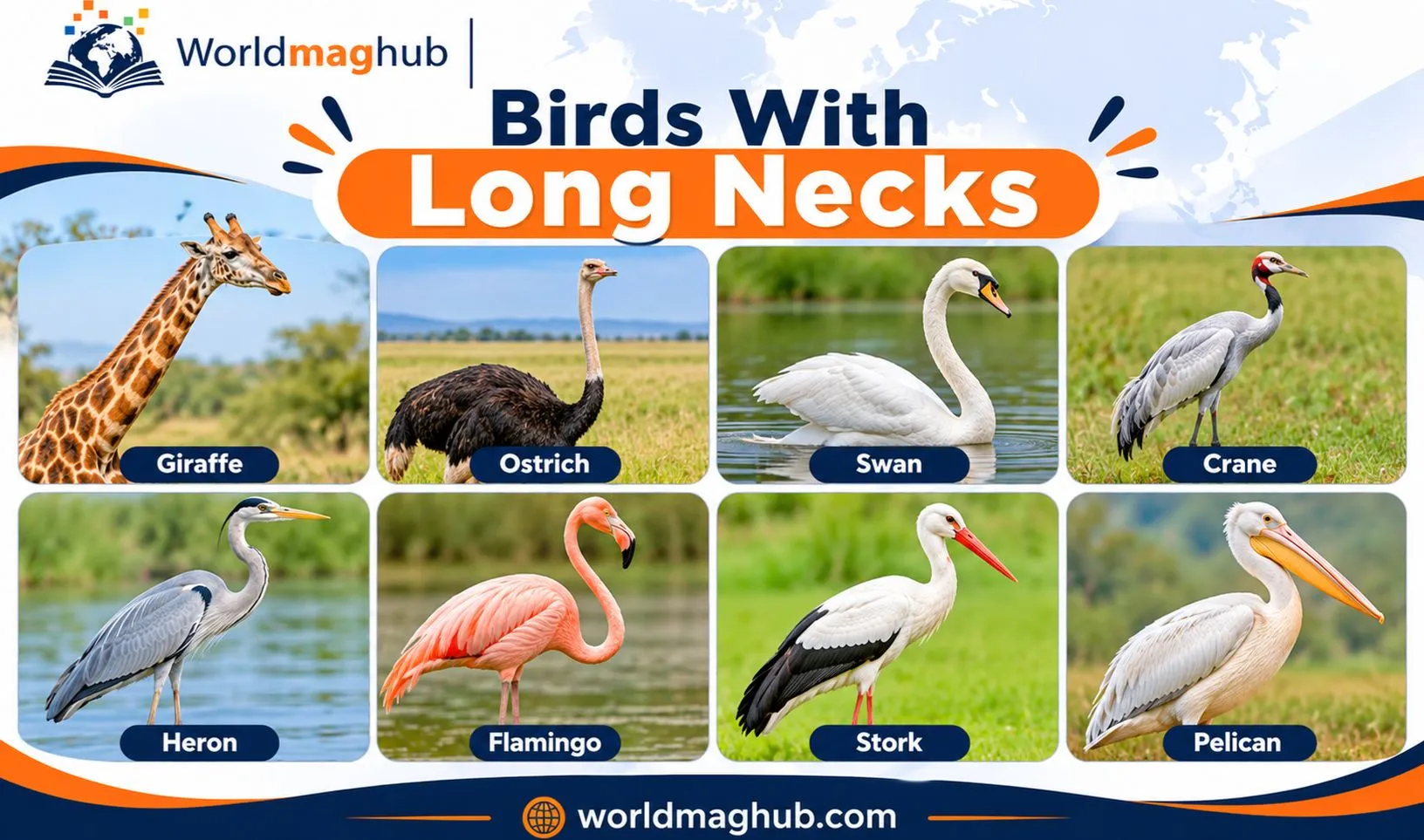
Some birds have necks that seem almost as long as the rest of their bodies. A flamingo curves its neck downward to filter food from water, a heron coils its neck before striking at a fish, and a swan reaches below the surface to feed on aquatic plants.
Birds with long necks include ostriches, flamingos, swans, cranes, herons, egrets, storks, ibises, anhingas, and pelicans. Their elongated necks help them reach food, capture prey, scan their surroundings, and perform courtship displays.
But neck length alone doesn’t tell you which bird you’re looking at. Its shape, posture, bill, habitat, and behavior often provide better clues.
Here are 20 remarkable long-necked birds from around the world, along with the features that make each one recognizable.
Which Bird Has the Longest Neck?
The Ostrich (Struthio camelus) has the longest neck of any living bird. According to Guinness World Records, an adult ostrich’s neck averages approximately 90 cm (35.4 inches or about 3 feet) from its base to the top of the head. Its long neck helps it scan open landscapes for danger and reach food at different heights.
Quick List of 20 Birds With Long Necks
| Bird | Scientific name | Distinctive neck or identification feature |
|---|---|---|
| Ostrich | Struthio camelus | Exceptionally long, mostly bare neck |
| Greater Flamingo | Phoenicopterus roseus | Long, curved neck and pink plumage |
| Trumpeter Swan | Cygnus buccinator | Long, gracefully extended neck |
| Great Blue Heron | Ardea herodias | S-curved neck, folded during flight |
| Great Egret | Ardea alba | Slender S-shaped neck and white body |
| Sandhill Crane | Antigone canadensis | Straight neck in flight, red crown |
| White Stork | Ciconia ciconia | Extended neck, long red bill |
| Emu | Dromaius novaehollandiae | Upright, feathered neck |
| Black Swan | Cygnus atratus | Curved neck and dark plumage |
| Anhinga | Anhinga anhinga | Snake-like neck above water |
| American Flamingo | Phoenicopterus ruber | Pink-red plumage and flexible neck |
| Purple Heron | Ardea purpurea | Slender, striped neck |
| Roseate Spoonbill | Platalea ajaja | Long neck and spoon-shaped bill |
| Whooping Crane | Grus americana | Tall, upright white crane |
| Canada Goose | Branta canadensis | Black neck and white cheek patches |
| Great White Pelican | Pelecanus onocrotalus | Long neck supporting a large pouched bill |
| Southern Cassowary | Casuarius casuarius | Blue neck with red wattles |
| White Ibis | Eudocimus albus | Extended neck and curved reddish bill |
| Sarus Crane | Antigone Antigone | Tall body with red head and upper neck |
| Australian Darter | Anhinga novaehollandiae | Thin, snake-like neck |
These are representative examples, not a ranking of neck length. Some have exceptionally long necks in absolute terms, while others stand out because of their neck shape or proportions.
20 Birds With Long Necks With Pictures
1. Ostrich
Scientific name: Struthio camelus
Habitat: African savannas, grasslands, and semi-arid landscapes.
The Ostrich is the tallest living bird, with an exceptionally long, mostly bare-looking neck. Unlike herons, which often curve their necks, ostriches typically hold theirs upright while walking or scanning open landscapes.
Their elevated viewpoint helps them detect approaching predators, while their flexible necks allow them to lower their heads to feed on grasses, leaves, and seeds.
Identification tip: Look for a huge, flightless bird with a small head, long neck, powerful legs, and rounded body.
2. Greater Flamingo
Scientific name: Phoenicopterus roseus
Habitat: Saline lakes, coastal lagoons, estuaries, and shallow wetlands across Africa, Europe, and Asia.
The Greater Flamingo has a remarkably long, flexible neck that allows it to lower its head into shallow water while feeding. It often turns its head upside down, using specialized structures inside its curved bill to filter small aquatic organisms.
Its pale pink plumage, long reddish legs, and distinctive feeding posture make it one of the most recognizable long-necked waterbirds.
Identification tip: Look for a tall, pale pink bird with a long curved neck, reddish legs, and sharply bent bill.
3. Trumpeter Swan
Scientific name: Cygnus buccinator
Habitat: Freshwater lakes, rivers, marshes, and wintering wetlands in North America.
The Trumpeter Swan is a large white waterbird with a remarkably long neck and broad black bill. It uses its neck to reach submerged aquatic plants, sometimes tipping its body forward while feeding.
Unlike long-legged wading birds such as egrets, swans float on the water and stretch their necks below the surface to obtain vegetation.
Identification tip: Look for a very large white swan with a long neck, heavy body, and black bill extending into the dark facial skin.
4. Great Blue Heron
Scientific name: Ardea herodias
Habitat: Lakes, rivers, marshes, estuaries, and coastal wetlands in North and Central America.
The Great Blue Heron is a large, blue-gray wading bird with an S-shaped neck and pointed, dagger-like bill. It often stands motionless in shallow water before rapidly extending its neck to capture fish, frogs, and other prey.
The Great Blue Heron illustrates how some predators locate food through careful visual observation before making a rapid strike. Other animals rely on smell, hearing, or specialized sensory abilities, as explained in our guide to how animals find food.
During flight, it typically folds its neck back toward its shoulders, unlike cranes and storks, which usually fly with their necks extended.
Identification tip: Look for a tall blue-gray bird with long trailing legs and a folded neck during flight.
5. Great Egret
Scientific name: Ardea alba
Habitat: Freshwater and coastal wetlands across much of the world.
The Great Egret is a tall white wading bird with a slender, S-shaped neck and long pointed bill. It moves slowly through shallow water, watching for fish and amphibians before making quick, precise strikes.
Like other herons, it typically retracts its neck during flight while extending its long legs behind its body. Its bill color can vary with location and breeding condition.
Identification tip: Look for an entirely white wading bird with a long curved neck, pointed bill, and dark legs.
6. Sandhill Crane
Scientific name: Antigone canadensis
Habitat: Wetlands, prairies, agricultural fields, and grasslands across North America.
The Sandhill Crane is a tall gray bird with a long upright neck and distinctive red crown. It searches open fields and wetlands for seeds, insects, roots, and small animals.
During courtship, pairs perform elaborate displays involving jumping, bowing, wing spreading, and neck stretching. Unlike herons, Sandhill Cranes fly with their necks extended forward and legs trailing behind.
Identification tip: Look for a large gray bird with a red crown, straight neck in flight, and loud rattling calls.
7. White Stork
Scientific name: Ciconia ciconia
Habitat: Wetlands, farmland, meadows, and open landscapes across parts of Europe, Africa, and western Asia.
The White Stork is a large bird with white plumage, black flight feathers, red legs, and a long red bill. Its neck remains relatively straight while walking or flying.
It searches wetlands and agricultural fields for insects, amphibians, small mammals, and other prey. Unlike herons, White Storks typically fly with their necks extended and often soar on rising warm air.
Identification tip: Look for a large white-and-black bird with red legs, a straight red bill, and an extended neck.
8. Emu
Scientific name: Dromaius novaehollandiae
Habitat: Grasslands, open woodlands, and semi-arid regions of Australia.
The Emu is Australia’s tallest native bird and the second-tallest living bird after the Ostrich. Its relatively long neck rises above a shaggy brown body, with bluish skin sometimes visible around the head and upper neck.
Emus use their height to observe their surroundings while searching for vegetation and other food. Inflatable structures in the neck region also contribute to their distinctive booming vocalizations.
Identification tip: Look for a large, flightless Australian bird with shaggy brown feathers, powerful legs, and a long upright neck.
9. Black Swan
Scientific name: Cygnus atratus
Habitat: Lakes, wetlands, estuaries, and other water bodies, especially in Australia.
The Black Swan is recognizable by its dark plumage, reddish bill, and gracefully curved neck. Like other swans, it stretches its long neck underwater to reach aquatic vegetation.
Its neck posture changes while swimming, feeding, and interacting with other birds. The species also uses neck movements during courtship and territorial displays. White flight feathers become noticeable when it spreads its wings.
Identification tip: Look for a dark swan with a long curved neck, red bill, and white flight feathers.
10. Anhinga
Scientific name: Anhinga anhinga
Habitat: Freshwater lakes, swamps, ponds, and slow-moving waterways in warmer parts of the Americas.
The Anhinga is often called the snakebird because of its unusually long, slender neck. When swimming, much of its body may remain submerged, leaving only its head and snake-like neck visible above the water.
It dives to catch fish underwater, using its pointed bill and flexible neck. After swimming, it commonly perches with its wings spread to dry.
Identification tip: Look for a dark waterbird with a thin, snake-like neck emerging from freshwater, often near a branch used for drying its wings.
11. American Flamingo
Scientific name: Phoenicopterus ruber
Habitat: Coastal lagoons, salt flats, and shallow saline wetlands in the Caribbean and nearby regions.
The American Flamingo is known for its vivid pink-red plumage, long legs, and remarkably flexible neck. It lowers its head into shallow water and uses its sharply bent bill to filter small aquatic organisms.
Compared with the Greater Flamingo, it generally shows more intense coloration, although age and diet influence its appearance. Neck stretching and coordinated head movements are also important during social displays.
Identification tip: Look for a brightly colored pink-red flamingo with a long neck and sharply curved bill in Caribbean wetlands.
12. Purple Heron
Scientific name: Ardea purpurea
Habitat: Marshes, reedbeds, and vegetated wetlands across Europe, Africa, and Asia.
The Purple Heron has a slender body and unusually long, narrow neck marked with dark and chestnut-colored stripes. These markings help it blend into dense wetland vegetation.
It hunts fish, amphibians, and other small animals along reedbeds and marsh edges. When alarmed, it may stretch its neck upward and remain motionless among the reeds. During flight, it typically retracts its neck like other herons.
Identification tip: Look for a slim heron with a striped neck and chestnut-gray plumage in dense marsh vegetation.
13. Roseate Spoonbill
Scientific name: Platalea ajaja
Habitat: Coastal marshes, mangroves, lagoons, and shallow wetlands in the Americas.
The Roseate Spoonbill is a pink wading bird with a long neck and distinctive spoon-shaped bill. It feeds by sweeping its flattened bill from side to side through shallow water, detecting small aquatic animals through touch.
Although its pink plumage may resemble a flamingo’s, the bill provides an easy distinction. Flamingos have sharply bent filtering bills, while spoonbills have broad, flattened tips.
Identification tip: Look for a pink long-necked bird with a wide, spoon-shaped bill.
14. Whooping Crane
Scientific name: Grus americana
Habitat: North American wetlands, coastal marshes, and grasslands along migration routes.
The Whooping Crane is one of North America’s tallest birds, with white plumage, a reddish crown, dark legs, and black flight feathers visible when its wings are extended.
Its long neck gives it an upright appearance and plays an important role in feeding and courtship displays. Pairs perform dances involving jumping, bowing, and neck stretching. In flight, the neck extends straight forward.
Identification tip: Look for a very tall white crane with a red crown, long neck, and black wingtips.
15. Canada Goose
Scientific name: Branta canadensis
Habitat: Lakes, rivers, marshes, parks, grasslands, and agricultural areas across North America and introduced ranges.
The Canada Goose has a prominent black neck, white cheek patches, and brownish body. Although its neck is shorter relative to its body than a swan’s, it remains one of the bird’s most recognizable features.
Canada Geese use their necks while grazing, watching for danger, and communicating with other birds. They may extend their heads and necks forward when displaying aggression or defending territory.
Identification tip: Look for a brown goose with a black head and neck and distinctive white cheek patches.
16. Great White Pelican
Scientific name: Pelecanus onocrotalus
Habitat: Large lakes, deltas, shallow wetlands, and sheltered coastal waters across parts of Africa, Europe, and Asia.
The Great White Pelican is a massive pale-colored waterbird with a long neck and enormous bill supported by an expandable throat pouch.
It catches fish by scooping them into its pouch and draining excess water before swallowing. Groups sometimes feed cooperatively to concentrate fish in shallow water. While resting, the bird may fold its neck and settle its bill against its body.
Identification tip: Look for a huge pale waterbird with a long neck, large bill, and conspicuous throat pouch.
17. Southern Cassowary
Scientific name: Casuarius casuarius
Habitat: Tropical rainforests of New Guinea and northeastern Australia.
The Southern Cassowary is a large flightless bird with black plumage, bright blue skin on its head and neck, and red fleshy wattles. A prominent helmet-like casque rises from its head.
Although its neck is not proportionally as long as a flamingo’s, its upright posture and exposed, colorful skin make it highly distinctive. Cassowaries feed heavily on fallen fruit and play an important role in seed dispersal.
Identification tip: Look for a large black flightless bird with a blue neck, red wattles, and prominent casque.
18. White Ibis
Scientific name: Eudocimus albus
Habitat: Marshes, mangroves, coastal wetlands, flooded fields, and shallow water in the Americas.
The White Ibis is a medium-sized wading bird with a long neck and slender, downward-curved reddish bill. Adults have mostly white plumage, reddish legs, and black wingtips visible during flight.
Unlike herons that often strike at visible prey, White Ibises probe soft mud and shallow water for insects, crustaceans, and other small animals. They usually fly with their necks extended.
Identification tip: Look for a white wading bird with a long curved red bill, reddish legs, and black wingtips.
19. Sarus Crane
Scientific name: Antigone antigone
Habitat: Wetlands, agricultural fields, and open plains in parts of South and Southeast Asia and Australia.
The Sarus Crane is the tallest living flying bird, recognized by its long upright neck, gray body, and distinctive red head and upper neck.
It searches wetlands and agricultural fields for plant material, insects, and small animals. Pairs perform elaborate courtship displays involving synchronized calls, jumping, and neck stretching. Its exceptional height makes it highly visible in open landscapes.
Identification tip: Look for a very tall gray crane with a long neck and red head, especially in Asian wetlands and farmland.
20. Australian Darter
Scientific name: Anhinga novaehollandiae
Habitat: Freshwater rivers, lakes, wetlands, and sheltered waterways in Australia and nearby regions.
The Australian Darter has a remarkably long, slender neck that gives it a snake-like appearance when swimming. Much of its body may remain underwater, leaving only its head and neck visible.
It dives to hunt fish, using its pointed bill and flexible neck to capture prey. After swimming, it often rests on branches or exposed structures with its wings spread to dry.
Identification tip: Look for a dark waterbird with a thin, snake-like neck and pointed bill, often perched near freshwater with its wings outstretched.
How to Identify a Bird With a Long Neck
A long neck may be the first feature you notice, but it shouldn’t be the only one you use.
Look at the bird’s posture, bill, plumage, surroundings, and movement before deciding on a species.
Check the Neck Shape
| Neck appearance | Birds to consider |
|---|---|
| Strong S-shaped curve | Great Blue Heron, Great Egret, Purple Heron |
| Graceful curve over a floating body | Black Swan, Trumpeter Swan |
| Thin, snake-like neck | Anhinga, Australian Darter |
| Tall, mostly upright neck | Ostrich, Emu, Sarus Crane |
| Long black neck with white cheek markings | Canada Goose |
| Long neck with bare, colorful skin | Southern Cassowary, Sarus Crane |
Neck shape changes with activity. A heron that appears short-necked while resting can suddenly reveal its full neck length while feeding.
Watch How the Bird Flies
Flight posture is one of the most reliable ways to separate several long-necked bird groups.
Heron or egret
Usually flies with its neck folded back toward the shoulders.
Crane
Flies with its neck extended forward and its legs trailing behind.
Storks, ibises, and spoonbills also generally fly with their necks extended.
This distinction is particularly helpful when the bird is too far away to see fine plumage details. Cornell’s identification guides confirm the contrasting flight postures of Great Blue Herons and Sandhill Cranes.
Check the Bill and Habitat
Bill shape and habitat can help distinguish similar long-necked birds. Herons use pointed bills to catch prey, flamingos have bent filtering bills, and spoonbills have broad, flattened bills. Swans and geese commonly float on open water, while herons and cranes are often seen walking through wetlands or open fields. Consider geographic range before identifying a species.
For a closer comparison of these feeding adaptations, see our guide to birds with long beaks.
Long-Necked Birds That Look Similar
Some long-necked birds look alike, especially when seen from a distance. Their neck posture, bill shape, and body markings can help you tell them apart.
Heron vs. Crane
Herons and cranes both have long necks and legs, but their flight posture is a useful identification clue. Herons typically fly with their necks folded into an S-shape, while cranes extend their necks forward. Herons also have pointed, dagger-like bills, whereas cranes generally have straighter, less sharply pointed bills.
Swan vs. Goose
Swans generally have longer, more gracefully curved necks than geese. A Trumpeter Swan has a large white body and long neck, while a Canada Goose has a brownish body, black neck, and distinctive white cheek patches. Swans also frequently use their long necks to reach underwater vegetation.
Flamingo vs. Spoonbill
Flamingos and Roseate Spoonbills can both appear pink with long necks, but their bills are very different. Flamingos have sharply bent bills designed for filter feeding, while spoonbills have long, flattened bills with widened tips that they sweep through shallow water to detect prey.
Why Do Birds Have Long Necks?
Birds have evolved long necks for different feeding, movement, and survival needs.
- Reaching food: Swans stretch their necks underwater to reach aquatic plants, while flamingos lower their heads to filter food from shallow water.
- Catching prey: Herons and egrets use flexible, S-shaped necks to make rapid strikes at fish and other small animals.
- Spotting danger: Ostriches and emus raise their heads above surrounding vegetation to watch for potential threats.
- Communication: Cranes, swans, and flamingos stretch or curve their necks during courtship and social displays.
Neck length is only one adaptation. Its flexibility, posture, and movement also determine how each bird uses it.
Birds come in an incredible variety of shapes and sizes, and you can discover random bird species to explore even more of that diversity.
Long necks aren’t limited to birds. Giraffes, camels, gerenuks, and even certain freshwater turtles have developed elongated necks suited to their feeding habits and environments. These animals with long necks demonstrate how the same physical feature can serve different purposes across species.
Sources and Further Reading
Frequently Asked Questions
Which bird has the longest neck in the world?
The ostrich has the longest neck of any living bird. Its elongated neck helps it survey open landscapes and reach food at different heights. The ostrich is also the tallest living bird.
What white bird has a long neck?
Several white birds have long necks, including the Great Egret, Trumpeter Swan, Whooping Crane, White Stork, and Great White Pelican. Look at the bill shape, leg color, body size, and whether the bird is swimming or wading to identify it.
What bird has a long, snake-like neck?
The Anhinga and Australian Darter are known for their slender, snake-like necks. When swimming with their bodies partly submerged, their heads and necks may be the only parts visible above the surface.
Do all long-necked birds live near water?
No. Many long-necked birds, including flamingos, herons, and swans, depend heavily on aquatic habitats. Others, such as ostriches and emus, live in grasslands, woodlands, and semi-arid environments.
Are long-necked birds related to one another?
Not necessarily. Long necks occur in several bird groups, including swans, cranes, herons, flamingos, and flightless birds such as ostriches. Similar neck shapes have evolved in different lineages because they provide useful advantages for feeding, movement, or communication.