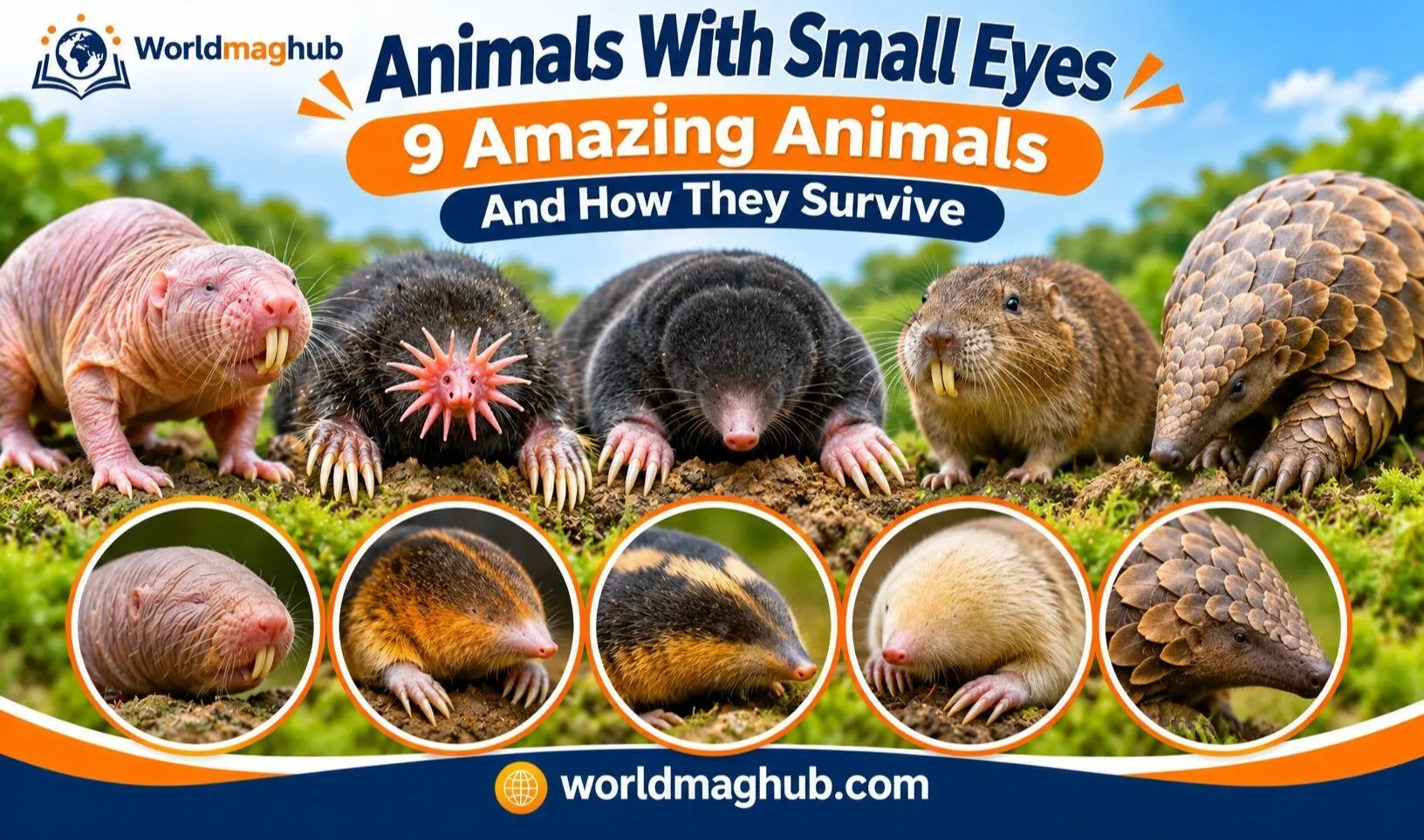
Some animals have eyes so small that they are almost impossible to see. The naked mole-rat has tiny eyes that detect light but provide little detailed vision, while the star-nosed mole uses its extraordinary nose to find food in dark underground environments.
Animals with small eyes include naked mole-rats, star-nosed moles, blind mole-rats, European moles, golden moles, marsupial moles, pocket gophers, and pangolins. Many spend much of their lives underground, where touch, smell, and other senses are often more useful than detailed eyesight.
However, small eyes do not always mean blindness. Some animals retain functional eyes, while others have reduced or vestigial eye structures concealed beneath their skin or fur.
Here are nine scientifically documented animals with unusually small eyes, including how their sensory adaptations help them survive.
Scientific verification: The species featured here are recognized animals documented in zoological records and scientific research. Their eye characteristics are supported by anatomical studies, wildlife organizations, and established species references. This list compares animals with notably small or reduced eyes; it is not a scientific ranking of the world’s nine smallest eyes.
Animals With Small Eyes: Quick Comparison
Some small-eyed animals can detect light, while others rely almost entirely on nonvisual senses to navigate their surroundings.
The following table provides a quick overview of their eye characteristics and sensory adaptations.
| Animal | Eye characteristic | Main sensory adaptation |
|---|---|---|
| Naked mole-rat | Tiny eyes with severely limited vision | Touch, smell, and light detection |
| Star-nosed mole | Small eyes partly concealed by fur | Highly sensitive star-shaped nose |
| Blind mole-rat | Rudimentary eyes beneath skin and fur | Touch, smell, and limited light detection |
| European mole | Small but functional eyes | Touch, smell, and light detection |
| Cape golden mole | Vestigial eyes concealed beneath skin and fur | Nonvisual sensory navigation |
| Grant’s golden mole | Extremely reduced, hidden eyes | Detecting vibrations in sandy environments |
| Southern marsupial mole | Vestigial eye structures beneath skin | Touch and underground navigation |
| Southeastern pocket gopher | Small eyes and reduced external ears | Whiskers, touch, and smell |
| Ground pangolin | Small eyes relative to its head | Strong sense of smell |
Note: These animals are not ranked by eye diameter. Comparable measurements are unavailable for many species, and some have eyes concealed beneath the skin.
9 Animals With Surprisingly Small Eyes
1. Naked Mole-Rat – A Rodent With Tiny Eyes
- Scientific name: Heterocephalus glaber
- Habitat: Underground burrows in East Africa
- Diet: Underground plant parts, especially tubers
- Eye characteristic: Extremely small eyes with poor image-forming vision
The naked mole-rat is one of the clearest examples of an animal with very small eyes.
This unusual rodent spends nearly its entire life inside underground tunnel systems, where natural light is scarce.
Its eyes are approximately one millimeter in diameter or smaller, according to published anatomical research. They retain recognizable eye structures, but their ability to form detailed visual images is severely reduced.
Instead of relying on eyesight, naked mole-rats use their sense of touch, smell, and sensitivity to physical contact to navigate tunnels and communicate with colony members.
Their bodies also have sensory hairs that help them detect nearby surfaces.
Although often described as blind, naked mole-rats retain some ability to respond to light. Researchers suggest this may help regulate biological rhythms or detect unusual exposure to daylight.
What makes it special: The naked mole-rat demonstrates how a mammal can retain limited light sensitivity while relying primarily on other senses for everyday activities.
2. Star-Nosed Mole – Small Eyes and an Extraordinary Nose
- Scientific name: Condylura cristata
- Habitat: Wetlands and moist soils of eastern North America
- Diet: Earthworms, insects, and aquatic invertebrates
- Eye characteristic: Tiny eyes partly concealed by fur
The star-nosed mole is an unusual mammal with small eyes and a distinctive nose surrounded by 22 fleshy appendages.
These appendages are not simply decorative. They contain thousands of specialized touch receptors known as Eimer’s organs.
Together, they create an exceptionally sensitive sensory structure that allows the mole to examine its surroundings and identify food rapidly.
The star-nosed mole often searches for prey in muddy soil, underground tunnels, and shallow water.
In these environments, detailed eyesight is less important than detecting physical contact with potential food.
Its small eyes can still provide limited visual information, but the extraordinary sensitivity of its nose is its defining adaptation.
This species is also a good example of how animals find food using senses other than vision.
What makes it special: Its 22 touch-sensitive nasal appendages help it locate prey without depending heavily on eyesight.
3. Blind Mole-Rat – An Animal With Eyes Hidden Beneath Its Skin
- Scientific group: Blind mole-rats, including species traditionally placed in Spalax
- Habitat: Underground burrows in parts of Europe, Asia, and the Middle East
- Diet: Roots, bulbs, and other underground plant material
- Eye characteristic: Rudimentary eyes concealed beneath skin and fur
Blind mole-rats are among the most remarkable mammals with reduced eyes.
Their eyes are hidden beneath the skin, making them appear completely eyeless from the outside.
Unlike European moles, which retain externally recognizable eyes, blind mole-rats have highly reduced visual structures that are not used for ordinary image-forming vision.
However, research has shown that some blind mole-rats retain light-sensitive cells and neural pathways involved in detecting environmental light cycles.
These responses may help regulate circadian rhythms, the biological processes associated with daily activity patterns.
Blind mole-rats dig extensive underground tunnels using their powerful incisors and navigate mainly through nonvisual sensory information.
What makes it special: Their hidden eyes demonstrate that an animal can lose useful image-forming vision while retaining limited biological responses to light.
4. European Mole – Small Eyes Concealed by Fur
- Scientific name: Talpa europaea
- Habitat: Grasslands, gardens, and woodland soils across much of Europe
- Diet: Earthworms and other soil invertebrates
- Eye characteristic: Small, functional eyes often hidden by dense fur
The European mole is a familiar underground mammal with a cylindrical body, strong digging forelimbs, and tiny eyes.
Its eyes are difficult to notice because they are surrounded by thick, velvety fur.
European moles spend much of their time inside tunnels, searching for earthworms and other small animals.
Unlike blind mole-rats, they retain functional eyes with recognizable anatomical structures.
However, their vision is limited compared with that of many mammals living above ground.
They can respond to changes in light, but touch and smell are particularly important for finding food and moving through underground environments.
Their specialized forelimbs allow them to push soil aside efficiently while constructing tunnels.
What makes it special: The European mole shows that small eyes can remain functional even when an animal depends primarily on other senses.
5. Cape Golden Mole – A Mammal With Hidden Eyes
- Scientific name: Chrysochloris asiatica
- Habitat: Sandy and loose soils of southern Africa
- Diet: Insects and other small invertebrates
- Eye characteristic: Vestigial eyes covered by skin and fur
The Cape golden mole is a small African mammal whose eyes are not externally visible.
Although it resembles a true mole, it belongs to a separate evolutionary lineage.
Its body is adapted for digging through soil, with short, powerful forelimbs, specialized claws, and a pointed head.
Its eyes are vestigial, meaning they have become greatly reduced through evolutionary processes.
Anatomical studies have found that golden moles retain remnants of eye structures, but these are not used for ordinary vision.
Instead, they rely heavily on nonvisual sensory information while moving through their underground environments.
The similarity between golden moles and true moles is an example of convergent evolution, in which animals from different lineages independently develop comparable adaptations.
What makes it special: Cape golden moles have concealed, vestigial eyes and demonstrate how underground environments can favor similar adaptations in unrelated mammals.
6. Grant’s Golden Mole – A Desert Mammal With Reduced Eyes
- Scientific name: Eremitalpa granti
- Habitat: Sandy desert environments of southwestern Africa
- Diet: Termites and other small invertebrates
- Eye characteristic: Extremely reduced eyes concealed beneath the skin
Grant’s golden mole is another small-eyed mammal, but it differs from many underground animals because it is adapted to loose desert sand.
Instead of relying on permanent underground tunnels, some populations move through sand in a manner often described as sand-swimming.
Their compact bodies and specialized forelimbs help them travel beneath the surface while searching for food.
Like other golden moles, Grant’s golden mole has vestigial eyes concealed beneath the skin.
Its survival depends much more on detecting physical and environmental signals than on forming visual images.
Research has documented the importance of vibration sensitivity in these desert-adapted mammals.
Unlike the Cape golden mole, which inhabits different soil environments, Grant’s golden mole illustrates how similar eye reduction can occur alongside adaptations to desert conditions.
What makes it special: It combines extremely reduced eyes with specialized movement and sensory abilities suited to sandy habitats.
7. Southern Marsupial Mole – An Australian Animal With Vestigial Eyes
- Scientific name: Notoryctes typhlops
- Habitat: Sandy desert regions of central Australia
- Diet: Small invertebrates and other underground prey
- Eye characteristic: Vestigial eye structures beneath the skin
The southern marsupial mole is one of Australia’s most unusual underground mammals.
It has pale, silky fur, a wedge-shaped head, and powerful digging claws adapted for moving through loose sand.
Unlike true moles and African golden moles, this species is a marsupial.
Despite its different evolutionary ancestry, it has developed a similar body shape because it occupies a comparable underground environment.
Its eyes are so reduced that only vestigial structures remain beneath the skin.
Scientific studies of marsupial moles and golden moles have examined changes in eye-related genes, providing evidence of evolutionary processes associated with reduced vision.
The southern marsupial mole relies on nonvisual sensory information to navigate and search for prey beneath the sand.
What makes it special: Its vestigial eyes provide an example of eye reduction evolving independently in a marsupial lineage.
8. Southeastern Pocket Gopher – A Burrowing Rodent With Small Eyes
- Scientific name: Geomys pinetis
- Habitat: Sandy soils of the southeastern United States
- Diet: Roots and other plant material
- Eye characteristic: Small eyes and reduced external ears
The southeastern pocket gopher is a burrowing rodent with a rounded body, strong digging claws, and small eyes.
Its physical characteristics are well suited to spending much of its life underground.
The animal constructs tunnels for feeding, shelter, and protection.
Because little light reaches these tunnels, detailed vision plays a less prominent role in its daily activities than touch and smell.
Its whiskers help it sense nearby surfaces, while its strong claws and teeth allow it to excavate soil.
Pocket gophers also have external, fur-lined cheek pouches used to carry food.
Unlike blind mole-rats or golden moles, the southeastern pocket gopher retains externally visible eyes.
What makes it special: It demonstrates how a burrowing mammal can have relatively small but recognizable eyes while relying heavily on other senses underground.
9. Ground Pangolin – A Scaly Mammal With Small Eyes
- Scientific name: Smutsia temminckii
- Also known as: Temminck’s ground pangolin
- Habitat: Grasslands, savannas, and scrublands of sub-Saharan Africa
- Diet: Ants and termites
- Eye characteristic: Small eyes relative to its narrow head
The ground pangolin is a distinctive mammal covered in protective scales.
Unlike most animals on this list, it does not spend nearly its entire life underground.
Instead, it moves through terrestrial environments searching for ants and termites.
Its eyes are relatively small, and its sense of smell is especially important for locating insect colonies.
Once it finds food, the pangolin uses its strong claws to open nests and its long, sticky tongue to collect insects.
Its small eyes are part of a broader sensory system that differs from the heavily vision-dependent behavior of many other mammals.
Ground pangolins can also curl into a protective ball when threatened, using their overlapping scales as armor.
What makes it special: The ground pangolin shows that small eyes are not limited to strictly underground mammals. Other senses can be especially important for feeding even in animals that regularly move above ground.
Why Do Some Animals Have Small Eyes?
Small eyes can result from different evolutionary processes, but underground living is one of the clearest examples.
Animals that spend most of their lives in darkness often gain less benefit from detailed vision than animals living in well-lit environments.
Over many generations, some underground species have evolved reduced eye structures while retaining or developing sensory abilities better suited to their surroundings.
Limited light underground: Blind mole-rats and golden moles have evolved greatly reduced eyes in environments where normal image-forming vision offers limited advantages.
Greater reliance on other senses: Star-nosed moles use specialized touch receptors, while naked mole-rats and pocket gophers rely heavily on tactile and chemical information.
Retaining light detection: Small eyes do not always mean complete blindness. Some subterranean mammals retain the ability to respond to changes in light even when their eyes cannot form detailed images.
Different feeding strategies: Ground pangolins rely strongly on smell to find ants and termites, demonstrating that reduced visual emphasis is not limited to underground life.
However, eye size alone does not determine how well an animal can see.
The structure of the retina, light-sensitive cells, neural processing, and the animal’s environment also influence visual ability.
For comparison, animals such as tarsiers, owls, and colossal squid have very different visual adaptations. Our guide to animals with big eyes explores the opposite end of this anatomical variation.
If this article sparked your curiosity, consider discovering additional wildlife species through random selection.
Frequently Asked Questions
What animal has the smallest eyes in the world?
There is no universally established record for the animal with the smallest eyes.
Blind mole-rats, naked mole-rats, and golden moles are among the best-known examples of mammals with extremely small or reduced eyes.
Some blind mole-rats have rudimentary eyes measuring less than one millimeter across, but that does not establish an absolute record across all animal species.
Which animal has small eyes and a big nose?
The star-nosed mole is an excellent example.
It has tiny eyes and a distinctive nose surrounded by 22 fleshy appendages containing specialized touch receptors.
These allow it to identify objects and locate prey without relying heavily on detailed eyesight.
What animal has small eyes and a large head?
Several animals can fit this general description.
Naked mole-rats have small eyes that may look unusually tiny compared with their heads, while pangolins have narrow heads with relatively inconspicuous eyes.
However, “small eyes and a large head” is a descriptive appearance rather than a formal zoological category.
Are animals with small eyes always blind?
No. Some animals with small eyes retain limited vision.
European moles have small but functional eyes, while naked mole-rats can respond to light despite severely reduced image-forming vision.
Other animals, including golden moles, have vestigial visual structures that do not support ordinary eyesight.
Which animals have eyes hidden beneath their skin?
Blind mole-rats, golden moles, and southern marsupial moles have highly reduced eye structures concealed beneath the skin or fur.
These animals may appear eyeless from the outside, but they retain anatomical remnants of eyes.
Can naked mole-rats see?
Naked mole-rats have severely limited visual abilities.
Research indicates that their eyes can detect some changes in light intensity, but they do not provide detailed image-forming vision comparable to that of many surface-dwelling rodents.
They rely mainly on other sensory systems to navigate underground tunnels.
What is the difference between small-eyed and eyeless animals?
Small-eyed animals possess eyes, even when those eyes are reduced, poorly functioning, or hidden beneath the skin.
Truly eyeless animals lack eyes altogether.
An animal can be functionally blind while still retaining anatomical eye structures, so blindness and the complete absence of eyes are not necessarily the same thing.
Scientific Sources and Fact-Checking
The animals included in this article are documented species or zoological groups. Their eye characteristics and sensory adaptations are supported by scientific studies and established zoological references.
- Central Visual System of the Naked Mole-Rat — Research describing reduced visual structures and retained light-related functions in naked mole-rats.
- Natural History Museum – Why Do Star-Nosed Moles Have a Hand on Their Face? — Explains the 22 nasal appendages and specialized touch receptors of star-nosed moles.
- Non-Image-Forming Light Detection in the Blind Mole-Rat — Documents light-sensitive pathways retained in blind mole-rats despite severely reduced eyes.
- Animal Diversity Web – European Mole — Provides information about European mole anatomy and underground adaptations.
- Animal Diversity Web – Cape Golden Mole — Describes the species’ vestigial eyes and subterranean adaptations.
- IUCN Afrotheria Specialist Group – Golden Moles — Explains golden mole anatomy, evolutionary relationships, and sensory adaptations.
- Three Blind Moles: Molecular Evolutionary Insights on Convergent Eye Degeneration — Scientific research comparing evolutionary changes in eye-related genes in southern marsupial moles and golden moles.
- Animal Diversity Web – Southeastern Pocket Gopher — Documents the species’ small eyes and adaptations for burrowing.
- Animal Diversity Web – Ground Pangolin — Provides information about pangolin feeding behavior and sensory adaptations.
Editorial clarification: These references support the identities and biological characteristics of the animals described. This article does not claim that the nine species hold scientifically verified rankings for the smallest eyes in the world. “Small-eyed animals” is a descriptive category, not a formal zoological classification.