Wolves follow scents to locate prey, eagles spot small animals from above, and bats use sound echoes to detect flying insects. Although their methods differ, all these animals depend on specialized abilities to find food in the wild.
Animals find food using their senses, instincts, learned behavior, memory, and physical adaptations. Some rely on smell, sight, or hearing, while others use echolocation, electrical sensing, or sensitive body parts to detect hidden food. Certain species also remember feeding locations or cooperate with others.
The method depends on the animal’s diet, habitat, and environmental conditions. A polar bear searching for seals on Arctic sea ice faces different challenges from a monkey locating ripe fruit in a tropical rainforest.
Here are eight research-supported ways animals find food, with real examples of how these methods work in nature.
8 Ways Animals Find Food
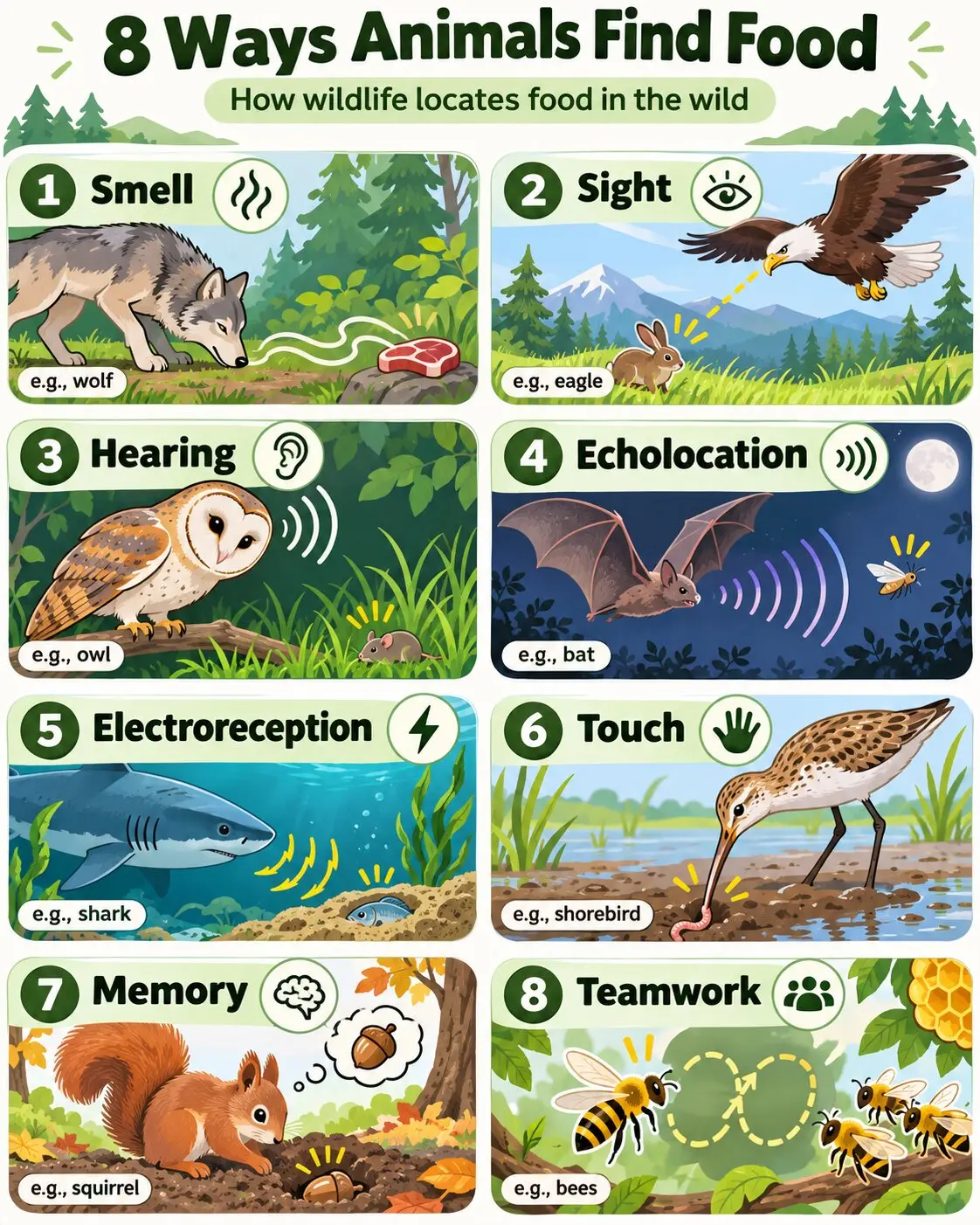
Animals use different sensory and behavioral strategies to locate prey, plants, and other food sources.
| Food-Finding Method | How It Works | Animal Examples |
|---|---|---|
| Smell | Detects chemical cues associated with food or prey | Wolves, bears, ants |
| Sight | Identifies food, prey, or movement | Eagles, monkeys, hummingbirds |
| Hearing | Detects sounds produced by hidden prey | Barn Owls, foxes |
| Echolocation | Uses returning sound echoes to locate targets | Insect-eating bats, dolphins |
| Electroreception | Detects weak electrical fields produced by living organisms | Sharks, platypuses |
| Touch | Locates concealed food through sensitive body structures | Shorebirds, star-nosed moles |
| Memory and learning | Helps animals return to known feeding locations | Squirrels, primates |
| Communication and cooperation | Helps share food information or coordinate hunting | Honeybees, wolves |
These methods are not mutually exclusive. Many animals combine several senses and learned behaviors while searching for food.
1. Using Smell to Locate Food
Smell helps animals detect food that may be hidden, distant, or difficult to see.
Wolves can follow scent cues associated with prey, helping them investigate areas where other animals have recently moved.
Bears also use their strong sense of smell to search for carcasses, vegetation, insects, and other available food. Smell also helps some animals locate carcasses. Turkey Vultures, for example, can detect odors associated with dead animals. Our guide to scavenger animals explains how different species find and consume animal remains.
Among insects, ants detect chemical signals through sensory structures on their antennae. Some ant species follow pheromone trails laid by other colony members to reach food.
Smell is particularly useful when darkness, vegetation, or other obstacles reduce visibility.
Example: A wolf may detect prey-related scents before using movement, hearing, and vision to locate an animal more precisely.
2. Using Eyesight to Spot Food
Many animals rely heavily on vision to locate potential food sources.
Eagles and other birds of prey use keen eyesight to detect small animals while perched or flying above open landscapes.
Fruit-eating monkeys use vision to recognize fruits, leaves, and other food sources while moving through trees.
Hummingbirds locate flowers visually and can learn which feeding locations provide nectar.
Visual searching depends on the animal’s eyesight, available light, and whether the food is exposed or concealed.
Example: An eagle can detect prey movement from an elevated position before approaching or diving toward it.
3. Using Hearing to Detect Hidden Prey
Some predators can locate food by listening for sounds produced by animals moving nearby.
Barn Owls are particularly well adapted for this method.
Their sensitive hearing allows them to locate rodents moving through grass or other vegetation, even when visibility is extremely limited.
Their facial discs help direct sound toward their ears, while differences in the arrival time and intensity of sounds help them determine prey position.
Foxes also use hearing to detect small mammals moving beneath vegetation or snow.
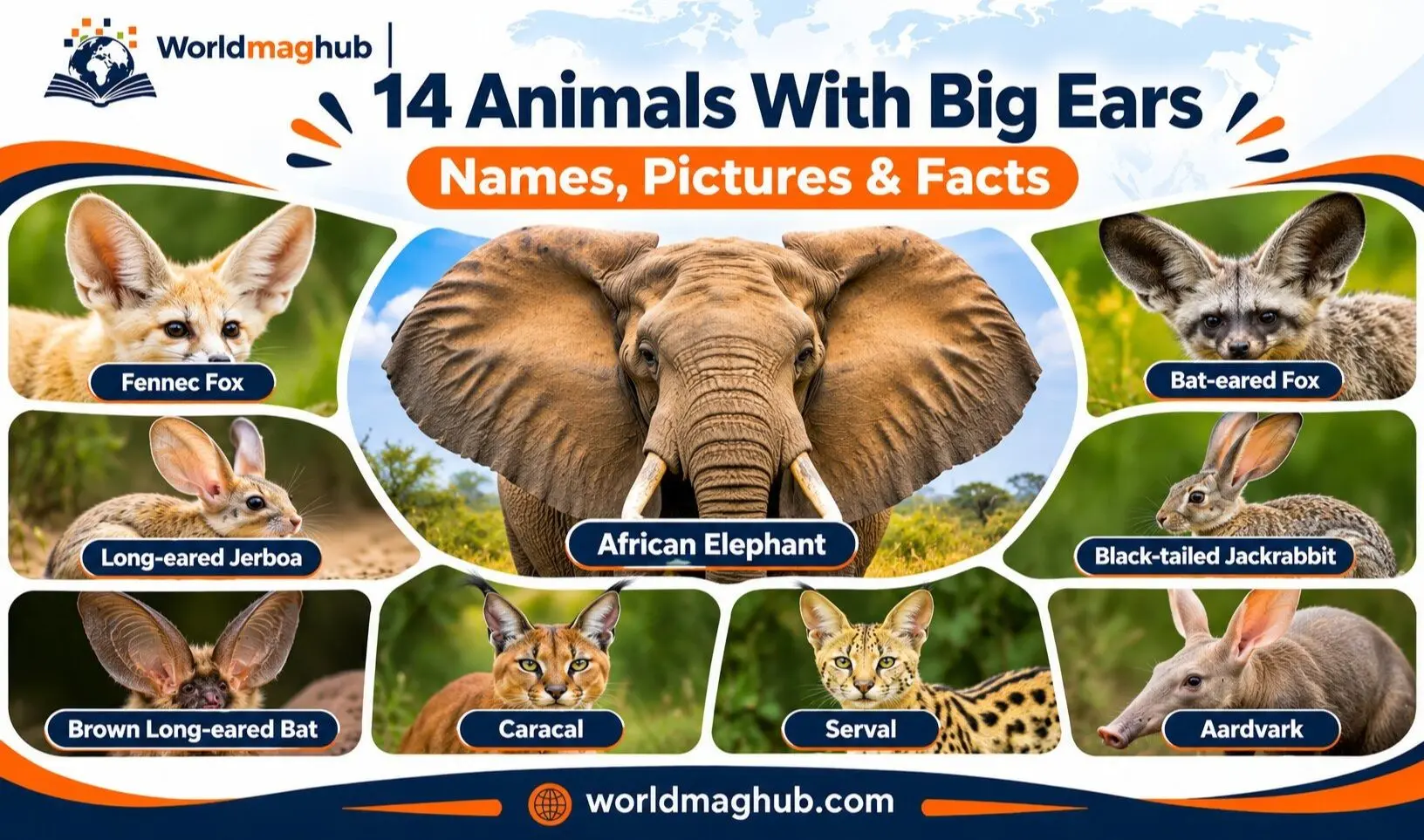
Sensitive hearing is especially important for animals that hunt prey hidden beneath sand or vegetation. Fennec foxes, bat-eared foxes, and servals are examples of mammals with unusually large ears that help them detect sounds. Explore our guide to animals with big ears to learn how these adaptations support hearing and survival.
Example: A Barn Owl can locate a mouse through sound, even when the prey is hidden from view.
4. Using Echolocation to Find Prey
Echolocation is a specialized method of detecting objects through sound.
Many insect-eating bats produce high-frequency calls while flying. When these sounds encounter insects or other objects, some of the sound returns as echoes.
The bat interprets the returning signals to estimate a target’s position and adjust its movement.
Dolphins and other toothed whales also use echolocation to locate objects and prey underwater.
Research published in the Journal of Experimental Biology documents how bats and toothed whales adjust their echolocation behavior while searching for and approaching prey.
Unlike passive hearing, echolocation is an active sensory method because the animal produces the sound used for detection.
Example: A hunting bat uses returning echoes to track a flying insect and adjust its flight before capture.
5. Detecting Electrical Signals Underwater
Some aquatic animals possess a specialized sensory ability called electroreception.
This allows them to detect weak electrical fields associated with living organisms.
Sharks and rays have specialized sensory structures that help them detect electrical signals produced by potential prey, including animals concealed beneath sand.
The platypus provides another remarkable example.
When diving underwater, a platypus closes its eyes, ears, and nostrils. Its bill contains specialized receptors sensitive to electrical signals and mechanical stimulation.
According to the Australian Museum, these sensory abilities help the platypus locate small aquatic animals, including insect larvae and crustaceans.
Electroreception is not a universal animal ability. It occurs in particular groups with specialized sensory adaptations.
Example: A platypus can search for underwater prey using information detected through its sensitive bill.
6. Using Touch to Find Hidden Food
Touch helps some animals locate food concealed beneath mud, soil, sand, or water.
Certain shorebirds possess sensitive bill tips containing specialized mechanoreceptors.
These structures can help detect prey through direct contact or mechanical signals transmitted through the surrounding substrate.
For example, some probing shorebirds use their long bills to search for invertebrates beneath wet sediment. Some shorebirds have long, sensitive bills that help them detect food beneath mud and shallow water. Explore our guide to birds with long beaks to learn how different bill shapes support feeding in the wild.
The Star-nosed Mole has an even more unusual tactile adaptation.
Its nose contains 22 fleshy appendages covered with thousands of touch receptors, allowing it to examine nearby objects and locate small prey rapidly.
Research on tactile perception confirms that specialized sensory structures play an important role in food detection among these animals.
Example: A shorebird can probe soft mud and detect prey that is difficult to locate through vision alone.
7. Remembering Where Food Is Located
Animals do not always need to discover food sources from the beginning.
Some remember previously productive feeding areas and return when food becomes available.
Squirrels provide a familiar example.
Many squirrels collect nuts and seeds, hide them in different locations, and recover them later.
Research has shown that Gray Squirrels can remember the locations of buried food. Smell can also help them detect or recover caches.
Some primates remember productive fruiting trees and adjust their travel routes according to seasonal food availability.
These abilities are useful when food is scattered or changes throughout the year.
Example: A squirrel may use spatial memory and smell to recover a nut it buried earlier.
8. Working Together or Sharing Food Information
Some animals improve their chances of obtaining food through communication or cooperation.
Honeybees provide one of the clearest examples of sharing information about feeding locations.
When a worker honeybee discovers a productive source of nectar or pollen, it may return to its colony and perform a waggle dance.
The dance communicates information about the direction and approximate distance of the food source, helping other bees locate it.
Wolves and African Wild Dogs demonstrate a different type of cooperation through group hunting.
Working together can allow predators to pursue or capture prey that would be more difficult for an individual animal to obtain alone.
These are different mechanisms: honeybees communicate food-location information, while pack-hunting predators coordinate their movements to obtain prey.
Example: A honeybee can help nestmates find a flower patch by communicating its approximate location through a waggle dance.
How Do Animals Find Food in Different Habitats?
Animals adjust their food-searching behavior according to habitat, temperature, seasonal conditions, and the distribution of available resources.
| Habitat or Condition | Food-Finding Strategy | Animal Examples |
|---|---|---|
| Rainforest | Search trees and forest vegetation using sight, smell, memory, and climbing ability | Monkeys, toucans, jaguars |
| Desert | Forage during cooler hours, locate scattered food, and sometimes store seeds | Kangaroo rats, desert foxes |
| Winter | Retrieve stored food, dig through snow, continue hunting, or migrate | Squirrels, foxes, Clark’s nutcrackers |
| Arctic | Locate prey on sea ice, hunt small mammals, scavenge, or dig for vegetation | Polar bears, Arctic foxes, caribou |
In tropical forests, monkeys may remember the locations of fruiting trees, while birds search branches and vegetation for food.
Desert animals often face widely scattered resources and high daytime temperatures. Kangaroo rats, for example, forage for seeds mainly at night and can transport them in cheek pouches.
During winter, squirrels and certain birds recover food stored earlier, while predators continue hunting when conditions allow.
Arctic animals face additional challenges from snow, ice, and seasonal changes in food availability. Polar bears primarily hunt seals using sea-ice habitats, while Arctic foxes may hunt or scavenge.
The key difference is food availability. Animals often use the same basic senses in different ways depending on the environment and the resources they need.
While senses help animals locate food, physical strength can be equally important for catching prey, digging, carrying food, or overcoming obstacles. Discover how different animals use their strength in our guide to the world’s most powerful species.
Frequently Asked Questions
Do Animals Use Instinct or Learning to Find Food?
Both. Animals have inherited sensory abilities and feeding behaviors, while experience helps them recognize food sources and search more effectively. A young predator may possess natural hunting instincts but become more successful through practice.
How Do Nocturnal Animals Find Food in the Dark?
Nocturnal animals use specialized senses, including hearing, smell, low-light vision, and echolocation. Barn Owls locate prey through sound, while many insect-eating bats use returning echoes to detect flying insects.
How Do Animals Find Food Underwater?
Aquatic animals use vision, chemical sensing, touch, water movement, echolocation, or electroreception. Dolphins use echolocation to locate prey, while sharks detect weak electrical fields associated with living organisms.
How Do Animals Find Food in the Arctic?
Arctic animals use specialized feeding strategies suited to snow, sea ice, and seasonal food shortages. Polar bears hunt seals near breathing holes or other accessible locations, Arctic foxes hunt and scavenge, and caribou may dig through snow to reach vegetation.
How Do Animals Find Food in Trees?
Tree-dwelling animals search branches, leaves, bark, and flowers using sight, smell, touch, and memory. Monkeys locate fruit and insects, squirrels collect nuts and seeds, and some marmosets use specialized teeth to obtain plant gums from tree bark.
How Do Animals Decide Which Food to Eat?
Animals select food according to availability, nutritional value, experience, and the effort or risk involved in obtaining it. Predators may avoid difficult or dangerous prey, while herbivores may select nutritious plants. Ecologists study these trade-offs through foraging theory, but animals do not necessarily make conscious calculations.
Sources and Further Reading
This guide presents eight research-supported examples of how animals locate food through sensory abilities, learning, and cooperation.
The methods are not an exhaustive scientific classification, and many species use several strategies together.
The following scientific studies and institutional references support the main biological explanations:
- Cornell Lab of Ornithology — Barn Owl — Exceptional hearing and detecting prey in darkness.
- Journal of Experimental Biology — Adaptive Echolocation in Bats and Toothed Whales — Echolocation during prey detection and pursuit.
- Australian Museum — Platypus — Electrical and mechanical sensing during underwater feeding.
- Peer-Reviewed Research — Shorebird Bill-tip Sensory Organs — Touch-sensitive bill structures used to detect buried prey.
- Vanderbilt University — Star-nosed Mole Research — Specialized touch organs and prey detection.
- North Carolina State University Extension — Honey Bee Dance Language — Communication of food direction and distance.
- Animal Behaviour — Grey Squirrels Remember the Locations of Buried Nuts — Experimental evidence of spatial memory during food recovery.
- Arizona-Sonora Desert Museum — Kangaroo Rats and Pocket Mice — Nocturnal seed foraging and food storage.
- U.S. Geological Survey — Polar Bear Foraging Behavior — Sea-ice hunting, seal prey, and seasonal feeding conditions.