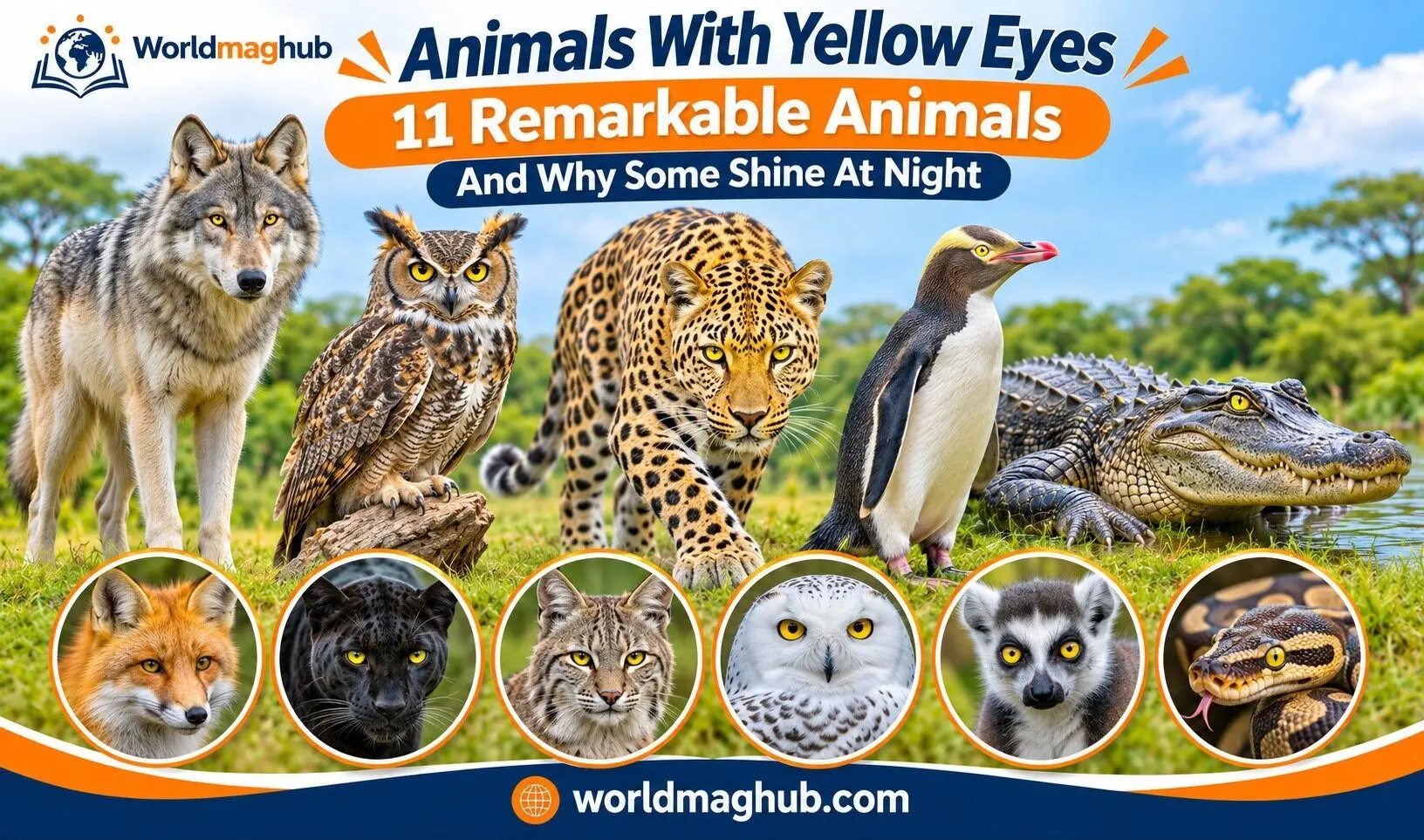
A gray wolf staring through a snowy forest, a great horned owl watching from a tree, or a black leopard with golden eyes can be unforgettable. Across the animal kingdom, yellow eyes appear in birds, mammals, and reptiles, sometimes creating a striking contrast with their fur, feathers, or scales.
Animals with yellow eyes include gray wolves, great horned owls, red foxes, leopards, bobcats, snowy owls, ring-tailed lemurs, and yellow-eyed penguins. Other animals, such as alligators and some snakes, can have yellowish, golden, or amber-colored eyes.
However, naturally yellow eyes and yellow eyeshine are different. An animal’s irises may be golden in daylight, while another animal with dark eyes may reflect yellowish light at night.
Below are 11 real, scientifically documented animals with yellow or golden eye appearances, how to recognize them, and what makes their eyes distinctive.
Scientific verification: The animals featured in this article are recognized species or documented color forms. Their eye colors are described using established zoological references and species-identification information. Eye shades can vary between individuals, ages, and lighting conditions. This list is not a scientific ranking of eye color or brightness.
Yellow-Eyed Animals at a Glance
Some animals have naturally bright yellow irises, while others display softer golden or amber tones. The following table provides a quick comparison.
| Animal | Typical eye appearance | Distinguishing feature |
|---|---|---|
| Gray wolf | Yellow, golden, or amber | Wild canine with varied coat colors |
| Great horned owl | Bright yellow | Prominent feather tufts |
| Red fox | Yellowish or amber | Reddish coat and pointed muzzle |
| Leopard | Yellowish, golden, or greenish | Rosette-patterned coat |
| Black leopard | Golden or yellowish in some individuals | Dark, melanistic coat |
| Bobcat | Yellowish or amber | Short tail and tufted ears |
| Snowy owl | Bright yellow | Predominantly white plumage |
| Ring-tailed lemur | Yellow to orange | Black-and-white ringed tail |
| Yellow-eyed penguin | Pale yellow | Yellow feather band around its head |
| American alligator | Yellowish, olive, or brownish; variable | Eyes positioned high on its head |
| Ball python | Golden-brown or amber in many individuals | Patterned body and vertical pupils |
Note: The table describes typical or observed eye appearances, not fixed colors for every individual. Yellow, gold, amber, and orange can overlap visually.
11 Animals With Naturally Yellow or Golden Eyes
1. Gray Wolf – A Wild Canid With Golden Eyes
- Scientific name: Canis lupus
- Habitat: Forests, tundra, grasslands, and mountains
- Eye color: Commonly yellow, golden, or amber in adults
The gray wolf is one of the most recognizable wild animals with yellow eyes.
Adult wolves often have golden-yellow irises that stand out against their gray, brown, white, or nearly black fur. The exact shade varies among individuals.
Wolf pups generally begin life with bluish eyes, and their iris color changes as they develop. Many adults eventually display the familiar amber or yellow appearance.
Wolves rely on multiple senses to explore their surroundings and hunt. Their vision helps them detect movement, while hearing and smell are particularly important for identifying prey and communicating with other wolves.
The golden color of their irises comes from their natural eye characteristics, not from their eyes producing light.
Distinctive feature: Golden-yellow eyes that contrast with the wolf’s thick coat.
2. Great Horned Owl – The Bird With Bright Yellow Eyes
- Scientific name: Bubo virginianus
- Habitat: Forests, deserts, grasslands, and urban environments across the Americas
- Eye color: Bright yellow
The great horned owl is famous for its intense yellow eyes and prominent feather tufts.
Its large, forward-facing eyes help provide overlapping visual fields, supporting depth perception while hunting.
Unlike human eyes, owl eyes are elongated and relatively fixed within their sockets. Owls turn their heads to look in different directions rather than moving their eyes extensively.
Great horned owls are particularly active during nighttime and twilight hours, when their specialized vision and hearing help them locate prey.
Their yellow irises are naturally visible in daylight; they do not need darkness to appear yellow.
The owl’s eye size is another remarkable feature. Our guide to animals with large eyes explains how big eyes support different visual abilities across the animal kingdom.
Distinctive feature: Large, forward-facing eyes with naturally bright yellow irises.
3. Red Fox – A Wild Animal With Amber-Yellow Eyes
- Scientific name: Vulpes vulpes
- Habitat: Forests, grasslands, farmland, and urban areas
- Eye color: Yellowish or amber in many adults
The red fox is a slender wild canine with pointed ears, a narrow muzzle, and eyes that often appear yellow or amber.
According to Animal Diversity Web, mature red foxes characteristically have yellow eyes.
Foxes are commonly active around dawn and dusk, although their activity patterns differ depending on habitat and human disturbance.
Their eyes are adapted to functioning under varying light conditions.
Like many mammals, red foxes possess a reflective structure behind the retina called the tapetum lucidum. It helps them use available light in dim environments.
This structure can also create visible eyeshine when a flashlight or another light source illuminates their eyes at night.
However, reflected eyeshine should not be confused with the natural color of the iris.
Distinctive feature: Yellowish eyes, narrow pupils, and a pointed fox-like face.
4. Leopard – A Big Cat With Golden Eyes
- Scientific name: Panthera pardus
- Habitat: Forests, savannas, mountains, and scrublands
- Eye color: Often yellowish, golden, or greenish-yellow
The leopard is a powerful wild cat known for its spotted coat, muscular body, and striking eyes.
Many leopards have irises that appear golden, yellowish, or greenish-yellow, although eye color varies among individuals.
Leopards are adaptable predators and may hunt during daylight, twilight, or nighttime depending on their environment and available prey.
Their visual adaptations, including pupil changes and light-sensitive retinal structures, help them function across different lighting conditions.
The golden appearance of a leopard’s eyes is especially noticeable in close-up photographs, where the iris contrasts with its dark facial markings.
Leopards can also occur in a melanistic, or black-coated, form.
Distinctive feature: Golden or yellowish eyes surrounded by dark facial markings and a spotted coat.
5. Black Leopard – A Dark-Coated Cat With Yellow Eyes
- Scientific identity: Melanistic Panthera pardus
- Habitat: Forests and other leopard habitats
- Eye color: Golden or yellowish in some individuals
A black leopard is one of the most striking examples of a black animal that can have golden-yellow eyes.
Often called a black panther, it is not a separate animal species. The name describes a melanistic leopard, although the term black panther is also used for melanistic jaguars.
Melanism produces unusually dark pigmentation in the coat.
Despite its almost black appearance, a leopard’s rosette patterns may still be visible under suitable lighting.
Its eye color can remain golden or yellowish, creating a noticeable contrast against the dark fur.
However, melanism does not guarantee a particular eye color, and the irises can vary.
Distinctive feature: A dark melanistic coat that may contrast strongly with yellow or golden eyes.
6. Bobcat – A Wild Cat With Yellowish Eyes
- Scientific name: Lynx rufus
- Habitat: Forests, deserts, grasslands, and scrublands of North America
- Eye color: Usually yellowish or amber in appearance
The bobcat is a medium-sized wild cat recognizable by its short tail, pointed ear tufts, and facial ruff.
Its eyes commonly appear yellowish or golden, although the intensity of the color can vary.
Bobcats are stealthy predators that hunt rabbits, rodents, birds, and other small animals.
They frequently hunt during dawn and dusk, using vision and hearing to detect potential prey.
Their eyes are positioned toward the front of the head, supporting binocular vision and distance judgment.
A bobcat may also show colored eyeshine when illuminated at night, but this reflection does not necessarily match its natural iris color.
Distinctive feature: Yellowish eyes, tufted ears, and a short tail.
7. Snowy Owl – A White Bird With Brilliant Yellow Eyes
- Scientific name: Bubo scandiacus
- Habitat: Arctic tundra and northern open landscapes
- Eye color: Bright yellow
The snowy owl has brilliant yellow eyes that stand out against its pale facial feathers.
It is one of the easiest yellow-eyed birds to recognize, especially when perched in an open landscape.
Unlike many owls that hunt primarily at night, snowy owls can be active during daylight.
This is particularly important in Arctic habitats, where summer brings extremely long periods of daylight.
Their eyes help them monitor surrounding landscapes while searching for lemmings and other prey.
Snowy owls also rely heavily on hearing, especially when locating prey that may be hidden beneath vegetation or snow.
Male snowy owls often become whiter as they mature, while females commonly retain more dark markings.
Distinctive feature: Piercing yellow eyes framed by predominantly white plumage.
8. Ring-Tailed Lemur – Yellow Eyes and a Striped Tail
- Scientific name: Lemur catta
- Habitat: Forests and scrublands of Madagascar
- Eye color: Yellow to orange
The ring-tailed lemur is an especially clear example of an animal with yellow eyes and a striped tail.
Its yellow-orange irises are surrounded by dark facial markings, creating a noticeable contrast with its white face.
The animal’s long tail features alternating black-and-white rings.
According to the Smithsonian’s National Zoo, ring-tailed lemurs have 13 alternating black-and-white tail bands.
Unlike many nocturnal lemurs, ring-tailed lemurs are primarily active during the day and frequently spend time on the ground.
They live in social groups and use vocalizations, scents, body movements, and visual signals to communicate.
Their naturally bright eyes are not an example of nighttime eyeshine.
Distinctive feature: Yellow-orange eyes and a long black-and-white striped tail.
9. Yellow-Eyed Penguin – The Bird Named for Its Eye Color
- Scientific name: Megadyptes antipodes
- Also known as: Hoiho
- Habitat: Coastal New Zealand and nearby islands
- Eye color: Pale yellow in adults
The yellow-eyed penguin is one of the clearest examples of a bird whose natural eye coloration is reflected in its common name.
Adult yellow-eyed penguins have pale yellow irises and a distinctive band of yellow feathers extending around the back of the head.
This feature makes them recognizable among penguins, many of which have darker eyes.
Yellow-eyed penguins forage at sea for fish and other marine prey, then return to land to rest, breed, and raise their young.
They are also known for nesting in relatively secluded areas instead of forming densely packed colonies like some other penguin species.
The species faces serious conservation challenges, including disease, habitat disturbance, and threats in the marine environment.
Distinctive feature: Pale yellow irises and a yellow feather band around the head.
10. American Alligator – A Reptile With Yellowish Eyes
- Scientific name: Alligator mississippiensis
- Habitat: Freshwater wetlands of the southeastern United States
- Eye appearance: Yellowish, olive, or brownish, varying among individuals
The American alligator has prominent eyes positioned high on its head.
This arrangement allows it to observe its surroundings while much of its body remains submerged.
Its irises may appear yellowish, olive, or brownish, depending on the individual and the lighting.
At night, alligator eyes can produce a noticeable reddish or orange reflection when illuminated.
That eyeshine is different from the natural color of the iris.
Alligators also possess a protective membrane called the nictitating membrane, which helps shield the eyes, particularly during underwater activity.
Distinctive feature: High-positioned eyes that may appear yellowish in daylight and reflect a different color at night.
11. Ball Python – A Snake With Golden or Amber Eyes
- Scientific name: Python regius
- Habitat: Grasslands, savannas, and other suitable habitats of West and Central Africa
- Eye appearance: Golden-brown or amber in many individuals
The ball python is a relatively small python known for its patterned body, broad head, and calm defensive behavior.
Many normally colored ball pythons have golden-brown or amber-looking irises, often with a darker vertical pupil.
However, their eye colors are not identical across individuals.
Selective breeding in captivity has also produced numerous color and pattern variations that may affect eye appearance.
Ball pythons often hunt under low-light conditions and use several senses to locate prey.
They possess heat-sensitive structures along the lips that help them detect warm-bodied animals.
Their natural eye color should not be confused with mammalian eyeshine, which often involves a reflective structure called the tapetum lucidum.
Distinctive feature: Golden-brown eyes with vertical pupils and a patterned body.
Yellow Eyes vs. Yellow Eyeshine: What’s the Difference?
A yellow iris and yellow eyeshine may look similar, but they occur for different reasons.
The iris is the colored structure surrounding the pupil. Its appearance depends on pigmentation, microscopic structures, and how light interacts with the tissue.
Some animals naturally have yellow or golden irises that remain visible under ordinary daylight.
Eyeshine, on the other hand, occurs when light enters an animal’s eye and is reflected back toward an observer.
In many mammals, a reflective layer called the tapetum lucidum lies behind the retina. It reflects incoming light, giving light-sensitive cells another opportunity to detect it.
This adaptation can improve vision under dim lighting.
The reflected color may appear yellow, green, blue, orange, or another shade depending on the animal’s anatomy and the lighting conditions.
| Feature | Naturally yellow iris | Yellow eyeshine |
|---|---|---|
| Appearance | Yellow or golden iris | Yellowish reflected light |
| Visible in daylight | Usually yes | Usually not conspicuous |
| Requires reflected artificial light | No | Usually requires a directed light source at night |
| Main cause | Iris pigmentation and optical structure | Reflection from within the eye |
| Example | Great horned owl | Raccoon showing amber eyeshine |
| Indicates better night vision? | Not by itself | Some reflective structures support low-light sensitivity |
For example, a raccoon generally has dark irises, but its eyes can appear yellowish or amber when illuminated at night.
Similarly, a fox with naturally yellowish eyes may show a different eyeshine color under a flashlight.
Animal eyes do not normally produce their own yellow light. The glow seen in photographs or at night is usually reflected illumination.
Eye color is also not a reliable indicator of intelligence, aggression, or whether an animal is dangerous.
Beyond the familiar animals discussed here, you can explore a wider variety of animals using our discovery tool.
Frequently Asked Questions
What animals have yellow-looking eyes at night?
Wolves, foxes, bobcats, raccoons, and domestic cats can display yellowish or amber-looking eyes when illuminated at night.
However, the appearance may result from reflected eyeshine rather than naturally yellow irises.
Eyeshine color alone cannot reliably identify an animal.
Which birds have bright yellow eyes?
Great horned owls, snowy owls, great gray owls, burrowing owls, and yellow-eyed penguins are notable examples.
Their yellow eye color is naturally present in the iris rather than caused by nighttime reflection.
Do crocodiles and alligators have yellow eyes?
Some crocodilians have yellowish, olive, greenish, or brownish irises, depending on the species and individual.
Their eyes may also reflect bright light at night, but the reflected color does not necessarily match their natural iris color.
Does yellow eye color help animals see better in the dark?
Not necessarily.
Yellow iris pigmentation alone does not establish superior night vision.
Low-light vision depends on several factors, including pupil size, retinal anatomy, photoreceptor sensitivity, and reflective eye structures.
Can yellow eyeshine identify an animal?
Not reliably.
Several different animals can produce similar yellowish or amber eye reflections.
Body shape, size, movement, habitat, and geographic location provide more useful identification clues.
If you notice an unidentified wild animal at night, observe it from a safe distance rather than approaching to inspect its eyes.
Scientific Sources and Fact-Checking
The animals featured in this article are documented species or recognized color forms. Their eye characteristics and biological adaptations were checked using established wildlife references and veterinary research.
- Cornell Lab of Ornithology – Great Horned Owl — Documents the owl’s characteristic bright yellow eyes and visual adaptations.
- Cornell Lab of Ornithology – Snowy Owl — Identifies the snowy owl’s yellow eyes and characteristic appearance.
- New Zealand Department of Conservation – Yellow-Eyed Penguin — Provides identification and conservation information about the yellow-eyed penguin.
- Animal Diversity Web – Gray Wolf — Provides species biology and developmental characteristics.
- Animal Diversity Web – Bobcat — Describes bobcat anatomy, behavior, and habitat.
- Animal Diversity Web – American Alligator — Provides biological information about American alligators.
- Animal Diversity Web – Ball Python — Provides species identification and biological characteristics.
- VCA Animal Hospitals – Why Does Your Pet’s Eyes Glow in the Dark? — Explains the tapetum lucidum and the cause of reflected eyeshine.
- Comparative Morphology of the Tapetum Lucidum — Veterinary research examining reflective eye structures in different animals.
Editorial clarification: The species identities and major biological characteristics are documented in zoological references. Yellow, golden, and amber are descriptive eye-color terms that may overlap, and individual variation is common. The list does not claim that all individuals of these species have identical iris colors or that the animals hold verified eye-color records.