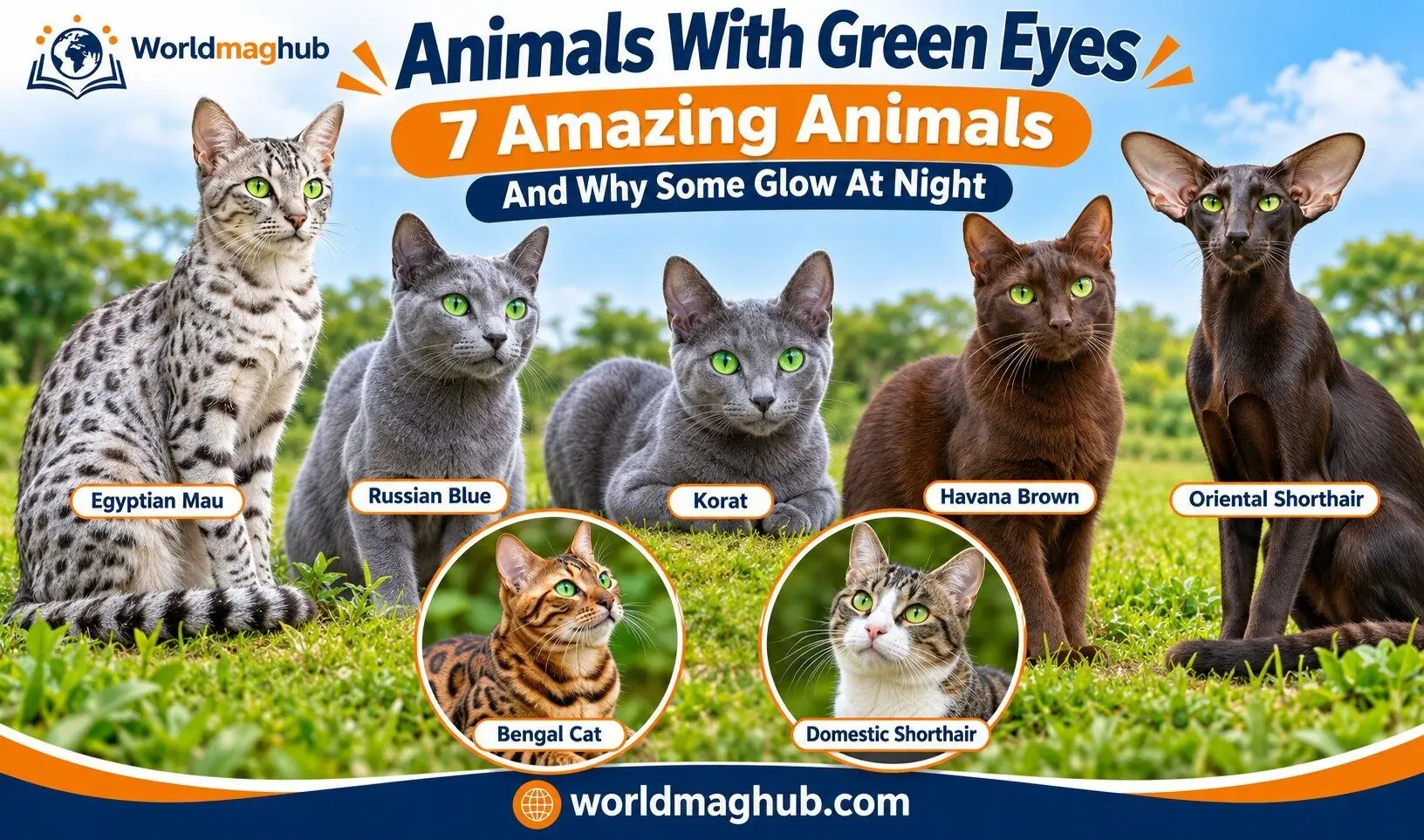
Green eyes are among the most striking features found in animals. A Russian Blue cat can have vivid emerald-green irises, while an Egyptian Mau is known for its distinctive gooseberry-green eyes. But the glowing green eyes sometimes spotted in forests at night may belong to animals whose natural eye color is not green at all.
Animals with naturally green eyes include Egyptian Maus, Russian Blue cats, Korats, Havana Browns, Oriental Shorthairs, and some Bengal and domestic shorthair cats. In several established cat breeds, green eyes are a recognized characteristic, while in others they occur as a natural variation.
However, green iris color and green eyeshine are different. Deer, coyotes, foxes, and black-footed ferrets may reflect green light at night even when their natural irises are brown or amber.
Here are seven documented examples of green-eyed animals, followed by an explanation of what causes their eye color and why other animals’ eyes can appear to glow green in the dark.
Scientific verification: The seven examples below are recognized domestic cat breeds or documented domestic-cat groups. Their green-eye characteristics are supported by established breed standards and feline references. The nighttime eyeshine information is supported by veterinary research and wildlife field documentation. These are verified examples of naturally occurring green irises, not a ranking of the world’s greenest eyes.
Green-Eyed Animals at a Glance
Not all green eyes have the same appearance. Some are vivid emerald green, others are yellow-green or gooseberry green, and some develop their mature coloration gradually.
| Animal | Typical green-eye appearance | Distinguishing feature |
|---|---|---|
| Egyptian Mau | Gooseberry green | Naturally spotted coat |
| Russian Blue | Vivid emerald green | Silvery blue-gray coat |
| Korat | Luminous green in mature adults | Heart-shaped face and silver-blue fur |
| Havana Brown | Clear, rich green | Chocolate-brown coat |
| Oriental Shorthair | Green in many non-pointed varieties | Large ears and almond-shaped eyes |
| Bengal cat | Green, gold, or hazel in different individuals | Spotted or marbled coat |
| Domestic shorthair cat | Green, yellow-green, or other colors | Wide variation in coat and eye colors |
Note: This table compares documented green-eye appearances. All seven are domestic cats, and the eye color is not uniform across every individual or variety.
7 Animals With Naturally Green Eyes
1. Egyptian Mau – A Cat With Gooseberry-Green Eyes
- Scientific name: Felis catus
- Origin: Domestic breed with Egyptian-associated ancestry
- Eye color: Gooseberry green
The Egyptian Mau is one of the clearest examples of a cat with naturally green eyes.
Its irises have a distinctive shade commonly described as gooseberry green, a yellowish-green color recognized in the Cat Fanciers’ Association breed standard.
Unlike cats with solid coats, the Egyptian Mau has a naturally spotted pattern. Its spots may appear against silver, bronze, or smoke-colored fur, creating a noticeable contrast with its eyes.
The green eye color does not necessarily appear fully developed in kittens.
According to the breed standard, some green should be visible by approximately eight months of age, with the mature green coloration developing by around 18 months.
This makes the Egyptian Mau a particularly useful example of how an animal’s iris pigmentation can change during development.
Its athletic build, spotted coat, and distinctively colored eyes help distinguish it from other domestic cats.
Distinctive feature: Gooseberry-green eyes that are an established characteristic of the breed.
2. Russian Blue – A Cat With Emerald-Green Eyes
- Scientific name: Felis catus
- Origin: Traditionally associated with Russia
- Eye color: Vivid green in mature adults
The Russian Blue is famous for its silvery blue-gray coat and brilliant green eyes.
Its short, dense double coat has silver-tipped hairs that give the fur a soft, shimmering appearance.
The contrast between the cool gray coat and emerald-green irises makes the breed particularly recognizable.
Russian Blue kittens do not necessarily have the same intense green eyes as mature adults.
Their eye coloration develops gradually, and the green shade generally becomes stronger with age.
The Cat Fanciers’ Association describes vivid green eyes as a defining characteristic of the breed.
Although the eye color is distinctive, it does not establish superior visual ability or better night vision compared with other cats.
Distinctive feature: Emerald-green eyes that contrast with a dense, silver-tipped blue-gray coat.
3. Korat – A Cat Whose Eyes Become Green With Age
- Scientific name: Felis catus
- Origin: Thailand
- Eye color: Luminous green in mature adults
The Korat is a Thai cat breed recognized for its heart-shaped face, silver-blue coat, and large expressive eyes.
Like the Russian Blue, it has a silvery coat and green eyes, but its facial shape and body structure are different.
One of the most interesting characteristics of the Korat is the way its eye color changes as it matures.
Young Korats may have amber or yellowish eyes before gradually developing the green shade associated with mature adults.
The Cat Fanciers’ Association describes luminous green as the preferred eye color, while an amber cast may be acceptable.
This gradual transition illustrates why eye color should sometimes be considered alongside an animal’s age.
A young Korat with yellow-green eyes may develop a more distinctly green appearance later in life.
Distinctive feature: Large green eyes that develop their mature coloration gradually.
4. Havana Brown – A Brown Cat With Green Eyes
- Scientific name: Felis catus
- Origin: Developed in Britain
- Eye color: Green
The Havana Brown has one of the most recognizable combinations of coat and eye color among domestic cats.
Its rich chocolate-brown fur contrasts with clear green irises, creating a distinctive appearance.
Unlike the Russian Blue and Korat, which have silver-blue coats, the Havana Brown is recognized for its warm brown coloration.
Its head has a distinctive shape with prominent whisker pads, and its whiskers are also brown.
According to the Cat Fanciers’ Association, green eye color is an important part of the breed standard.
The Havana Brown is a particularly strong example of why green eyes should not be associated exclusively with gray or black-coated cats.
Its naturally green eyes can stand out against a brown coat just as clearly.
Distinctive feature: Rich green eyes paired with an unusually uniform chocolate-brown coat.
5. Oriental Shorthair – A Cat With Almond-Shaped Green Eyes
- Scientific name: Felis catus
- Origin: Developed from Siamese-related breeding lines
- Eye color: Green in many non-pointed varieties
The Oriental Shorthair is a slender domestic cat recognized for its large ears, elongated body, and almond-shaped eyes.
Many non-pointed Oriental Shorthairs have naturally green irises that complement their distinctive facial structure.
The breed occurs in a wide range of coat colors and patterns, making it visually more diverse than breeds with tightly defined coat coloration.
However, not every Oriental-type cat has green eyes.
Certain pointed varieties have blue eyes, while some white or bicolor varieties may have different recognized eye colors depending on the breed standard.
This is an important distinction because the breed’s eye color is connected to its particular color and pattern variety.
Distinctive feature: Almond-shaped green eyes, large ears, and an elegant, slender body.
6. Bengal Cat – A Spotted Cat That Can Have Green Eyes
- Scientific name: Felis catus
- Origin: Domestic breed developed through selective breeding
- Eye color: Green, gold, or hazel in different individuals
The Bengal cat is recognized for its striking spotted or marbled coat, which resembles the markings of some wild cats.
Unlike breeds whose standards require green eyes, Bengals may have several accepted iris colors.
Some have vivid green eyes, while others display gold, yellow-green, or hazel tones.
The specific eye color can vary with the cat’s genetics and coat-color variety.
Green irises are particularly noticeable in Bengals with warm brown coats and dark rosette markings.
Although their appearance resembles that of certain wild felines, modern Bengal cats are domesticated animals.
Their green eyes do not make them more closely related to wild cats than other Bengals with different iris colors.
Distinctive feature: Green or yellow-green eyes that may contrast with a spotted or marbled coat.
7. Domestic Shorthair Cat – Green Eyes in Mixed-Breed Cats
- Scientific name: Felis catus
- Distribution: Worldwide
- Eye color: Green, yellow, amber, copper, blue, or mixed
Domestic shorthair cats are not one standardized breed. The term generally describes short-haired domestic cats with varied or mixed ancestry.
Because these cats have diverse genetic backgrounds, they can display a wide range of iris colors.
Some have vivid emerald-green eyes, while others have pale yellow-green or hazel irises.
Green eyes can appear especially striking in black cats, where the bright iris contrasts with dark fur.
However, a black cat with green eyes does not automatically belong to a specific breed.
The appearance occurs among ordinary domestic cats with different coat colors and family backgrounds.
This makes domestic shorthairs an important example of naturally occurring eye-color diversity beyond selectively established pedigree characteristics.
Distinctive feature: Naturally variable green-eye coloration across cats with different coats and ancestry.
Why Do Some Animals Have Green Eyes?
Green eye color results from the interaction between pigments in the iris and the way light passes through and scatters within its tissues.
The iris is the colored structure surrounding the pupil.
In domestic cats, different amounts and distributions of pigment can produce eye colors ranging from yellow and amber to green and blue-green.
Green eyes generally involve a combination of iris pigmentation and optical effects rather than a single, universal green pigment.
Genetics influence these characteristics, but eye color can also change during development.
For example, Korats and Egyptian Maus may develop their mature green eye coloration gradually rather than displaying it fully as kittens.
Natural eye color should not be confused with eye size or visual performance.
A cat with vivid green eyes does not automatically have better night vision than a cat with yellow, amber, or another iris color.
Other animals have different pigmentation patterns. For additional examples, explore our guides to animals with blue eyes.
Green Eyes vs. Green Eyeshine: What’s the Difference?
Naturally green irises and glowing green eyes at night are different phenomena.
A green iris is an eye-color characteristic visible under ordinary illumination.
Green eyeshine occurs when light entering an animal’s eye is reflected toward the observer.
Many mammals possess a reflective structure behind the retina called the tapetum lucidum.
This structure reflects incoming light through the retina, allowing light-sensitive cells another opportunity to detect it.
The reflection may appear green, yellow, blue, orange, or another shade depending on the species, eye anatomy, and viewing conditions.
| Feature | Naturally green iris | Green eyeshine |
|---|---|---|
| Appearance | Green iris surrounding the pupil | Greenish reflected light |
| Visible in daylight | Yes | Usually not conspicuous |
| Main cause | Pigmentation and optical effects | Reflection from within the eye |
| Requires directed external light | No | Usually yes |
| Example | Russian Blue cat | Black-footed ferret under a spotlight |
| Indicates better night vision? | Not by itself | Reflective structures can improve low-light sensitivity |
Which Animals Produce Green Eyeshine at Night?
Green eyeshine has been documented in several North American mammals.
The U.S. Fish and Wildlife Service’s Black-Footed Ferret Field Operations Manual identifies distinctive eyeshine colors recorded during wildlife spotlight surveys.
| Animal | Documented eyeshine appearance |
|---|---|
| Black-footed ferret | Emerald green |
| Swift fox | Green or blue-green |
| Coyote | Green or white |
| Long-tailed weasel | Green |
| Bobcat | Green or orange |
| Pronghorn | Green |
| Deer | Green |
| American bison | Green or white |
These observations are useful because they come from wildlife field documentation rather than assumptions based solely on photographs.
However, reflected eye color can vary with the light source, viewing angle, and conditions.
For example, a coyote might show green or whitish reflections, while a deer may appear to have green eyes under a spotlight even though its irises are naturally brown.
The eyes are not producing their own green light. The visible effect is reflected illumination.
Eyeshine color alone is not a reliable way to identify an animal. Body shape, size, movement, habitat, and location provide additional clues.
From familiar species to lesser-known creatures, our tool lets you discover animals from different groups without following a particular order.
Frequently Asked Questions About Animals With Green Eyes
What animals naturally have green eyes?
Egyptian Maus, Russian Blue cats, Korats, Havana Browns, and many Oriental Shorthairs are recognized examples of naturally green-eyed cats.
Green irises also occur in some Bengal cats and mixed-breed domestic shorthairs.
What animals have glowing green eyes at night?
Black-footed ferrets, coyotes, deer, swift foxes, long-tailed weasels, and some other mammals can produce greenish eyeshine under suitable lighting.
This does not mean that their natural irises are green.
What do green eyes with slit-shaped pupils look like?
Green eyes with slit-shaped pupils have a green iris surrounding a narrow, vertically elongated black pupil.
Domestic cats are familiar examples.
In bright light, the pupil can narrow into a thin vertical slit. In darkness, it widens to admit more light.
What color do coyotes’ eyes glow at night?
Coyotes can produce green or whitish eyeshine when illuminated at night.
Their natural iris color is generally brownish or amber rather than vivid green.
The reflected color may change depending on lighting and viewing conditions.
What color do deer eyes glow at night?
Deer can show greenish eyeshine when illuminated by headlights or spotlights.
Their natural eyes are generally brown, and the reflected color is not fixed.
Identifying deer requires additional clues beyond eyeshine color.
Do black cats have green eyes?
Yes. Some black domestic cats have naturally green or yellow-green irises.
However, black coat color does not automatically determine eye color, and green-eyed black cats do not necessarily belong to a particular pedigree breed.
Do green eyes help animals see better in the dark?
No. Green iris coloration alone does not establish superior night vision.
Low-light vision depends on retinal sensitivity, pupil function, photoreceptors, and other anatomical features.
Some mammals also possess a reflective tapetum lucidum that helps them use available light and produces visible eyeshine.
Scientific Sources and Fact-Checking
The green-eyed animal examples in this article are documented through recognized domestic cat breed standards and feline references. Information about nighttime eyeshine is supported by veterinary and wildlife research.
- Cat Fanciers’ Association – Egyptian Mau — Documents the distinctive gooseberry-green iris color and spotted coat.
- Cat Fanciers’ Association – Oriental — Provides eye-color standards and distinctions among coat-color varieties.
- Cat Fanciers’ Association – Bengal — Describes accepted coat patterns and variations in eye color.
- Cat Fanciers’ Association – Coat and Color Descriptions — Provides information about naturally occurring iris colors in domestic cats.
- VCA Animal Hospitals – Why Do Your Pet’s Eyes Glow in the Dark? — Explains how the tapetum lucidum causes reflected eyeshine.
Editorial clarification: The main list consists of documented domestic cat breeds and groups in which green irises occur. The nighttime wildlife examples demonstrate reflected eyeshine, not necessarily naturally green irises. The term “green-eyed animals” is descriptive and does not represent a scientific ranking or a separate taxonomic group.