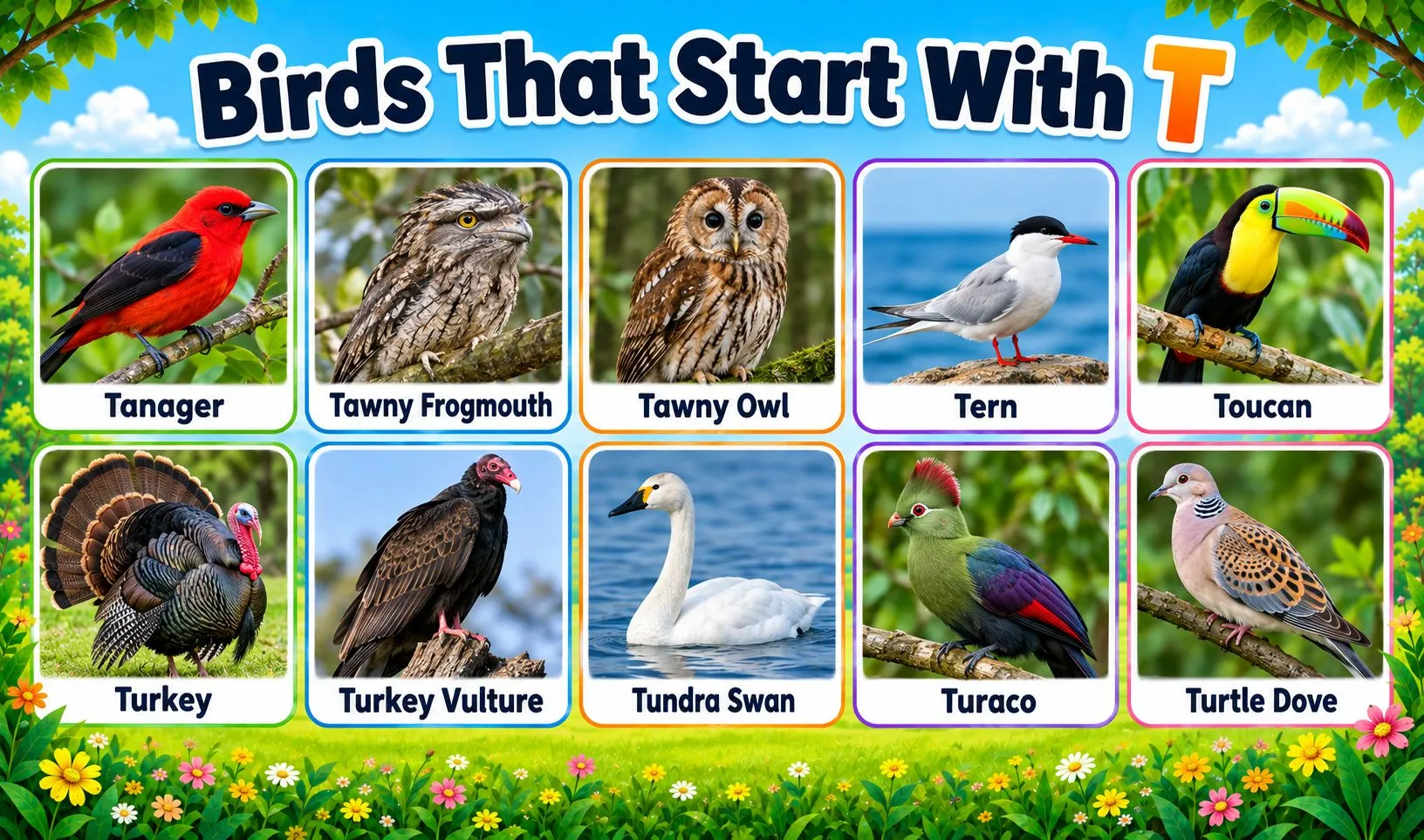
Birds that start with T include the toucan, turkey, tern, takahē, Tawny Frogmouth, Turkey Vulture, Tree Swallow, Trumpeter Swan, Toco Toucan, and Tufted Titmouse. Some are familiar backyard birds, while others live in remote forests, mountain grasslands, or wetlands.
The letter T includes several particularly unusual birds. The takahē is a flightless New Zealand species once believed extinct. The Torrent Duck raises its young beside fast-flowing mountain rivers, and the Tree Swallow can survive short periods of cold weather by temporarily reducing its body temperature.
Below are 15 birds beginning with T, with their scientific names, habitats, identifying features, and interesting facts. The selection includes both individual species and broader bird groups, with those distinctions explained where relevant.
Quick List of 15 Birds That Start With T
| Bird name | Scientific name | Main habitat or region |
|---|---|---|
| Takahē | Porphyrio hochstetteri | New Zealand grasslands |
| Tanager | Family Thraupidae (in modern usage) | Mainly Central and South America |
| Tawny Frogmouth | Podargus strigoides | Australia |
| Tawny Owl | Strix aluco | Europe and western Asia |
| Tern | Family Laridae, subfamily Sterninae | Coastal and inland waters worldwide |
| Toco Toucan | Ramphastos toco | South America |
| Torrent Duck | Merganetta armata | Andean mountain rivers |
| Tree Swallow | Tachycineta bicolor | North America |
| Trumpeter Swan | Cygnus buccinator | North America |
| Tufted Titmouse | Baeolophus bicolor | Eastern North America |
| Tundra Swan | Cygnus columbianus | Arctic and temperate wetlands |
| Turaco | Family Musophagidae | Sub-Saharan Africa |
| Turkey | Meleagris gallopavo | North America |
| Turkey Vulture | Cathartes aura | North, Central and South America |
| Turtle Dove | Streptopelia turtur | Europe, Western Asia and Africa |
Note: Tanager, tern and turaco are broader bird names rather than single species. The remaining entries identify individual species.
15 Birds Beginning With T and Their Unique Characteristics
1. Takahē
The takahē is a large, flightless bird native to New Zealand. Its deep blue body, green back, thick red bill, and sturdy legs make it one of the country’s most distinctive birds.
It belongs to the rail family, Rallidae, which also includes coots and moorhens.
Unlike many smaller rails that inhabit wetlands, takahē are strongly adapted to feeding on grasses. Their powerful bills help them strip nutritious parts from tussock and other vegetation.
For decades, the species was believed extinct. That changed on November 20, 1948, when an expedition led by Dr Geoffrey Orbell rediscovered a surviving population in the Murchison Mountains of Fiordland.
The discovery prompted one of New Zealand’s longest-running wildlife recovery programs. Conservation work now includes predator management, breeding programs, and establishing populations at protected sites.
Interesting fact: The takahē is a rare example of a bird returning to scientific attention after being presumed extinct for nearly 50 years.
2. Tanager
Tanagers are a diverse group of songbirds, many of which inhabit the tropical forests of Central and South America.
Their appearance varies considerably. Some species have brilliant combinations of blue, green, red, yellow, and black feathers, while others display more subdued colors.
The Paradise Tanager, for example, is recognized by its bright green head, blue underparts, and contrasting red and black plumage.
Tanagers are also interesting from a classification perspective. The modern tanager family, Thraupidae, includes birds that don’t necessarily have tanager in their common names. Conversely, some birds historically called tanagers are now classified in other families.
Many tropical tanagers consume both fruit and insects, although feeding habits vary between species.
Their movements through the forest canopy can help distribute seeds, while insect-eating species participate in controlling local invertebrate populations.
Interesting fact: The familiar English name tanager doesn’t always indicate membership in the modern scientific tanager family.
3. Tawny Frogmouth
The Tawny Frogmouth is an Australian nocturnal bird with gray-brown feathers, yellow eyes, and an exceptionally wide mouth.
People frequently mistake it for an owl because of its broad head, forward-facing eyes, and nighttime activity.
However, Tawny Frogmouths belong to the family Podargidae, not the owl families.
Their feeding method also differs from that of typical owls. Rather than relying primarily on powerful talons to capture prey, frogmouths use their broad mouths and bills to catch insects and other small animals.
They frequently hunt from exposed perches, watching for movement before dropping toward prey.
Tawny Frogmouths also form long-lasting pair bonds. Both parents participate in nesting duties, and pairs may reuse suitable territories over successive breeding seasons.
Interesting fact: Their common name comes from the frog-like width of their mouth, not from eating frogs as a primary food source.
4. Tawny Owl
The Tawny Owl is a medium-sized woodland owl found across much of Europe and parts of western Asia.
Its rounded head, dark eyes, and patterned brown or gray plumage help distinguish it from many other owls.
Unlike the Tawny Frogmouth, this bird is a true owl, belonging to the family Strigidae.
Tawny Owls are primarily nocturnal hunters. They capture small mammals, birds, amphibians, and other available prey.
Their hearing is particularly important when hunting in darkness. Like other owls, they have specialized facial feathers that help direct sound toward their ears.
They usually establish territories in wooded environments and may nest in natural tree cavities.
The familiar hooting calls often associated with owls in European films and literature are frequently based on the Tawny Owl’s vocalizations.
Interesting fact: The female’s sharp contact call and the male’s longer territorial hoot are different sounds. The familiar call sequence people associate with this species can involve communication between two birds.
5. Tern
Terns are slender waterbirds recognized by their pointed wings, streamlined bodies, and often deeply forked tails.
They belong to the gull family, Laridae, but differ from many familiar gulls in their body proportions and feeding behavior.
Terns are particularly skilled aerial hunters. Many species locate small fish while flying above water, then dive to capture prey near the surface.
Their nesting habits vary. Some establish colonies on beaches and islands, while others breed around freshwater lakes and rivers.
One especially interesting example is the Common Tern, Sterna hirundo.
During courtship, males may present fish to females. These food offerings can provide information about a potential mate’s ability to obtain food.
Terns are also known for their strong territorial defense around nesting colonies.
Interesting fact: A tern colony can appear peaceful from a distance, but adults may aggressively dive toward intruders that approach their eggs or chicks.
6. Toco Toucan
The Toco Toucan is the largest living toucan species and one of South America’s most recognizable birds.
Its enormous orange-yellow bill contrasts sharply with its black body and white throat.
Although the bill looks heavy, much of its internal structure consists of lightweight, foam-like bone covered by a keratin sheath.
This construction provides strength without making the bill as heavy as its appearance suggests.
Toco Toucans inhabit a variety of relatively open environments, including woodland edges, savannas, and areas with scattered trees.
They often nest in existing tree cavities because their bills aren’t adapted for excavating deep holes in solid wood.
Their feeding behavior is also distinctive. A toucan may pick up a fruit with the tip of its bill, toss its head backward, and swallow the fruit whole.
Interesting fact: A Toco Toucan’s bill is a multifunctional structure used for feeding, handling objects, visual communication, and regulating body temperature.
7. Torrent Duck
The Torrent Duck is an unusual South American waterbird that lives along cold, fast-flowing rivers in the Andes.
Unlike ducks commonly seen floating on calm ponds, this species is highly specialized for turbulent mountain water.
Its streamlined body, strong swimming ability, and powerful feet allow it to move through currents that would challenge many other waterbirds.
Torrent Ducks often swim upstream, dive among submerged rocks, and search for aquatic invertebrates.
Males and females look noticeably different. Males typically have contrasting white and dark markings, while females have more extensive reddish-brown coloring on their underparts.
Pairs establish territories along suitable river sections, where they feed and raise their young.
Ducklings must begin coping with strong currents early in life, making sheltered areas and access to suitable feeding sites particularly important.
Interesting fact: Torrent Ducks are closely associated with flowing mountain streams rather than the still-water habitats many people associate with ducks.
8. Tree Swallow
The Tree Swallow is a small North American songbird with iridescent blue-green upperparts and a clean white underside.
It spends much of its time flying over fields, marshes, and open water while catching insects.
Tree Swallows are cavity nesters, using natural tree holes, abandoned woodpecker cavities, and suitable nest boxes.
They also line their nests with feathers, which help insulate eggs and developing chicks.
One of their most useful adaptations is the ability to enter temporary torpor during difficult conditions. By lowering body temperature and reducing energy expenditure, they can conserve resources when cold weather limits insect availability.
Tree Swallows also differ from many other swallow species because they can consume substantial quantities of berries, particularly during colder periods.
This dietary flexibility helps them survive when flying insects are scarce.
Interesting fact: Tree Swallows are among the earliest swallows to return to northern breeding areas in spring.
9. Trumpeter Swan
The Trumpeter Swan is North America’s heaviest native waterbird and one of its most impressive freshwater birds.
Adults have white plumage, long necks, black bills, and powerful webbed feet.
Their name comes from their loud, resonant calls, which can sound remarkably similar to a trumpet.
Trumpeter Swans feed mainly on aquatic vegetation. Their long necks allow them to reach submerged plants while swimming in shallow water.
Pairs often maintain strong breeding bonds and may return to familiar nesting areas across successive years.
Historically, Trumpeter Swans suffered severe population declines from hunting and habitat loss. Conservation programs, including habitat protection and reintroduction, have helped restore them to parts of their former range.
Interesting fact: Young Trumpeter Swans, called cygnets, have grayish plumage that gradually changes as they mature.
10. Tufted Titmouse
The Tufted Titmouse is a small songbird found in deciduous and mixed woodlands across eastern North America.
It has soft gray upperparts, pale underparts, large dark eyes, and a prominent pointed crest.
Its behavior becomes particularly interesting during autumn and winter.
Tufted Titmice store food for later use, carrying individual seeds to concealed locations in bark crevices and other sheltered places.
Cornell Lab of Ornithology notes that these birds often remove the shell before hiding a seed. They also frequently choose relatively large seeds when collecting food.
Their nesting habits reveal another unusual behavior.
Titmice may line nests with animal hair, sometimes collecting it directly from living mammals. Reported sources include squirrels, rabbits, livestock, and domestic pets.
They rely on existing cavities for nesting because they cannot excavate their own holes in solid wood.
Interesting fact: A Tufted Titmouse may make repeated trips to a feeder, collecting and hiding one seed at a time rather than eating every seed immediately.
11. Tundra Swan
The Tundra Swan is a large migratory waterbird that breeds in northern Arctic environments.
It resembles the Trumpeter Swan, but there are useful differences between them.
Tundra Swans are generally smaller, have somewhat different head and bill proportions, and North American birds often display a small yellow patch near the base of the bill.
However, the yellow marking is not present on every individual, so it should not be used as the only identification feature.
Their seasonal movements connect Arctic breeding grounds with more temperate wetlands and agricultural landscapes.
During migration and winter, Tundra Swans may feed in fields, consuming leftover grain and other plant material.
They also communicate through distinctive calls, which help maintain contact between individuals in moving flocks.
Interesting fact: Tundra Swans can be identified partly by their voices. Their higher-pitched calls differ from the deeper, more resonant sounds of Trumpeter Swans.
12. Turaco
Turacos are a distinctive family of birds found in sub-Saharan Africa.
Many species have striking green, blue, purple, or red plumage, along with prominent crests and long tails.
They are primarily associated with wooded habitats, where they move through branches in search of fruit and other food.
Some turacos possess unusual feather pigments.
The red pigment turacin and green pigment turacoverdin are especially notable because they contribute to colors that are uncommon in bird plumage chemistry.
In many other green birds, the apparent green color results from a combination of structural feather effects and pigments rather than a dedicated green pigment.
Turacos are generally strong climbers and can move quickly through forest vegetation, although they are also capable of flight.
Interesting fact: Turacos are among the few birds whose feathers contain the naturally occurring green pigment turacoverdin.
13. Turkey
The Wild Turkey is a large North American bird with iridescent plumage, a relatively small head, and strong legs.
It is the wild ancestor of domestic turkey varieties.
Although turkeys spend considerable time walking and feeding on the ground, wild individuals are capable of strong, short-distance flight.
They often use this ability to reach elevated nighttime roosts in trees.
Wild Turkeys have complex social relationships. Outside the breeding season, they may form groups organized partly by age and sex.
During courtship, males spread their tails, lower their wings, puff out their body feathers, and perform elaborate strutting displays.
Male turkeys also possess a fleshy appendage above the bill called a snood. Its size and appearance can change during social and courtship displays.
Interesting fact: Turkey feathers display iridescence, meaning their appearance can shift with the viewing angle and lighting rather than depending only on pigment color.
14. Turkey Vulture
The Turkey Vulture is a large scavenging bird found throughout much of the Americas.
Its reddish, largely featherless head and broad wings help distinguish adults from other soaring birds.
Turkey Vultures are especially skilled at locating animal remains, including carcasses that may be concealed beneath vegetation.
Their sense of smell plays an important role in this ability.
They also have an unusual defensive response. When threatened at close range, a Turkey Vulture may regurgitate partially digested food, potentially discouraging an approaching predator.
Their flight provides another useful identification clue.
Turkey Vultures frequently soar with their wings held in a shallow V-shaped position, rocking gently from side to side as they ride rising air currents.
Cornell Lab of Ornithology identifies this flight posture as one of the species’ most recognizable field marks.
Interesting fact: Turkey Vultures have relatively weak feet compared with many predatory raptors. They rely more heavily on their hooked bills when feeding on carrion.
15. Turtle Dove
The European Turtle Dove is a slender migratory pigeon recognized by its warm brown plumage, patterned wings, and distinctive black-and-white markings on the sides of its neck.
It breeds across parts of Europe and western Asia before migrating to sub-Saharan Africa for the nonbreeding season.
Unlike many urban pigeons that readily exploit human food waste, Turtle Doves depend heavily on seeds from wild plants and agricultural landscapes.
Changes in farming practices, loss of suitable feeding habitats, and hunting pressure along migration routes have contributed to substantial population declines.
Its soft, repetitive purring call is particularly distinctive and has influenced its cultural association with affection and companionship.
Turtle Doves usually construct relatively simple platform nests using twigs and other plant material.
Interesting fact: Despite their gentle appearance, Turtle Doves undertake demanding seasonal migrations that require suitable feeding and resting habitats across several countries.
How to Identify Birds That Start With T
A bird’s name may be easy to remember, but recognizing it outdoors usually requires more than one visual clue.
Body shape, bill structure, movement, habitat, and vocalizations are often more reliable when considered together.
| Identification clue | Bird to consider |
|---|---|
| Large blue-green flightless bird with a red bill | Takahē |
| Wide mouth and branch-like resting posture | Tawny Frogmouth |
| Rounded owl with dark eyes and no ear tufts | Tawny Owl |
| Large orange-yellow bill and black body | Toco Toucan |
| Duck swimming through strong mountain currents | Torrent Duck |
| Small blue-green bird with white underparts | Tree Swallow |
| Large white swan with a deep, trumpet-like call | Trumpeter Swan |
| Small gray songbird with a pointed crest | Tufted Titmouse |
| Green or purple African forest bird with a crest | Turaco |
| Large soaring scavenger with wings held in a shallow V | Turkey Vulture |
Remember that bird appearance can change with age, sex, season, and lighting conditions. A single feature is rarely enough for reliable identification.
What Makes These T Birds Different?
The birds in this list occupy different ecological roles, even when they share similar appearances or habitats.
Flightless Birds Beginning With T
The takahē is the clearest flightless example in this selection.
Its reduced flight ability is associated with a largely ground-dwelling lifestyle. Strong legs and a powerful bill are more important to its daily feeding behavior than long-distance flight.
Other flightless birds with names beginning with T exist, but they aren’t included in this deliberately limited 15-bird selection.
Waterbirds Beginning With T
The Torrent Duck, Trumpeter Swan, Tundra Swan, and many tern species are associated with aquatic environments.
However, their feeding methods differ substantially.
Torrent Ducks search for aquatic invertebrates in flowing rivers. Swans consume large quantities of plant material, while many terns catch fish through aerial hunting.
These differences show why the general term waterbird describes habitat use rather than one feeding strategy or taxonomic family.
Birds Beginning With T That Eat Fruit
Tanagers, Toco Toucans, and many turacos consume fruit as an important part of their diets.
Fruit-eating birds can contribute to seed dispersal when they swallow fruit and later deposit viable seeds away from the parent plant.
The ecological importance of this behavior depends on the bird species, fruit type, seed size, and local environment.
Small Birds That Start With T
The Tree Swallow and Tufted Titmouse are two relatively small birds on this list.
Both occur in North America, but they use their environments differently.
Tree Swallows spend much of their time catching flying insects in open air, while Tufted Titmice search branches and foliage for insects, seeds, and other food.
Their different feeding strategies help explain why they can occupy some of the same broader landscapes without relying on identical resources.
For a wider alphabetical collection that also includes mammals, reptiles, fish, insects, and other wildlife, explore our guide to animals that start with T.
Frequently Asked Questions
What are five birds that start with T?
Five recognizable examples are the turkey, toucan, tern, Tawny Owl, and Tree Swallow. Other birds beginning with T include the takahē, Trumpeter Swan, Turkey Vulture, and Turtle Dove.
What is a colorful bird that starts with T?
The Toco Toucan and many turaco species are particularly colorful. The Toco Toucan has a large orange-yellow bill, while some turacos display striking green, purple, blue, and red feathers.
Which bird starts with T and cannot fly?
The takahē is a flightless bird native to New Zealand. It has strong legs, a large red bill, and blue-green plumage.
What is a small bird that starts with T?
The Tufted Titmouse and Tree Swallow are two small birds beginning with T. Both occur in North America but differ in appearance, diet, and behavior.
Is a Tawny Frogmouth an owl?
No. Tawny Frogmouths belong to the family Podargidae, while true owls belong to Strigidae or Tytonidae. Their similar appearance reflects some shared adaptations to nocturnal life rather than membership in the same bird family.
Are a Trumpeter Swan and Tundra Swan the same species?
No. The Trumpeter Swan is Cygnus buccinator, while the Tundra Swan is Cygnus columbianus. They differ in average size, bill proportions, vocalizations, and aspects of their geographic distribution.
How many birds start with the letter T?
There is no single fixed total. The answer depends on which bird checklist is used and whether broad groups, individual species, regional names, and alternative English common names are counted separately.