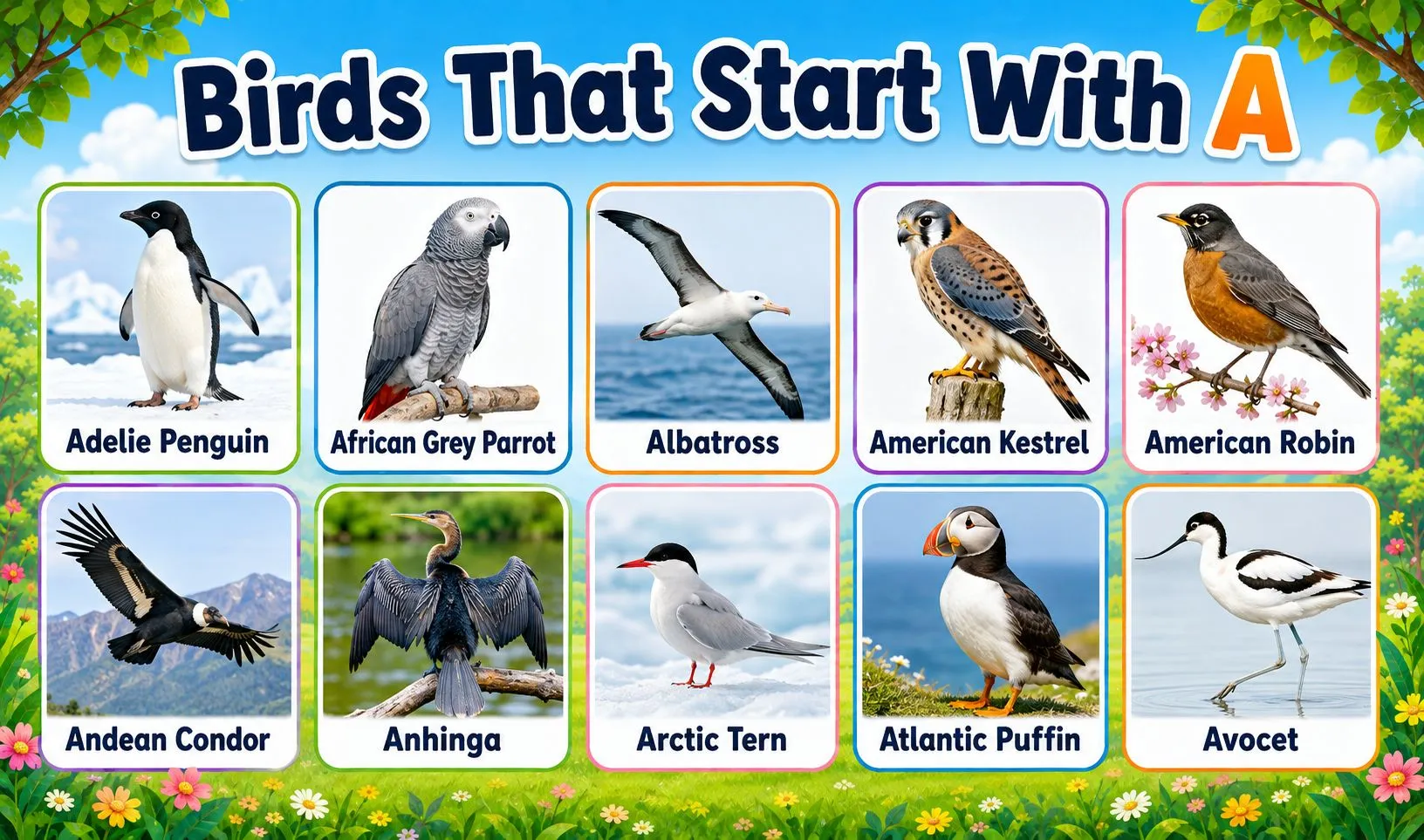
Birds that start with A include the albatross, avocet, anhinga, African grey parrot, American robin, American kestrel, Arctic tern, Atlantic puffin, and Australian magpie. The letter also begins less familiar bird names, including the Abyssinian Ground Hornbill and Azure-winged Magpie.
These birds have surprisingly little in common beyond their names. Some hunt insects among tree branches, others search for food underwater, and a few spend much of their lives crossing oceans. The Arctic Tern travels between polar regions, while the Acorn Woodpecker stores food in carefully drilled holes in trees.
Below are 25 birds that begin with A, along with their scientific names, natural habitats, identifying features, and interesting facts.
The list includes individual species and a few broader bird groups, so you can distinguish an everyday bird name from a scientific classification.
Quick List of 25 Birds That Start With A
| Bird name | Scientific name | Main habitat or region |
|---|---|---|
| Abyssinian Ground Hornbill | Bucorvus abyssinicus | African savannas |
| Acorn Woodpecker | Melanerpes formicivorus | Oak woodlands, Americas |
| Adélie Penguin | Pygoscelis adeliae | Antarctica |
| African Fish Eagle | Icthyophaga vocifer | African lakes and rivers |
| African Grey Parrot | Psittacus erithacus | Central African forests |
| African Jacana | Actophilornis africanus | African freshwater wetlands |
| African Penguin | Spheniscus demersus | Southern African coasts |
| Albatross | Family Diomedeidae | Southern Ocean, North Pacific |
| American Avocet | Recurvirostra americana | North American wetlands |
| American Bittern | Botaurus lentiginosus | North American marshes |
| American Coot | Fulica americana | North and Central American wetlands |
| American Crow | Corvus brachyrhynchos | North America |
| American Flamingo | Phoenicopterus ruber | Caribbean and nearby regions |
| American Goldfinch | Spinus tristis | North America |
| American Kestrel | Falco sparverius | The Americas |
| American Redstart | Setophaga ruticilla | North and Central America, Caribbean |
| American Robin | Turdus migratorius | North America |
| Andean Condor | Vultur gryphus | Western South America |
| Anhinga | Anhinga anhinga | American freshwater wetlands |
| Anna’s Hummingbird | Calypte anna | Western North America |
| Arctic Tern | Sterna paradisaea | Arctic and Antarctic regions |
| Atlantic Puffin | Fratercula arctica | North Atlantic |
| Australian Magpie | Gymnorhina tibicen | Australia |
| Australian Pelican | Pelecanus conspicillatus | Australia and nearby regions |
| Azure-winged Magpie | Cyanopica cyanus | East Asia |
This is a representative selection, not a complete scientific inventory. Many additional species have English names beginning with A. The number also depends on how a list treats general names such as albatross compared with individual species names such as American Avocet.
25 Birds Beginning With A and Their Unique Characteristics
1. Abyssinian Ground Hornbill
The Abyssinian Ground Hornbill is an imposing African bird with black plumage, a large curved bill, and patches of bare, brightly colored skin around its face and throat. Males have blue and red facial coloring, while females have predominantly blue bare skin.
Unlike many hornbills, this species spends much of its time walking through grasslands and savannas rather than moving through forest canopies.
It feeds on a wide variety of small animals, including reptiles, insects, and rodents. Its powerful bill helps it capture and handle prey.
Although capable of flight, the Abyssinian Ground Hornbill is strongly adapted to life on the ground. Its long legs allow it to cover considerable distances while searching for food.
It is one of two living ground hornbill species, the other being the Southern Ground Hornbill.
2. Acorn Woodpecker
The Acorn Woodpecker lives in oak-rich woodlands of western North America and parts of Central America. It has a distinctive black-and-white face, red crown, and a sharp bill used for drilling into wood.
Its most interesting behavior is food storage.
Instead of hiding acorns in scattered places, Acorn Woodpeckers often create communal storage sites called granaries. They drill numerous holes in tree trunks or wooden structures and fit an individual acorn into each opening.
These granaries may contain thousands of acorns, and family groups defend them against other birds and animals.
Their social organization is equally unusual. Several adult birds may cooperate in caring for young, and some groups contain multiple breeding males and females. Cornell Lab of Ornithology describes this communal breeding system as one of the species’ defining characteristics.
3. Adélie Penguin
The Adélie Penguin is a small Antarctic penguin identified by its black head, white belly, and narrow white ring around each eye.
One of its most recognizable behaviors is nest construction. Adélie Penguins gather small stones to build raised nests on rocky, ice-free breeding grounds.
The stones help keep eggs above wet ground and melting snow. Because suitable nesting material can be valuable within crowded colonies, penguins sometimes take stones from neighboring nests.
Adélie Penguins are also highly capable swimmers. They chase krill and small fish underwater, using their flipper-like wings for propulsion.
Although they live in one of Earth’s coldest regions, they must still manage overheating during active periods or unusually warm weather. Their dense feathers and insulating fat provide excellent protection against cold but can become a disadvantage when temperatures rise.
4. African Fish Eagle
The African Fish Eagle is a large bird of prey commonly found near freshwater lakes, rivers, and reservoirs across sub-Saharan Africa.
Adults have rich brown bodies, white heads and chests, and powerful yellow feet equipped with curved talons.
Its name accurately reflects an important part of its diet. African Fish Eagles often catch fish close to the water’s surface, using their sharp talons to grip slippery prey.
They don’t always consume fish, though. Depending on availability, they may also eat waterbirds and other animals or scavenge.
One of the easiest ways to recognize an African Fish Eagle is by its loud, distinctive call, frequently heard around large African lakes.
The bird’s strong association with freshwater environments makes it an important predator within aquatic ecosystems.
5. African Grey Parrot
The African Grey Parrot is a medium-sized forest bird with layered gray feathers, pale facial skin, and a striking red tail.
This parrot is especially well known for its ability to imitate sounds, including human speech. But vocal imitation is only one aspect of its behavior.
African Grey Parrots are highly social birds that communicate through varied calls and complex interactions within flocks.
Research involving African grey parrots has also explored their abilities to associate words with objects, colors, numbers, and categories under controlled conditions.
In the wild, these parrots feed on fruits, nuts, seeds, and other plant material.
Their intelligence has contributed to their popularity in captivity, but the international wildlife trade and habitat loss have placed serious pressure on wild populations.
6. African Jacana
The African Jacana is an unusual wetland bird with extremely long toes and claws.
These extended toes distribute its weight across floating leaves and other aquatic vegetation, allowing it to walk over surfaces that would not support many other birds.
African Jacanas live around lakes, swamps, and shallow freshwater wetlands where water lilies and similar plants are abundant.
Their breeding system is particularly interesting. Females may mate with several males, while males take much of the responsibility for incubating eggs and caring for chicks.
When danger approaches, a male may shelter chicks beneath his wings and carry them away, leaving their long legs dangling below his body.
The species is a useful example of how foot structure and parental behavior can evolve in response to a particular environment.
7. African Penguin
The African Penguin is a flightless seabird native to the coast of southern Africa.
Unlike Antarctic penguins, it inhabits a comparatively warm region, where it must balance the need to retain body heat while swimming with the need to avoid overheating on land.
Its black-and-white plumage includes distinctive spots on the chest. The pattern differs between individuals and can help researchers recognize particular birds.
African Penguins also have patches of bare skin above their eyes that help release excess body heat.
They feed mainly on small schooling fish, including sardines and anchovies.
Their conservation outlook is serious. Declining food availability, environmental pressures, and disturbances around breeding colonies have contributed to major population losses.
8. Albatross
Albatrosses are a family of ocean-going seabirds whose bodies are remarkably well suited to extended flights over open water.
Rather than constantly flapping their wings, they take advantage of changing wind speeds above ocean waves through a technique called dynamic soaring.
This allows them to cover enormous distances while using relatively little energy.
Their elongated wings are ideal for gliding but make maneuvering on land more awkward than it is for smaller birds.
Albatrosses also have a specialized tendon mechanism that helps hold their wings extended with reduced muscular effort.
Most species feed on marine animals, including squid, fish, and other food available near the ocean surface.
Because albatrosses travel so widely, fishing practices and environmental conditions far from their nesting colonies can influence their survival.
9. American Avocet
The American Avocet is a slender shorebird with long bluish-gray legs, a black-and-white body, and an unmistakably upturned bill.
During the breeding season, its head and neck develop a warm cinnamon color. Outside that season, those feathers become paler.
Its curved bill serves a practical purpose.
American Avocets often feed by sweeping their bills from side to side through shallow water, capturing small aquatic invertebrates.
They commonly nest on the ground in open wetland habitats, sometimes where shade is limited.
To help protect eggs from excessive heat, adults may wet their belly feathers before returning to the nest. Cornell documents this behavior along with the species’ distinctive feeding movements.
Interested in how birds use their unusually long legs? Our guide to birds with long legs compares 20 species and explains how their anatomy supports wading, feeding, and running.
10. American Bittern
The American Bittern is a secretive marsh bird with streaked brown-and-buff feathers that closely resemble surrounding reeds.
Its camouflage is particularly effective when the bird stands motionless with its bill pointing upward.
By extending its neck and blending its striped body into the vegetation, an American Bittern can be difficult to detect even at a relatively short distance.
It hunts small fish, amphibians, insects, and other wetland animals, usually by moving slowly through shallow water.
The bird is also famous for its unusual low-pitched call, often described as a series of hollow, pumping sounds.
American Bitterns are members of the heron family, although their stocky appearance and concealed behavior differ from the more conspicuous herons commonly seen standing in open water.
11. American Coot
The American Coot is a dark, duck-like waterbird with a white bill and red eyes.
At first glance, it may resemble a small black duck, but it belongs to the rail family, Rallidae.
Its feet reveal an especially important difference.
Rather than having the broad webbing typical of ducks, American Coots possess long toes bordered by flexible lobes of skin.
These lobes help propel them through water while also making movement over muddy ground easier.
Coots can gather in large flocks on lakes and reservoirs, where they feed on aquatic plants and other available food.
Their distinctive feet make them a particularly useful bird for explaining why appearance alone doesn’t always reveal an animal’s closest relatives.
12. American Crow
American Crows are intelligent, adaptable black birds found in forests, farmland, parks, and urban environments across North America.
Their diet is broad, including insects, fruit, seeds, small animals, and carrion.
Crows are especially interesting because of their social behavior.
Young birds sometimes remain near their parents and help defend territories or care for younger siblings. Their family relationships can continue beyond a single breeding season.
American Crows also respond strongly to potential threats. Groups may gather around predators, giving loud alarm calls and attempting to drive them away.
Scientific research has demonstrated that crows can learn to recognize particular threatening human faces and retain those associations.
Their ability to learn from experience helps explain their success in environments heavily modified by people.
13. American Flamingo
The American Flamingo is a large, pink wading bird associated with tropical wetlands, salt lagoons, and coastal habitats.
Its long neck, elongated legs, and strongly curved bill create one of the most recognizable silhouettes among birds.
Flamingos don’t use their bills like herons or other birds that grab individual fish.
Instead, they lower their heads into the water and use specialized structures inside the bill to filter small food particles from mud and water.
Their diet includes small crustaceans, algae, and other aquatic organisms.
The pigments responsible for their pink coloration come largely from carotenoids in their food. Young flamingos are not born with the intense coloration seen in many healthy adults.
14. American Goldfinch
The American Goldfinch is a small North American finch commonly associated with open fields, woodland edges, and gardens.
Breeding males develop bright yellow plumage with a black cap and black wings. Females and nonbreeding birds are generally less vivid.
Its diet is unusually plant-focused.
American Goldfinches eat seeds from thistles, sunflowers, and many other plants. They also provide their nestlings with a primarily seed-based diet.
Their breeding season tends to begin later than that of many North American songbirds, often coinciding with the availability of seed-bearing plants and fibrous nesting material.
Cornell notes that American Goldfinches replace their body feathers twice annually, accounting for the noticeable seasonal changes in their appearance.
15. American Kestrel
The American Kestrel is North America’s smallest falcon, but it possesses the speed, sharp vision, and hunting abilities associated with larger birds of prey.
Males have blue-gray wings and warm rusty upperparts, while females are more extensively reddish-brown and barred.
One of the bird’s most useful hunting techniques is hovering.
An American Kestrel may briefly hold its position in the air while scanning the ground for insects, small mammals, or reptiles.
Its diet varies by habitat and season. Insects can be particularly important during warmer months.
American Kestrels commonly nest in cavities rather than constructing elaborate open nests. Natural tree holes and appropriately designed nest boxes can provide breeding sites.
16. American Redstart
The American Redstart is a small, active warbler that moves quickly through trees while searching for insects.
Adult males have glossy black feathers with bright orange patches on the wings, sides, and tail. Females and immature birds display grayish coloring with yellow patches.
Those bright markings aren’t purely decorative.
American Redstarts repeatedly fan and flick their tails while foraging, a behavior thought to help disturb insects hiding among leaves.
The bird then pursues the insects through quick, agile movements.
This species breeds in North American woodlands and migrates to the Caribbean, Central America, and northern South America.
Cornell describes its tail-flashing behavior as a characteristic feature of the species’ feeding strategy.
17. American Robin
The American Robin is a familiar North American thrush with a gray-brown back, reddish-orange chest, and yellow bill.
It’s particularly noticeable on lawns, where it often runs a short distance, pauses, and watches the ground before catching earthworms or other invertebrates.
Robins use several senses while locating food. They can detect prey through visual cues and other environmental information rather than relying on one simple method.
Their diet also changes seasonally.
Insects and earthworms are important during the warmer months, while fruits become a major food source at other times.
Although commonly associated with spring, American Robins do not all migrate the same distance. Some remain in northern regions through winter where adequate food is available.
18. Andean Condor
The Andean Condor is a huge South American vulture found along the Andes and nearby western regions.
Its broad wings allow it to glide efficiently on rising air currents generated by mountains and warm ground surfaces.
Andean Condors often search for food by soaring high above large landscapes rather than continuously flapping their wings.
They feed mainly on carrion, helping remove animal remains from the environment.
Their bald heads are associated with their scavenging lifestyle, although the exact advantages of bare head and neck skin can vary among vultures.
Andean Condors mature slowly and produce relatively few young compared with many smaller birds.
These life-history characteristics make population recovery difficult when adults are lost to poisoning, persecution, or other threats.
19. Anhinga
The Anhinga is a freshwater bird with a long, narrow neck and a pointed bill.
When swimming, much of its body may remain underwater, leaving only its neck and head visible above the surface. This appearance has earned it the nickname snakebird.
Anhingas catch fish underwater by using their sharp bills to spear prey.
Their plumage is less water-resistant than that of many other aquatic birds, which helps reduce buoyancy and makes underwater movement easier.
After swimming, Anhingas frequently stand with their wings extended to dry their feathers.
They can also soar surprisingly well once airborne, taking advantage of rising warm air. Cornell identifies both the species’ underwater hunting and wing-drying behavior as characteristic adaptations.
20. Anna’s Hummingbird
Anna’s Hummingbird is a small hummingbird native to western North America.
Adult males have green feathers and a brilliant iridescent pink head and throat. The color can appear surprisingly dull when viewed without direct light because the effect depends on feather structure and viewing angle.
Males perform dramatic courtship flights, climbing high into the air before diving steeply.
Near the end of the dive, their tail feathers create a distinctive sound.
Anna’s Hummingbirds are also noteworthy for their ability to survive cool conditions.
Like many hummingbirds, they can enter torpor, a temporary state in which metabolic activity and body temperature decrease to conserve energy.
Their distribution has expanded in association with flowering ornamental plants, feeders, and changes in available habitat.
21. Arctic Tern
The Arctic Tern is a slender seabird with narrow wings, a forked tail, and a black cap during the breeding season.
It is among the world’s most extraordinary long-distance migrants.
Arctic Terns breed in northern regions and spend the nonbreeding season around Antarctic waters. Rather than simply traveling in a straight line, their routes respond to winds and ocean conditions.
During migration, they search for small fish and other marine prey.
Their pole-to-pole movements allow them to take advantage of productive feeding environments during different seasons.
Arctic Terns can also live for decades, which means a single bird may complete many remarkable annual journeys over its lifetime.
22. Atlantic Puffin
The Atlantic Puffin is a compact seabird with black-and-white plumage, short wings, and a colorful bill during the breeding season.
Although it may look awkward on land, it is an excellent underwater hunter.
Puffins use their wings for propulsion beneath the surface while steering with their feet.
They are especially skilled at catching several small fish during a single diving trip.
Their bills and tongues have adaptations that allow them to hold captured fish while continuing to hunt.
Atlantic Puffins usually breed in colonies, nesting in burrows or sheltered rock crevices on islands and sea cliffs.
Outside the breeding season, they spend much of their time at sea, where their feeding and movement patterns are less visible to casual observers.
23. Australian Magpie
The Australian Magpie is a black-and-white songbird native to Australia, commonly found in grasslands, parks, agricultural areas, and suburbs.
Despite its name, it is not a close relative of the magpies in the crow family.
Instead, it belongs to the family Artamidae, which also includes butcherbirds.
Australian Magpies are known for their rich, varied songs and their ability to adapt to human-modified environments.
They feed largely on insects and other small animals, often searching lawns and open ground.
During the nesting season, some individuals aggressively defend areas near their nests. This behavior, commonly called swooping, is associated with protecting eggs and young rather than general aggression toward people.
Most Australian Magpies do not attack humans.
24. Australian Pelican
The Australian Pelican is a large waterbird with mostly white plumage, black wing markings, and an exceptionally long bill.
It inhabits coastal waters, lakes, rivers, estuaries, and inland wetlands across much of Australia.
Its bill supports a flexible throat pouch used to scoop fish and water during feeding.
Contrary to a common misconception, pelicans do not normally carry large quantities of fish long distances inside their pouches. The pouch primarily assists with capturing prey and draining water before swallowing.
Australian Pelicans can gather at temporary inland lakes when suitable breeding conditions develop after heavy rainfall.
This mobility allows them to make use of freshwater habitats that may remain dry for long periods.
The Australian Pelican holds the record for the longest bill among living birds. See how it compares with hummingbirds, curlews, toucans and other species in our guide to birds with long beaks.
25. Azure-winged Magpie
The Azure-winged Magpie is a graceful bird with a black cap, pale gray-brown body, and striking blue wings and tail.
Unlike the unrelated Australian Magpie, this bird is a true member of the crow family, Corvidae.
Azure-winged Magpies live in parts of East Asia, where they occupy open woodlands, wooded farmland, and areas with scattered trees.
They are social birds that frequently travel in small groups while searching for insects, fruit, and other food.
Their communal behavior can extend into breeding activities, with some individuals helping feed or protect young that are not their own.
The Iberian Magpie, found in Spain and Portugal, was formerly treated as part of the same species complex but is now generally recognized separately as Cyanopica cooki.
This distinction is worth remembering when reading older references that describe Azure-winged Magpies as occurring in both East Asia and the Iberian Peninsula.
Which Birds Starting With A Are the Easiest to Recognize?
Some birds on this list have distinctive features that make identification relatively straightforward.
| Bird | Most useful identification clue |
|---|---|
| Acorn Woodpecker | Red crown, black-and-white face, acorn storage holes |
| American Avocet | Long legs and upward-curving bill |
| American Bittern | Streaked camouflage and upright posture among reeds |
| American Coot | Dark body, white bill and lobed toes |
| American Flamingo | Pink feathers and strongly bent bill |
| American Goldfinch | Bright yellow breeding plumage in males |
| Anhinga | Snake-like neck and spread-wing drying posture |
| Anna’s Hummingbird | Iridescent pink head and throat on males |
| Atlantic Puffin | Large, colorful breeding-season bill |
| Azure-winged Magpie | Black cap and long, pale-blue tail |
Identification becomes more reliable when you combine appearance with habitat, behavior, and geographic location.
For example, a dark bird swimming on a lake could be a coot, duck, or another waterbird. The bill shape, foot structure, and movement pattern help separate them.
Likewise, a small bright-yellow bird isn’t automatically an American Goldfinch. Plumage changes with the season, and many unrelated birds display yellow coloration.
What Do These Birds Have in Common?
Beyond sharing the first letter of their English names, these birds demonstrate several different ways that flight, feeding, and habitat have shaped avian evolution.
Birds That Start With A and Cannot Fly
Two flightless birds in this list are the Adélie Penguin and African Penguin.
Both belong to the penguin family, Spheniscidae. Their wings function as flippers, supporting underwater movement rather than flight through the air.
They are not the only flightless birds beginning with A. The Auckland Island Teal, Anas aucklandica, is another example.
Birds That Start With A and Have Colorful Feathers
Several species have especially distinctive plumage.
The American Flamingo gets its pink coloration from dietary pigments, while Anna’s Hummingbird produces iridescent colors through microscopic feather structures.
Male American Goldfinches also change appearance with the seasons, becoming much brighter during the breeding period.
These examples illustrate an important distinction: similar-looking feather colors can arise through different biological processes.
Birds That Start With A and Live Near Water
American Avocets, American Bitterns, American Coots, Anhingas, and Australian Pelicans all use aquatic environments, but they obtain food differently.
An avocet sweeps its slender bill through shallow water for invertebrates. A bittern waits among marsh vegetation and strikes at prey. An Anhinga pursues fish underwater, while a pelican captures them with its expandable pouch.
Sharing a wetland habitat doesn’t necessarily mean sharing the same feeding strategy.
Birds That Start With A and Migrate Long Distances
The Arctic Tern is the most famous long-distance migrant on this list, but many other species also travel seasonally.
American Redstarts move between North American breeding grounds and warmer nonbreeding regions. Atlantic Puffins leave their breeding colonies and spend much of the year at sea.
Migration isn’t always a simple journey from north to south. Some birds follow ocean currents, winds, changing food supplies, or complex regional routes.
For a wider alphabetical collection covering birds, mammals, reptiles, fish, and other wildlife, explore our guide to animals with A.
Frequently Asked Questions
What are five common birds that start with A?
Five recognizable birds beginning with A are the albatross, American Robin, American Crow, American Goldfinch, and American Kestrel. The last four are North American species, while albatrosses occur across several ocean regions.
What is a small bird that starts with A?
Anna’s Hummingbird is one of the smallest birds on this list. Other relatively small species include the American Goldfinch, American Redstart, and American Kestrel.
Which bird starts with A and has a long beak?
The Australian Pelican has an exceptionally long bill, while the American Avocet has a slender upward-curving bill. Their bills serve different feeding functions.
Is an albatross a single bird species?
No. Albatrosses form the family Diomedeidae, which contains multiple species. Examples include the Wandering Albatross, Black-browed Albatross, and Laysan Albatross.
Which bird beginning with A is known for its intelligence?
The African Grey Parrot and American Crow are both known for sophisticated cognitive abilities. African Grey Parrots have been studied for vocal learning and concept association, while American Crows demonstrate complex social learning and recognition.
Are all birds beginning with A found in America?
No. They occur worldwide. African Jacanas inhabit African wetlands, Australian Pelicans live in Australia and nearby regions, Adélie Penguins breed in Antarctica, and Azure-winged Magpies inhabit East Asia.
How many bird names start with the letter A?
There is no single fixed total. The answer depends on which English common-name list is used and whether broader groups, individual species, subspecies, and regional names are counted separately.