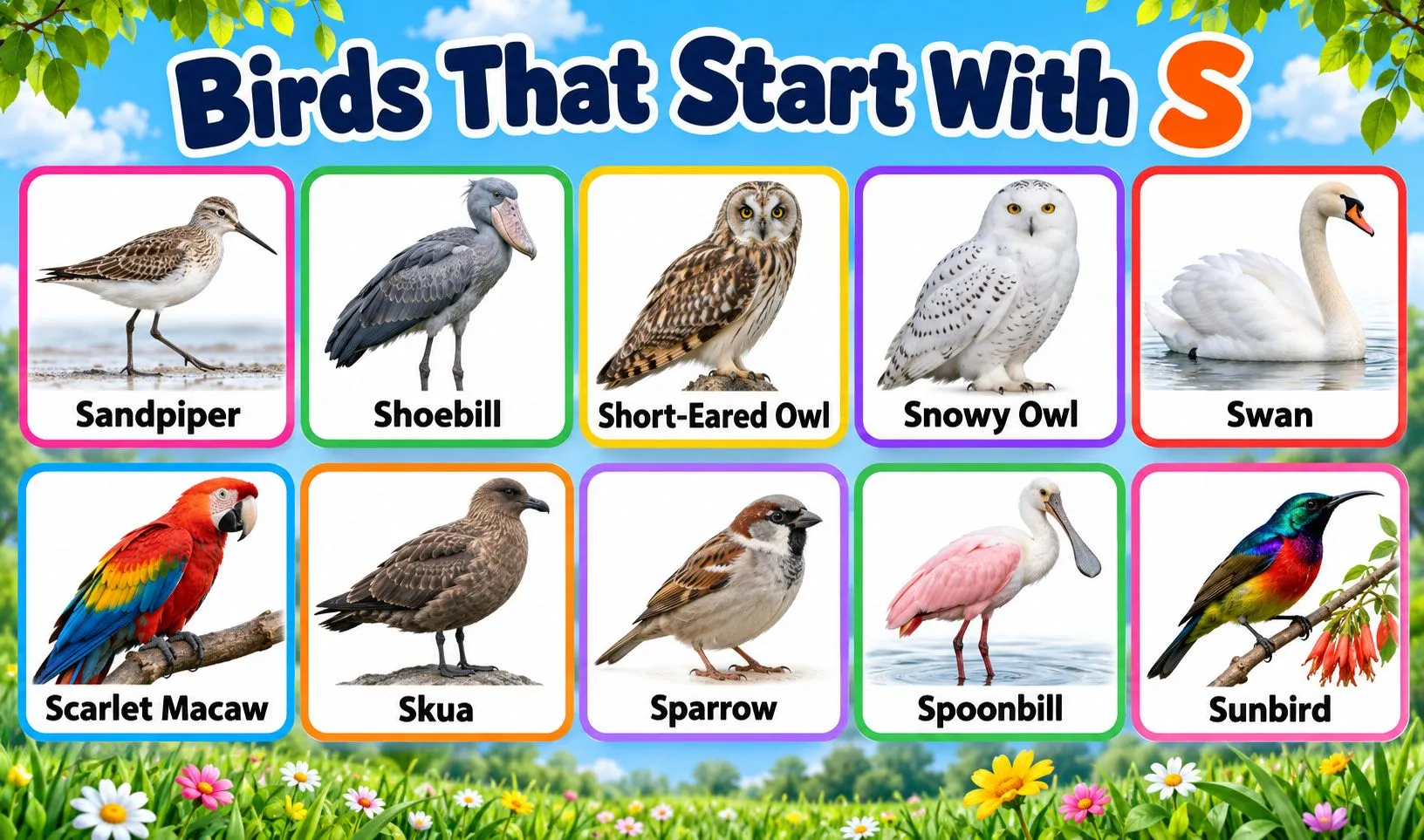
Birds that start with S include the Sandhill Crane, Secretarybird, Scarlet Macaw, Saker Falcon, Satin Bowerbird, Sanderling, and Spoon-billed Sandpiper. These birds range from powerful grassland hunters and colorful rainforest parrots to tiny shorebirds that search for food along tidal flats.
Some have unusual hunting techniques. The Secretarybird hunts on foot, using its long legs to strike at prey, while the Satin Bowerbird builds and decorates a display structure to attract a mate. Others have remarkable migrations or depend on habitats that are under pressure from human activity.
This guide covers 15 birds beginning with S, including their scientific names, where they live, how to recognize them, and what makes each one distinctive.
Quick List of 15 Birds That Start With S
| Bird name | Scientific name | Main habitat |
|---|---|---|
| Sandhill Crane | Antigone canadensis | North American wetlands and grasslands |
| Sanderling | Calidris alba | Sandy beaches and coastal flats |
| Sand Martin | Riparia riparia | Rivers, lakes, and open country |
| Satin Bowerbird | Ptilonorhynchus violaceus | Eastern Australian forests |
| Scarlet Macaw | Ara macao | Central and South American forests |
| Secretarybird | Sagittarius serpentarius | African grasslands and savannas |
| Saker Falcon | Falco cherrug | Open grasslands and steppe |
| Snow Bunting | Plectrophenax nivalis | Arctic tundra and rocky coasts |
| Snow Petrel | Pagodroma nivea | Antarctic and Southern Ocean environments |
| Song Sparrow | Melospiza melodia | Shrublands, marsh edges, and gardens |
| Southern Cassowary | Casuarius casuarius | Tropical rainforests of New Guinea and northeastern Australia |
| Spoon-billed Sandpiper | Calidris pygmaea | Arctic breeding grounds and Asian coastal wetlands |
| Steller’s Sea Eagle | Haliaeetus pelagicus | Northeastern Asian coasts and rivers |
| Superb Starling | Lamprotornis superbus | East African savannas and open woodland |
| Sunbird | Family Nectariniidae | Africa, Asia, and nearby tropical regions |
Note: Sunbird is a family-level common name covering many species. The other entries are individual bird species.
15 Birds Beginning With S and Their Unique Characteristics
1. Sandhill Crane
The Sandhill Crane is a tall, long-legged bird native to North America and parts of northeastern Siberia. Adults have gray plumage, a red patch of bare skin on the forehead, and a long neck that gives them a distinctive silhouette.
Sandhill Cranes use wetlands for breeding and roosting, but they also forage in grasslands and agricultural fields. Their diet includes seeds, grains, insects, and other small animals.
One of their most memorable behaviors is their elaborate courtship dance. A crane may bow, spread its wings, jump into the air, and toss a stick or piece of vegetation. These displays help strengthen pair bonds and can occur outside courtship as well.
Their calls are equally distinctive. A long, coiled windpipe contributes to the resonant, bugling sound that carries across open landscapes.
Sandhill Cranes also gather in large flocks during migration, making suitable stopover wetlands and feeding grounds important to their annual movements.
Interesting fact: Sandhill Crane chicks are precocial, meaning they can leave the nest soon after hatching and begin moving with their parents.
2. Sanderling
The Sanderling is a small shorebird often seen running along sandy beaches as waves roll in and out.
Its behavior makes it easier to identify than its subtle coloring might suggest. Instead of remaining still and probing the ground like some other waders, a Sanderling often chases retreating waves to pick up tiny marine invertebrates before darting away from the next wave.
In winter, its plumage is mostly pale gray and white. During the breeding season, it develops warmer reddish-brown markings on the head and upperparts.
Sanderlings breed in the Arctic and migrate long distances to coastal regions around the world. Their seasonal journeys connect northern tundra with beaches, estuaries, and tidal flats in lower latitudes.
Because they feed along exposed shorelines, disturbance from beach traffic, dogs, and coastal development can affect their access to food and resting places.
Interesting fact: Watch a Sanderling on a beach for a few minutes, and you may see it repeatedly race toward the water and retreat with the waves. This is an efficient way to find prey exposed by moving water.
3. Sand Martin
The Sand Martin, known as the Bank Swallow in North America, is a small migratory bird with brown upperparts, pale underparts, and a narrow brown band across its chest.
It catches flying insects while moving rapidly over rivers, lakes, wetlands, and open fields.
Its nesting method is particularly distinctive. Sand Martins excavate tunnels into exposed banks of sand or soft soil, often along river edges or in suitable sandy cliffs. They create a nesting chamber at the end of the tunnel, where they lay eggs and raise their chicks.
These colonies can contain many nesting pairs, although the size of a colony depends on the availability and stability of suitable banks.
Sand Martins rely on a combination of safe nesting faces and abundant flying insects. Erosion, river engineering, and the removal of natural banks can change the availability of nesting habitat.
Interesting fact: Unlike many songbirds that use existing cavities, Sand Martins can dig their own nesting tunnels in loose, workable soil.
4. Satin Bowerbird
The Satin Bowerbird is an Australian songbird famous for its courtship behavior.
Adult males have glossy blue-black plumage and striking violet-blue eyes. Females and young birds are more subdued, with greenish-brown plumage and pale markings that provide camouflage among foliage.
The male builds a structure called a bower from sticks. This is not a nest for raising chicks. Instead, it serves as a display area where the male attempts to attract a female.
He decorates the surrounding space with objects that may include blue feathers, berries, flowers, and human-made items. He also performs displays and vocalizations near the bower.
Females inspect potential mates and their display sites before deciding where to mate. After mating, the female builds a separate nest and raises the young without the male’s direct parental care.
The bower’s arrangement and decoration reveal how mate choice can influence animal behavior.
Interesting fact: A Satin Bowerbird’s bower is a courtship display structure, not a nest. Confusing the two misses one of the most unusual aspects of this species’ biology.
5. Scarlet Macaw
The Scarlet Macaw is one of the most recognizable parrots of Central and South America. Its bright red plumage, yellow wing panels, blue flight feathers, large hooked bill, and long tail make it easy to distinguish from most other forest birds.
Scarlet Macaws use their strong bills to open hard fruits, nuts, and seeds. Their feet are also highly adapted for handling food, allowing them to grip an item while manipulating it with the bill.
They often travel in pairs or small groups and can form larger gatherings where food is abundant.
Like many large parrots, Scarlet Macaws nest in tree cavities. They depend on mature trees that provide suitable hollows, which means logging and the loss of old-growth forest can affect breeding opportunities even when some forest cover remains.
The species also faces pressure from trapping and the illegal wildlife trade in parts of its range.
Interesting fact: A parrot’s feet are zygodactyl, with two toes pointing forward and two backward. This arrangement helps Scarlet Macaws grip branches and hold food while eating.
6. Secretarybird
The Secretarybird is a large African bird of prey with exceptionally long legs, a hooked bill, and dark feathers projecting from the back of its head.
Unlike eagles and many hawks that catch prey with their feet, the Secretarybird spends much of its hunting time walking across open grassland.
It feeds on insects, small mammals, reptiles, and other animals. Snakes are a well-known part of its diet, but it is not exclusively a snake hunter.
When attacking prey, the Secretarybird can deliver forceful downward strikes with its feet. Its long legs help it move through grass while keeping its body relatively high above the ground.
It usually builds a large stick nest in a tree or tall shrub, often returning to familiar territories.
Although it is a powerful terrestrial hunter, it can fly well and may travel between feeding areas.
The species faces threats from habitat conversion, collisions with infrastructure, and other pressures associated with changing open landscapes.
Interesting fact: The Secretarybird’s hunting style is unusual among birds of prey because it often subdues prey with repeated foot strikes rather than relying primarily on a talon grip.
7. Saker Falcon
The Saker Falcon is a large falcon associated with open landscapes across parts of Europe, Central Asia, and Asia.
Its brown upperparts, pale underside, broad wings, and powerful build distinguish it from many smaller falcons. Individual appearance varies with age and region.
Saker Falcons hunt birds and small mammals, often using speed and controlled pursuit to capture prey. They may hunt from a perch or fly across open terrain while searching for movement.
Their natural habitats include steppe, grassland, semi-desert, and other open country where prey is accessible.
The species has a long history in falconry, particularly across parts of Eurasia and the Middle East. Demand for falcons, along with habitat changes and electrocution on power infrastructure, has contributed to conservation concerns in some regions.
Interesting fact: The Saker Falcon is adapted to hunting across open country. Its broad wings and strong flight allow it to pursue prey over grasslands and steppe rather than relying on forest cover.
8. Snow Bunting
The Snow Bunting is a hardy songbird that breeds in Arctic regions and spends the colder season farther south in open country.
Breeding males can appear strikingly white with black wing markings, while females and nonbreeding birds have more brown and buff tones.
Snow Buntings often forage on the ground, feeding on seeds and small invertebrates. During the breeding season, insects provide important food for growing chicks.
They nest in cavities and crevices among rocks, where the surrounding terrain offers some protection from weather and predators.
In winter, Snow Buntings gather in flocks and may feed in fields, along coastlines, or on windswept ground where seeds remain accessible.
Their seasonal distribution reflects the availability of food and suitable breeding sites in extreme northern environments.
Interesting fact: Snow Buntings are among the songbirds that breed farthest north. Their ability to use exposed, rocky Arctic terrain allows them to occupy places with very short summers.
9. Snow Petrel
The Snow Petrel is a small seabird associated with Antarctica and the Southern Ocean.
Its white plumage, black bill, and dark eyes create a clean appearance against ice and snow. It spends much of its life at sea, returning to land to breed on rocky ledges and cliffs.
Snow Petrels feed on a variety of marine food, including small fish, crustaceans, and other organisms available near the surface of the ocean.
They can fly over icy waters and use coastal cliffs or exposed rocky areas for nesting, often in places inaccessible to many land predators.
Their breeding colonies are closely tied to the availability of suitable ice-free nesting sites. Changes in local snow and ice conditions can affect access to those areas.
Interesting fact: Snow Petrels can be seen in some of the coldest marine environments on Earth, yet they still depend on productive ocean waters for food.
10. Song Sparrow
The Song Sparrow is a familiar North American bird found in a wide range of habitats, including gardens, marsh edges, thickets, and open woodland.
Its brown-and-gray plumage is marked by heavy streaks on the breast, often forming a darker central spot. This pattern can help distinguish it from other small brown sparrows.
The species is known for its varied song. Males produce a series of clear notes, trills, and buzzes, with patterns that differ between individuals and geographic regions.
Song Sparrows usually forage on or near the ground, searching for seeds and insects. During the breeding season, insects are particularly important for feeding chicks.
They nest in low vegetation or shrubs, though nesting sites vary with habitat.
Because the species occupies many environments, local populations can differ noticeably in size, coloration, and song.
Interesting fact: Song Sparrows from different regions may have noticeably different song patterns. Their vocalizations are useful for studying how bird communication varies across a species’ range.
11. Southern Cassowary
The Southern Cassowary is a large, flightless bird found in tropical rainforests of northeastern Australia and New Guinea.
It has coarse black feathers, a tall helmet-like structure called a casque on its head, bright blue skin on the neck, and red wattles hanging from the throat.
Cassowaries mainly eat fruit, although they also consume fungi, invertebrates, and other available food. They swallow many fruits whole, passing seeds through their digestive systems and depositing them elsewhere.
This makes them important seed dispersers for some rainforest plants, especially those with large fruits that smaller birds cannot swallow.
Cassowaries are generally solitary outside breeding interactions and can move quietly through dense forest despite their size.
They are capable of running quickly through vegetation and have powerful legs with sharp claws. They should be observed from a safe distance in the wild.
Interesting fact: The Southern Cassowary helps move large seeds through tropical forests, linking its feeding behavior directly to rainforest regeneration.
12. Spoon-billed Sandpiper
The Spoon-billed Sandpiper is a tiny migratory shorebird named for its distinctive bill, which broadens at the tip into a small spatula shape.
It breeds in coastal areas of northeastern Russia and migrates along the East Asian–Australasian Flyway to wintering areas in Southeast Asia.
The spoon-shaped bill is its most recognizable feature. While feeding, the bird sweeps or probes the surface of wet mud and shallow water, collecting small invertebrates.
This specialized feeding method makes suitable intertidal habitat especially important.
The species is critically endangered, with threats including the loss and degradation of coastal wetlands, disturbance, and hunting along parts of its migration route. Conservation work has included habitat protection, monitoring, captive breeding, and releases in carefully managed programs.
Its survival depends on multiple countries protecting connected habitats rather than a single breeding site.
Interesting fact: The Spoon-billed Sandpiper is one of the world’s most distinctive shorebirds, but its unusual bill is more than an identifying feature: it is part of the bird’s specialized feeding equipment.
Birds have evolved some remarkably different bill shapes. Explore more examples, from sensitive probing bills to specialized fish-catching structures, in our guide to birds with long beaks.
13. Steller’s Sea Eagle
Steller’s Sea Eagle is a massive eagle native to northeastern Asia, particularly coastal regions and river systems around the Russian Far East and nearby areas.
It has dark brown plumage, conspicuous white shoulder and tail markings, and a large yellow bill.
Fish form a major part of its diet, although it also eats waterbirds and scavenges when opportunities arise. It often hunts near rivers, lakes, and coastlines where fish are accessible.
Some populations move seasonally, following food availability and changing ice conditions. Winter concentrations can occur around places where fish remain accessible in cold weather.
Because the species depends on productive waters and suitable nesting trees, changes to river systems, disturbance, and other environmental pressures can affect local populations.
Interesting fact: Steller’s Sea Eagle’s enormous bill and strong feet are well suited to handling large fish, making it one of the most impressive fish-eating raptors.
14. Superb Starling
The Superb Starling is a colorful bird native to East Africa, including parts of Kenya, Tanzania, and neighboring countries.
Its glossy blue-green upperparts, orange breast, white belly, and dark head make it easy to recognize.
Superb Starlings live in open woodland, savanna, scrub, and areas near human settlements. They eat insects, fruit, and other small food items, often foraging on the ground.
They are social birds and may form noisy groups, particularly where food is abundant. Their bright plumage contrasts with the dry landscapes they often inhabit.
In some populations, cooperative breeding occurs: individuals other than the breeding pair may help care for young. The degree of cooperation varies by group and circumstance.
Interesting fact: The starling’s glossy colors are influenced by the way light interacts with its feather structure, so the bird can appear to shift in color as the viewing angle changes.
15. Sunbird
Sunbirds are a family of small, often brightly colored birds found across Africa, Asia, and nearby tropical regions.
Many species have slender, curved bills and brush-tipped tongues that help them feed on nectar. They also eat insects and spiders, particularly when raising young.
Male sunbirds in many species display iridescent colors, including green, blue, purple, and red. Females are often duller, which can help with camouflage around nests.
Sunbirds are ecological counterparts to hummingbirds in some respects, but they are not closely related to them. Hummingbirds belong to the Americas, while sunbirds evolved in the Old World.
Many sunbirds perch while feeding, visiting flowers in gardens, woodland, scrub, and forest edges. Some plants benefit from this relationship when pollen is transferred between flowers.
Interesting fact: Sunbirds and hummingbirds both feed on nectar, but they evolved this feeding strategy independently in different parts of the world.
How to Identify Birds That Start With S
Bird identification becomes easier when you look at several clues together rather than relying on color alone.
| What you notice | Bird to consider | Useful identification clue |
|---|---|---|
| Very long legs and a red-and-black head | Secretarybird | Walks through open grassland while hunting |
| Small shorebird chasing waves | Sanderling | Runs along the water’s edge |
| Tiny bird with a spoon-shaped bill | Spoon-billed Sandpiper | Broad, spatulate bill tip |
| Bright red parrot with yellow and blue wings | Scarlet Macaw | Long tail and powerful hooked bill |
| Glossy dark male decorating a stick structure | Satin Bowerbird | Bower-building courtship behavior |
| Large white-and-dark eagle with a yellow bill | Steller’s Sea Eagle | Massive fish-eating raptor |
| Small brown bird with heavy breast streaks | Song Sparrow | Streaks often form a central breast spot |
| Flightless rainforest bird with a casque | Southern Cassowary | Bright blue neck and red wattles |
| White bird in Antarctic waters | Snow Petrel | Pure white plumage and dark bill |
When identifying a bird, also consider the location and season. A bird seen on a tropical coast is unlikely to be the same species as a similar-looking bird in Arctic tundra.
What Makes These S Birds Special?
Birds That Hunt in Unusual Ways
The Secretarybird hunts on foot, striking prey with its powerful legs. The Saker Falcon pursues prey across open terrain, while Steller’s Sea Eagle uses its large bill and feet to capture fish.
These species demonstrate how different body shapes can support different hunting strategies.
Birds With Unusual Bills
The Spoon-billed Sandpiper has a broadened bill tip that helps it collect small prey from mud and shallow water. The Scarlet Macaw uses a strong hooked bill to open tough fruits and seeds.
The shape of a bird’s bill is often closely related to its diet, although bill structure alone doesn’t tell the whole story.
Birds That Build or Decorate Structures
The Satin Bowerbird is notable for building a bower as a courtship display. The structure helps the male attract a mate but is separate from the nest where the female lays eggs.
Sand Martins also build in a distinctive way, digging tunnels into suitable banks rather than relying on existing tree cavities.
Birds That Depend on Migration Routes
The Sanderling and Spoon-billed Sandpiper rely on coastal habitats along long migration routes. Snow Buntings move between Arctic breeding areas and wintering grounds farther south.
For migratory birds, conservation must consider breeding areas, stopover sites, and wintering habitat as connected parts of the same annual cycle.
For a wider list of wildlife across different animal groups, see our guide to animals that start with S.
Frequently Asked Questions
What are five birds that start with S?
Five examples are the Sandhill Crane, Scarlet Macaw, Secretarybird, Saker Falcon, and Snow Bunting. Other birds beginning with S include the Satin Bowerbird, Sanderling, Song Sparrow, and Southern Cassowary.
What is a colorful bird that starts with S?
The Scarlet Macaw is a striking example, with red, yellow, and blue plumage. The Superb Starling also has vivid blue-green and orange coloring, while many sunbird species show iridescent feathers.
What is a bird that starts with S and has a spoon-shaped bill?
The Spoon-billed Sandpiper has a distinctive spatula-shaped bill tip. It feeds on small invertebrates in coastal mudflats and shallow water.
Which bird starting with S is flightless?
The Southern Cassowary is a large flightless bird native to tropical rainforests of New Guinea and northeastern Australia.
What bird that starts with S hunts snakes?
The Secretarybird is well known for hunting snakes and other small animals on foot. It uses its long legs and powerful feet to strike and subdue prey.
What is a small bird that starts with S?
The Sanderling, Sand Martin, Snow Bunting, and Song Sparrow are relatively small birds beginning with S. They occupy very different habitats, from beaches and riverbanks to Arctic tundra and shrubby areas.
How many birds start with the letter S?
There is no single fixed number. The total depends on the bird checklist used and whether broad groups, individual species, regional common names, and alternative names are counted separately.