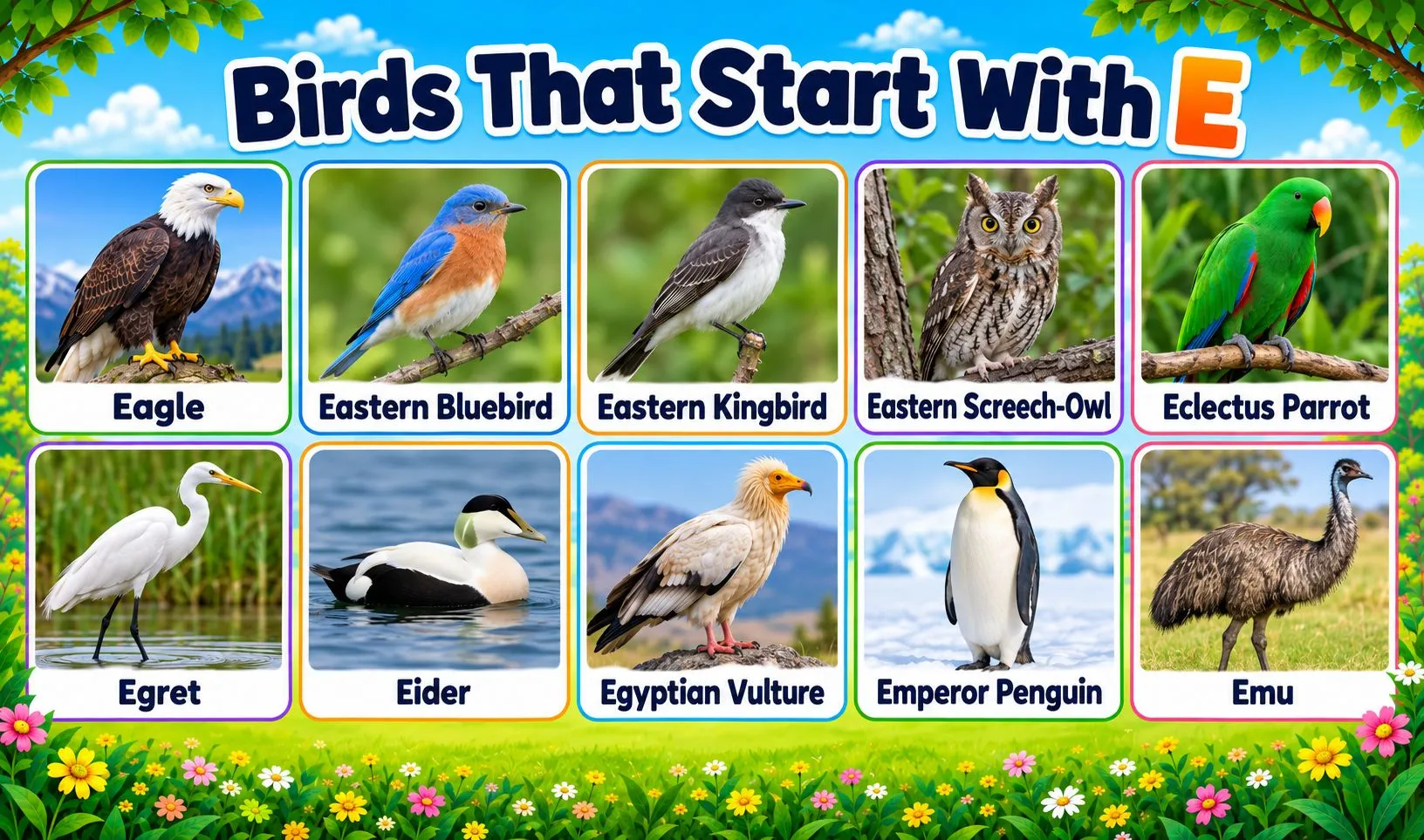
Birds that start with E include the eagle, egret, eider, emu, emperor penguin, Eastern Bluebird, Eastern Kingbird, Eastern Phoebe, Eclectus parrot, Egyptian vulture, and Evening Grosbeak.
Some are easy to recognize. Eagles are known for their powerful talons, while emus are large, flightless birds native to Australia. Others are less familiar, such as the Eared Grebe, a diving waterbird that spends part of the year temporarily unable to fly, and the Eastern Kingbird, a small flycatcher that aggressively defends its nesting territory.
This list features 25 birds beginning with E, including their scientific names, habitats, distinguishing features, and interesting behaviors. Some names refer to groups of birds, while others identify individual species.
Quick List of 25 Birds That Start With E
| Bird name | Scientific name | Where found |
|---|---|---|
| Eagle | Multiple genera | Worldwide except Antarctica |
| Eared Grebe | Podiceps nigricollis | Europe, Asia, Africa, Americas |
| Eastern Bluebird | Sialia sialis | North and Central America |
| Eastern Kingbird | Tyrannus tyrannus | Americas |
| Eastern Meadowlark | Sturnella magna | Americas |
| Eastern Phoebe | Sayornis phoebe | North America |
| Eastern Screech-Owl | Megascops asio | Eastern North America |
| Eastern Towhee | Pipilo erythrophthalmus | Eastern North America |
| Eastern Wood-Pewee | Contopus virens | Americas |
| Eclectus Parrot | Eclectus species | Australasian region |
| Egret | Multiple genera | Worldwide except Antarctica |
| Egyptian Goose | Alopochen aegyptiaca | Africa; introduced elsewhere |
| Egyptian Vulture | Neophron percnopterus | Europe, Africa, Asia |
| Eider | Somateria species | Northern coastal regions |
| Emerald Dove | Chalcophaps indica | South and Southeast Asia |
| Emerald Toucanet | Aulacorhynchus prasinus | Central America |
| Emperor Goose | Anser canagicus | Alaska and northeastern Asia |
| Emperor Penguin | Aptenodytes forsteri | Antarctica |
| Emu | Dromaius novaehollandiae | Australia |
| Eurasian Eagle-Owl | Bubo bubo | Europe and Asia |
| Eurasian Hoopoe | Upupa epops | Europe, Asia, parts of Africa |
| European Bee-eater | Merops apiaster | Europe, Africa, western Asia |
| European Goldfinch | Carduelis carduelis | Europe, North Africa, Asia |
| European Robin | Erithacus rubecula | Europe and nearby regions |
| Evening Grosbeak | Hesperiphona vespertina | North America |
The list includes both individual species and broader bird groups. For example, the emu is a single living species, whereas eagle, egret, and eider can refer to several species. Common names beginning with Eastern, European, or Eurasian are included because the complete English bird name starts with E.
Eagle
Eagles are powerful birds of prey recognized by their hooked beaks, strong feet, and sharp talons. They occur across much of the world, inhabiting mountains, forests, grasslands, and coastal environments.
The name eagle doesn’t refer to one species. It describes numerous raptors, including the golden eagle, bald eagle, and harpy eagle.
Different eagles have different hunting strategies. Golden eagles pursue mammals and birds, while bald eagles frequently capture fish and sometimes scavenge. Their sharp vision helps them locate prey from considerable distances.
Although eagles are usually associated with large size, not every eagle is exceptionally large. Their diets, body proportions, and habitats vary considerably between species.
Eared Grebe
- Scientific name: Podiceps nigricollis
- Habitat: Lakes, ponds, and saline wetlands
The Eared Grebe is a small diving bird with red eyes, a slender bill, and striking golden feathers that fan out behind its eyes during the breeding season.
Despite its name, it doesn’t have visible external ears. The golden breeding feathers create the ear-like appearance.
Eared Grebes feed on aquatic invertebrates, including brine shrimp. During migration, enormous numbers gather at saline lakes such as Utah’s Great Salt Lake and California’s Mono Lake.
One of their most unusual characteristics is their seasonal change in flight ability. Cornell Lab of Ornithology explains that Eared Grebes can become temporarily flightless for extended periods while building fat reserves. Their flight muscles shrink during this feeding stage and develop again before migration.
Eastern Bluebird
- Scientific name: Sialia sialis
- Habitat: Open woodlands, meadows, pastures, and gardens
The Eastern Bluebird is a small thrush with a bright blue back, rusty-orange chest, and white belly. Females have softer gray-blue coloring, making them less conspicuous than males.
These birds are common in open areas of eastern North America, where they often perch on fences or wires before dropping to the ground to catch insects.
Eastern Bluebirds are cavity nesters, meaning they raise their young inside holes in trees or suitable nest boxes.
Unlike many familiar backyard birds, they don’t rely heavily on ordinary seed feeders. Insects form a large part of their diet, although berries and other fruits become important during colder months.
According to the Cornell Lab of Ornithology, bluebirds readily use appropriately placed nest boxes, making them a familiar species in bird conservation and backyard birdwatching.
Eastern Kingbird
- Scientific name: Tyrannus tyrannus
- Habitat: Grasslands, open fields, and woodland edges
The Eastern Kingbird is a medium-sized flycatcher with dark gray upperparts, a white belly, and a distinctive white band at the tip of its tail.
It may look ordinary at first glance, but its behavior is anything but timid.
Eastern Kingbirds aggressively defend their nesting territories. They sometimes chase crows, hawks, and other birds much larger than themselves.
Their feeding habits also change seasonally. During the North American breeding season, they catch flying insects. In their South American wintering grounds, fruit becomes a major part of their diet.
The species has a small patch of yellow, orange, or reddish crown feathers that is usually concealed. These feathers may become visible during aggressive displays.
Eastern Meadowlark
- Scientific name: Sturnella magna
- Habitat: Grasslands, pastures, and agricultural fields
Eastern Meadowlarks are grassland birds with bright yellow underparts and a bold black V-shaped marking across the chest.
Their upper feathers are patterned brown and black, helping them blend into dry grasses when feeding or nesting on the ground.
They’re often heard before they’re seen. Males sing clear, whistling songs from fence posts and other exposed perches.
Despite their name, meadowlarks aren’t members of the true lark family. They belong to the blackbird family, Icteridae, alongside orioles, grackles, and cowbirds.
The Eastern Meadowlark is also a species of conservation concern. Cornell identifies it as a grassland bird experiencing a substantial long-term population decline.
Emerald Toucanet
- Scientific name: Aulacorhynchus prasinus
- Habitat: Mountain forests of Central America
The Emerald Toucanet is a small member of the toucan family with bright green plumage and a noticeably large, colorful bill.
Although it resembles a miniature toucan, it is a distinct species in its own right.
Emerald Toucanets inhabit humid mountain forests, where their green feathers blend with surrounding foliage.
Fruit makes up much of their diet, but they may also consume insects and other small animal foods.
Their large bills help them reach and manipulate food. Like other toucans, they can also use their bills to handle fruit without moving their entire bodies.
Emerald Toucanets typically nest in cavities within trees.
Emperor Goose
- Scientific name: Anser canagicus
- Habitat: Arctic tundra, brackish wetlands, and coastal areas
The Emperor Goose is a relatively small, heavily patterned goose native to Alaska and northeastern Asia.
Its white head and neck contrast with a blue-gray body marked by dark feather edges. Bright orange legs make adults particularly easy to recognize.
Emperor Geese spend much of their lives close to the coast, foraging in tidal habitats and resting on beaches.
They consume marine vegetation, including eelgrass and sea lettuce, alongside small invertebrates.
During summer, the white feathers on their heads may become stained reddish-brown by iron-rich mud.
Most Emperor Geese breed in western Alaska, particularly around the Yukon-Kuskokwim Delta.
Emperor Penguin
- Scientific name: Aptenodytes forsteri
- Habitat: Antarctic sea ice and Southern Ocean waters
The Emperor Penguin is the largest living penguin species and one of the most recognizable birds of Antarctica.
Adults have black heads and backs, white bellies, and yellow-to-orange shading near the neck.
Unlike flying birds, emperor penguins use their wings as stiff flippers to propel themselves underwater.
Their breeding behavior is especially unusual. They reproduce during the Antarctic winter, when temperatures can become extremely low.
After a female lays an egg, the male typically balances it on his feet beneath a protective fold of skin while the female travels to sea to feed.
Male emperor penguins may huddle together to conserve heat during the long incubation period.
Their dependence on stable sea ice also makes them vulnerable to changes in Antarctic conditions. Early sea-ice breakup can threaten chicks before they develop waterproof feathers.
Emu
- Scientific name: Dromaius novaehollandiae
- Habitat: Grasslands, open woodlands, and scrublands of Australia
The emu is the second-tallest living bird after the ostrich.
It has long, powerful legs, a shaggy brown body, a relatively small head, and wings too reduced for flight.
Instead of escaping predators by flying, emus rely on running. Their strong legs allow them to travel rapidly across open ground.
Emus eat a varied diet that includes seeds, fruit, flowers, insects, and other available foods.
Their breeding behavior is particularly interesting because males perform most of the incubation and chick-rearing duties.
After a female lays her eggs, the male remains with the nest for weeks, incubating the clutch and later protecting the young.
Emus also help disperse seeds through their feeding and movements across Australian landscapes.
Eurasian Eagle-Owl
- Scientific name: Bubo bubo
- Habitat: Forests, rocky hillsides, cliffs, and open country
The Eurasian Eagle-Owl is among the world’s largest owl species.
It has a broad head, prominent feather tufts, orange eyes, and heavily patterned brown plumage.
Its powerful talons enable it to capture a wide range of animals, including rodents, rabbits, and other birds.
Although it is mainly active during darker hours, it may also hunt around dawn and dusk.
Eurasian Eagle-Owls are often associated with rocky landscapes, where ledges and sheltered sites provide nesting opportunities.
Their deep, resonant calls can travel considerable distances and are especially noticeable during territorial activity.
Eurasian Hoopoe
- Scientific name: Upupa epops
- Habitat: Open woodlands, grasslands, orchards, and agricultural land
The Eurasian Hoopoe is one of the easiest birds to recognize because of its fan-shaped crest, long curved bill, and boldly striped black-and-white wings.
Its body is primarily warm pinkish-brown, creating a striking contrast with its wings.
Hoopoes usually feed on the ground. They insert their slender bills into soil to locate insects, larvae, and other invertebrates.
The bill is particularly useful for probing beneath the surface without extensive digging.
Their crown feathers can be raised into an impressive crest, especially when the bird lands or becomes alert.
The Eurasian Hoopoe is also known for nesting in cavities, including holes in trees, walls, and rocky structures.
European Bee-eater
- Scientific name: Merops apiaster
- Habitat: Open countryside, riverbanks, and warm grasslands
The European Bee-eater is a colorful, slender bird with turquoise underparts, chestnut upper feathers, a yellow throat, and a narrow curved bill.
As its name suggests, it eats bees. However, it also captures wasps, dragonflies, and other flying insects.
Bee-eaters are agile aerial hunters. They catch insects in flight before returning to a perch to handle their prey.
When dealing with stinging insects, they may repeatedly strike or rub the insect against a branch before swallowing it.
European Bee-eaters frequently nest in colonies. Instead of building conventional nests in trees, they excavate tunnels in sandy banks or suitable soil.
European Goldfinch
- Scientific name: Carduelis carduelis
- Habitat: Gardens, farmland, woodland edges, and open countryside
The European Goldfinch is a small songbird with a bright red face, black-and-white head markings, and yellow wing patches.
Its relatively slender bill helps it extract seeds from plants such as thistles and teasels.
Goldfinches often gather in small flocks outside the breeding season, moving through open habitats in search of seeds.
Their flight is light and undulating, while their calls are musical and tinkling.
Because these birds feed heavily on seeds, areas with naturally growing seed-producing plants can be valuable habitats for them.
The European Goldfinch is also widely recognized in European art, literature, and traditional birdkeeping.
European Robin
- Scientific name: Erithacus rubecula
- Habitat: Woodlands, gardens, parks, and hedgerows
The European Robin is a small, round-bodied bird with an orange-red face and breast, brown upperparts, and a pale belly.
It is particularly familiar in British and European gardens, where it may approach people working in the soil.
Robins feed on insects, worms, spiders, and other small invertebrates, along with fruits when available.
Despite their friendly reputation, they can be strongly territorial.
Both males and females defend territories, sometimes using song and aggressive displays to warn off other robins.
The European Robin shouldn’t be confused with the American Robin. Although they share a common name, the American Robin belongs to the thrush family, while the European Robin is an Old World flycatcher.
Evening Grosbeak
- Scientific name: Hesperiphona vespertina
- Habitat: Coniferous and mixed forests of North America
The Evening Grosbeak is a stocky finch with a remarkably thick bill.
Males have yellow bodies, dark heads, and conspicuous white wing patches. Females are more subdued, with grayish plumage and pale yellow markings.
Their strong bills allow them to crack hard seeds that smaller finches may struggle to open.
Despite their seed-eating reputation, Evening Grosbeaks also consume insects, especially during the breeding season.
Their winter movements are irregular. Some years they remain relatively far north, while in other years large flocks move south into areas where they are seldom seen.
These unpredictable movements are known as irruptions.
Interestingly, Cornell describes the Evening Grosbeak as a songbird that relies mainly on calls rather than the elaborate territorial songs associated with many other songbirds.
How to Identify Birds That Start With E
Bird names alone rarely tell you enough to recognize a species. Appearance, behavior, habitat, and sound are often more useful.
The following characteristics can help distinguish some of the birds in this list.
| What you notice | Bird to consider |
|---|---|
| Bright blue back and rusty chest | Eastern Bluebird |
| Golden head feathers and red eyes on a diving bird | Eared Grebe |
| Small gray bird repeatedly wagging its tail | Eastern Phoebe |
| Yellow chest with a black V-shaped marking | Eastern Meadowlark |
| Large flightless bird with long running legs | Emu |
| Long curved bill and prominent feather crest | Eurasian Hoopoe |
| Black-and-white tail with a white tip on a dark flycatcher | Eastern Kingbird |
| Bright red face and yellow wing patches | European Goldfinch |
| Large pale bill and yellow-black plumage | Evening Grosbeak |
Color can be helpful, but it shouldn’t be your only identification clue. Juvenile birds and females may look quite different from adult males, and some species change their appearance between breeding and nonbreeding seasons.
For more reliable identification, consider the bird’s location, body shape, feeding behavior, and vocalizations together.
Birds Beginning With E by Habitat and Behavior
The letter E includes birds from very different ecological groups.
Birds of prey: Eagles, Egyptian Vultures, Eurasian Eagle-Owls, and Eastern Screech-Owls have predatory or scavenging lifestyles.
Waterbirds and seabirds: Egrets, Eared Grebes, Eiders, Egyptian Geese, Emperor Geese, and Emperor Penguins are associated with wetlands, coasts, or marine environments.
Songbirds and other perching birds: Eastern Bluebirds, European Robins, Evening Grosbeaks, Eastern Towhees, and Eastern Meadowlarks occupy forests, grasslands, gardens, or shrublands.
Flightless birds: Emus and Emperor Penguins cannot fly, but their bodies are adapted for different forms of movement. Emus are runners, while emperor penguins are highly specialized swimmers.
These categories describe ecological characteristics, not one shared branch of bird classification. For example, an egret and a goose are both waterbirds but belong to different taxonomic families.
For more examples across mammals, reptiles, fish, insects, and birds, see our complete guide to animals that start with E.
Frequently Asked Questions
What are five birds that start with E?
Five well-known examples are eagle, egret, eider, emu, and emperor penguin. Other birds beginning with E include the Eastern Bluebird, European Robin, and Egyptian Vulture.
Which bird starts with E and cannot fly?
The emu and emperor penguin are two flightless birds whose names begin with E. Emus are adapted for running across Australian landscapes, while emperor penguins use their wings as flippers to swim underwater.
What is a small bird that starts with E?
The European Robin, European Goldfinch, Eastern Phoebe, and Eastern Wood-Pewee are examples of small birds beginning with E. They differ in plumage, habitat, diet, and vocalizations.
Are eagles and egrets the same type of bird?
No. Eagles are birds of prey, generally equipped with strong talons and hooked bills. Egrets belong to the heron family and typically have unusually long legs, slender necks, and pointed bills adapted for catching prey in wetlands.
What colorful birds start with E?
Colorful examples include the Eclectus Parrot, Emerald Toucanet, European Bee-eater, European Goldfinch, and Eastern Bluebird. Their distinctive colors may help with species identification, although appearance can vary by sex and age.
How many birds start with the letter E?
There is no single fixed number. The total depends on the bird-name checklist, taxonomic treatment, accepted English names, and whether the list counts broad names such as eagle alongside specific names such as Eastern Bluebird.