Vultures feeding on carcasses, hyenas searching for animal remains, and burying beetles discovering dead rodents are familiar examples of scavenging in nature.
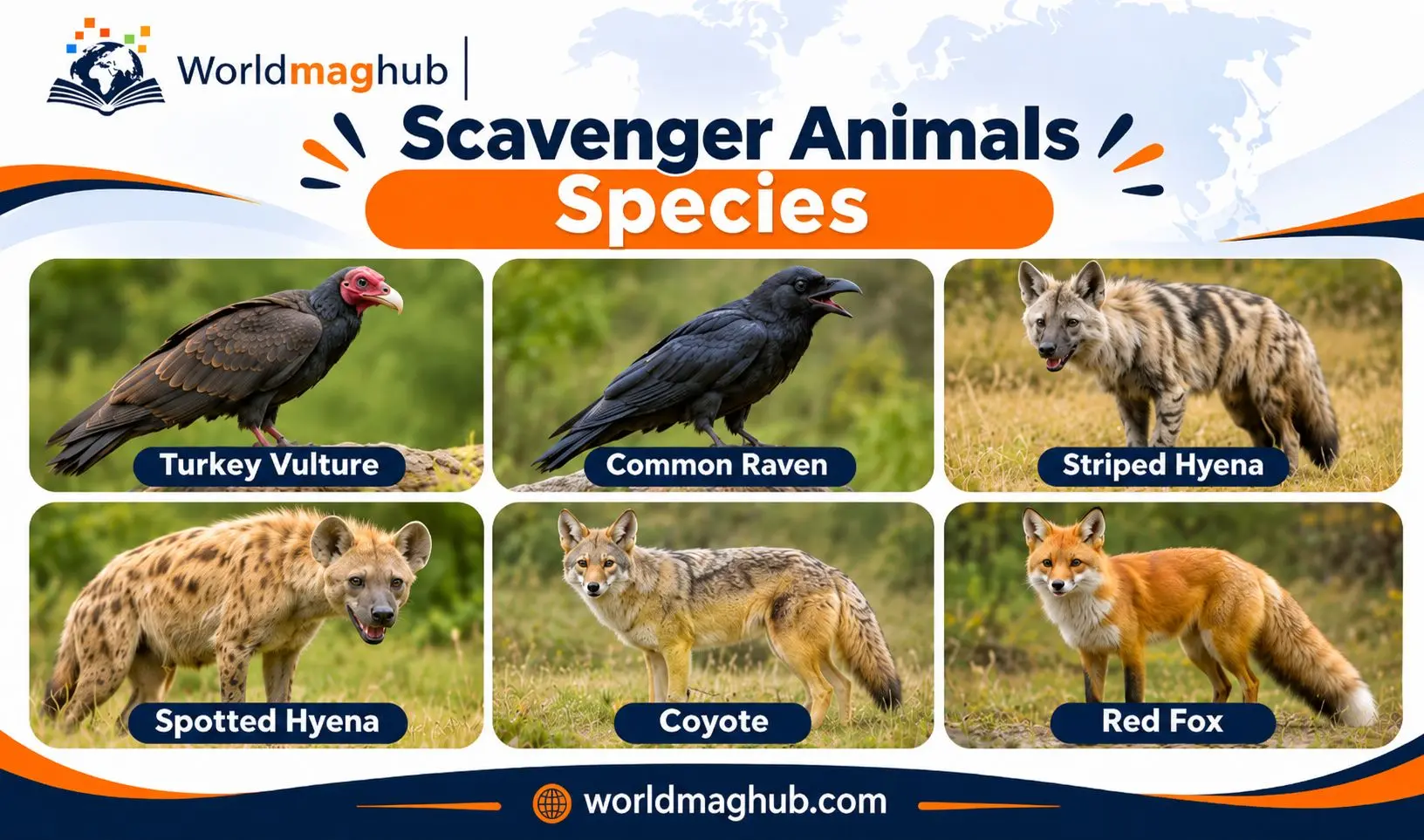
Scavenger animals are animals that feed on dead organisms or decaying organic material. Common examples include vultures, hyenas, ravens, coyotes, Tasmanian devils, sharks, hagfish, crabs, and carrion beetles.
Some scavengers depend heavily on carrion, the flesh of dead animals. Others, including spotted hyenas, foxes, coyotes, and Great White Sharks, hunt live prey but also consume carcasses when available.
Scavengers live in forests, grasslands, deserts, coastal waters, and deep oceans. Their feeding activities help remove animal remains and contribute to nutrient recycling.
Here are 15 documented examples of scavenger animals from around the world, including their names, habitats, feeding habits, and distinctive characteristics.
15 Scavenger Animals Around the World
These examples include birds, mammals, fish, crustaceans, and insects. They are not ranked by how much carrion they consume.
| Scavenger Animal | Scientific Name or Group | Main Region | Scavenging Behavior |
|---|---|---|---|
| Turkey Vulture | Cathartes aura | Americas | Carrion-dependent scavenger |
| Common Raven | Corvus corax | Northern Hemisphere | Opportunistic scavenger |
| Striped Hyena | Hyaena hyaena | Africa and Asia | Frequent scavenger |
| Spotted Hyena | Crocuta crocuta | Sub-Saharan Africa | Hunter and scavenger |
| Tasmanian Devil | Sarcophilus harrisii | Tasmania, Australia | Frequent scavenger |
| Coyote | Canis latrans | North and Central America | Opportunistic scavenger |
| Red Fox | Vulpes vulpes | Northern Hemisphere and introduced ranges | Opportunistic scavenger |
| Wolverine | Gulo gulo | Northern forests and tundra | Regular scavenger and hunter |
| Virginia Opossum | Didelphis virginiana | North and Central America | Omnivorous scavenger |
| Great White Shark | Carcharodon carcharias | Temperate and other marine waters | Predator and occasional scavenger |
| Hagfish | Family Myxinidae | Marine environments worldwide | Frequent marine scavenger |
| Shore Crab | Carcinus spp. and related shore-crab groups | Coastal habitats | Opportunistic marine scavenger |
| Lobster | Clawed lobsters and other lobster groups | Marine environments | Predator and opportunistic scavenger |
| Burying Beetle | Nicrophorus spp. | Various terrestrial habitats | Carcass specialist for reproduction |
| Blowfly | Family Calliphoridae | Worldwide | Carrion-associated larvae |
Not all scavengers depend on dead animals equally. Turkey Vultures rely heavily on carrion, while coyotes, foxes, and spotted hyenas also hunt. Burying beetles and many blowfly species use carcasses as food or resources for their developing young.
1. Turkey Vulture
Scientific name: Cathartes aura
Habitat: Forests, grasslands, farmland, and open landscapes across the Americas.
The Turkey Vulture is one of the clearest examples of a carrion-dependent scavenger. It feeds mainly on dead animals rather than hunting healthy live prey.
Unlike many birds, it has a well-developed sense of smell that helps it locate carcasses, including those partly concealed beneath vegetation.
Its bare red head, hooked bill, and broad wings are distinctive features. Turkey Vultures often soar with their wings raised in a shallow V.
Scavenging specialty: Locating and consuming animal carcasses using smell and sight.
2. Common Raven
Scientific name: Corvus corax
Habitat: Forests, mountains, grasslands, deserts, and other environments across much of the Northern Hemisphere.
Common Ravens are intelligent, adaptable birds that consume carrion alongside a variety of other foods.
They may visit carcasses left by predators or animals that have died naturally. Their diet also includes insects, eggs, small animals, seeds, and fruit.
Unlike vultures, ravens do not depend almost entirely on dead animals. Their flexible feeding habits allow them to exploit different food sources.
Scavenging specialty: Opportunistically feeding on animal remains alongside other available foods.
3. Striped Hyena
Scientific name: Hyaena hyaena
Habitat: Dry grasslands, scrublands, deserts, and open woodlands across parts of Africa and Asia.
The Striped Hyena is one of the best-known mammalian scavengers.
It typically searches for food at night, consuming carcasses, bones, and other available animal remains. Its diet may also include insects, fruit, and occasional live prey.
Unlike the Spotted Hyena, which frequently hunts, the Striped Hyena relies more heavily on scavenging.
Its powerful jaws allow it to crush bones and consume tough material that many other animals leave behind.
Scavenging specialty: Consuming carcass remains, including bones and other tough tissues.
4. Spotted Hyena
Scientific name: Crocuta crocuta
Habitat: Savannas, grasslands, and open woodlands of sub-Saharan Africa.
Spotted Hyenas are often portrayed as animals that survive by stealing food, but they are also highly capable hunters.
Their powerful jaws, strong teeth, and cooperative hunting behavior allow them to capture prey and consume substantial portions of carcasses.
They may hunt live mammals, scavenge animals that have died naturally, or take food from other predators.
Their reliance on hunting and scavenging varies with habitat, prey availability, and competition.
Although hyenas are commonly associated with scavenging, they are also capable predators. This distinction matters when discussing animals that hunt humans, because consuming a carcass is not the same as deliberately attacking a living person for food.
Scavenging specialty: Using powerful jaws to consume carcasses, including bones and remaining tissues.
5. Tasmanian Devil
Scientific name: Sarcophilus harrisii
Habitat: Forests, scrublands, grasslands, and coastal environments of Tasmania, Australia.
The Tasmanian Devil is a carnivorous marsupial known for its powerful bite and frequent scavenging behavior.
It eats dead wallabies, possums, wombats, and other animals. Its strong jaws allow it to consume skin, fur, flesh, and smaller bones.
Tasmanian Devils may also hunt live prey, but scavenging is an important part of their feeding behavior.
Several devils can gather around a carcass, producing the loud feeding sounds for which the species is famous.
Scavenging specialty: Consuming substantial portions of carcasses, including tough tissues and bones.
6. Coyote
Scientific name: Canis latrans
Habitat: Grasslands, forests, deserts, farmland, and urban environments across North and Central America.
Coyotes are adaptable predators that also consume dead animals when available.
They hunt rodents, rabbits, and other small prey but may feed on roadkill or carcasses left by larger predators.
Scavenging can provide an additional food source when hunting opportunities are limited.
Research in Denali National Park documented coyotes visiting carcasses alongside wolves, wolverines, and foxes, although larger carnivores often dominated access to food.
Scavenging specialty: Opportunistically consuming carrion while continuing to hunt live prey.
7. Red Fox
Scientific name: Vulpes vulpes
Habitat: Forests, grasslands, farmland, and human-modified landscapes across much of the Northern Hemisphere and introduced regions.
Red Foxes are opportunistic feeders that eat small mammals, birds, insects, fruit, and carrion.
They sometimes visit carcasses left by larger predators, particularly when other food sources are less available.
However, scavenging can expose foxes to competition with more powerful animals.
Research from Denali National Park documented foxes using carcasses while showing greater caution than larger carnivores.
Scavenging specialty: Taking advantage of accessible carcasses without depending exclusively on them.
8. Wolverine
Scientific name: Gulo gulo
Habitat: Northern forests, tundra, and mountainous regions of North America, Europe, and Asia.
Wolverines are powerful members of the weasel family that both hunt and scavenge.
They can feed on carcasses of animals considerably larger than themselves and may store pieces of food for later consumption.
Scavenging is particularly valuable during harsh winters when food can be difficult to obtain.
Research in Denali National Park found that wolverines were among the dominant scavengers visiting monitored carcasses.
Scavenging specialty: Exploiting large animal remains in cold environments where food availability can be unpredictable.
9. Virginia Opossum
Scientific name: Didelphis virginiana
Habitat: Woodlands, farmland, suburban areas, and other environments across parts of North and Central America.
The Virginia Opossum is a nocturnal marsupial with a varied diet.
It feeds on insects, fruit, eggs, small animals, and accessible carrion.
Opossums may consume roadkill or remains found while searching for food, making scavenging one part of their flexible feeding behavior.
Their adaptability helps them survive in natural habitats as well as environments modified by human activity.
Scavenging specialty: Consuming accessible dead animal matter alongside other foods.
10. Great White Shark
Scientific name: Carcharodon carcharias
Habitat: Temperate and other marine waters around the world.
Great White Sharks are powerful marine predators, but they also feed on dead animals.
One documented example involves scavenging on whale carcasses, which provide large, energy-rich meals.
A study published in PLOS ONE recorded repeated scavenging events involving Great White Sharks and whale remains in False Bay, South Africa.
Researchers observed sharks feeding on different parts of carcasses and interacting around the available food.
These observations show that even apex predators can benefit from animals they did not kill.
Scavenging specialty: Feeding on large marine carcasses, including dead whales.
11. Hagfish
Scientific group: Family Myxinidae
Habitat: Marine environments, particularly seafloor habitats.
Hagfish are unusual jawless marine animals with elongated, eel-like bodies.
They are well known for feeding on dead or dying animals that reach the ocean floor.
Their sensitive chemical senses help them locate food in dark underwater environments. Once they find a carcass, they use tooth-like feeding structures to tear away tissue.
Hagfish also produce large quantities of defensive slime when threatened.
Although strongly associated with scavenging, some species have also been observed feeding on living animals.
Scavenging specialty: Locating and consuming animal remains on the seafloor.
12. Shore Crab
Scientific group: Carcinus spp. and other shore-crab groups
Habitat: Coastal waters, estuaries, rocky shores, and intertidal environments.
Many shore crabs are opportunistic feeders that consume both living organisms and dead animal matter.
Their diets may include small mollusks, worms, algae, and remains washed into coastal habitats.
Crabs use their claws to handle food and can move through tidal pools, rocky shores, and shallow water while searching for available resources.
Unlike vultures, they do not depend primarily on carrion.
Scavenging specialty: Consuming accessible animal remains in coastal environments.
13. Lobster
Scientific group: Clawed lobsters and other lobster groups
Habitat: Marine environments, especially rocky and seafloor habitats.
Lobsters are marine crustaceans with hard exoskeletons and strong appendages for handling food.
Many species feed on mollusks, worms, crustaceans, and other bottom-dwelling animals. They may also consume dead animal remains when available.
Unlike specialized carrion feeders, lobsters obtain food through both hunting and scavenging.
Their diets vary across species and habitats.
Scavenging specialty: Opportunistically consuming dead animals along the seafloor.
14. Burying Beetle
Scientific group: Nicrophorus spp.
Habitat: Forests, grasslands, and other terrestrial environments, especially across the Northern Hemisphere.
Burying Beetles are among the most specialized insect scavengers.
These beetles locate small dead animals, such as rodents or birds, and may work together to bury the carcasses underground.
The remains provide food for developing larvae.
Adults can help prepare the carcass, protect the food source, and feed their offspring by regurgitating partially digested material.
Their behavior is an unusual example of parental care among insects.
Scavenging specialty: Burying small carcasses and using them to raise offspring.
15. Blowfly
Scientific group: Family Calliphoridae
Habitat: Terrestrial environments across much of the world.
Many blowfly species are associated with animal carcasses, particularly during their larval stage.
Adults can detect odors released by decomposing tissue and may lay eggs on suitable remains.
After hatching, the larvae, commonly called maggots, consume soft animal tissue and contribute to carcass breakdown.
Not all blowfly species have identical feeding or breeding habits, but carrion-associated species are important participants in decomposition.
Scavenging specialty: Larvae that consume decaying animal tissue.
Why Are Scavenger Animals Important?
Scavenger animals help maintain ecosystems by consuming dead organisms and transferring nutrients through food webs.
- Carcass removal: Vultures, hyenas, and other scavengers consume animal remains that might otherwise persist longer in the environment.
- Nutrient cycling: Scavenging transfers nutrients from carcasses into animals and eventually into wider ecosystems.
- Food-web support: Dead animals provide energy for mammals, birds, fish, crustaceans, and insects.
- Disease-related effects: Rapid carcass removal may reduce some opportunities for pathogen transmission, although the effects vary by environment and disease.
Scavengers also interact with decomposers such as fungi and bacteria. Both groups contribute to the breakdown and recycling of dead organic matter.
Every species has something distinctive about it, and our tool makes it easy to explore different animals randomly.
Frequently Asked Questions
What Are 10 Examples of Scavenger Animals?
Ten examples are Turkey Vulture, Common Raven, Striped Hyena, Spotted Hyena, Tasmanian Devil, Coyote, Red Fox, Wolverine, Hagfish, and Burying Beetle. Some rely heavily on carrion, while others also hunt or consume different foods.
What Are the Different Types of Scavengers?
Scavengers can be described as obligate or facultative based on their reliance on dead organisms. Obligate scavengers depend almost entirely on carrion, while facultative scavengers also hunt or obtain food in other ways. Scavengers can also be grouped by habitat or animal type, such as terrestrial, marine, vertebrate, and invertebrate scavengers.
Are Hyenas Scavengers or Predators?
Both. Striped Hyenas rely heavily on scavenging, while Spotted Hyenas are capable hunters that also consume carrion. Their feeding strategies depend on species, habitat, and food availability.
Which Animals Eat Only Dead Animals?
Many vultures depend almost entirely on carrion, making them among the clearest examples of specialized scavengers. However, saying an animal eats only dead organisms can be too absolute. Most other scavengers, including hyenas, coyotes, and ravens, obtain food in additional ways.
Are Scavengers and Decomposers the Same?
No. Scavengers are animals that consume dead organisms or organic remains. Decomposers, especially fungi and bacteria, chemically break down organic material into simpler substances. Both contribute to nutrient recycling, but their biological roles differ.
Sources and Further Reading
This research-supported guide presents 15 documented examples of scavenging behavior across different animal groups.
The examples are not ranked by carrion consumption, and not every animal depends exclusively on dead organisms. Some are regular carrion consumers, while others scavenge opportunistically.
The following references support the principal feeding behaviors, biological distinctions, and ecological explanations.
- National Geographic Education — Scavenger — Definition of scavenging, examples, and ecological functions.
- Cornell Lab of Ornithology — Turkey Vulture — Carrion diet, smell-based detection, habitat, and feeding behavior.
- U.S. National Park Service — Dominance Dynamics Among Scavengers — Research on wolves, wolverines, coyotes, and foxes at carcasses in Denali.
- Tasmanian Department of Natural Resources — Tasmanian Devil — Scavenging, hunting, and consumption of animal remains.
- Fallows et al. (2013), PLOS ONE — White Sharks Scavenging on Whales — Peer-reviewed observations of Great White Sharks feeding on whale carcasses.
- Natural History Museum — Hagfish Feeding and Slime — Hagfish scavenging, feeding structures, and defensive adaptations.
- University of Minnesota — Burying Beetles — Carcass burial, feeding, reproduction, and parental care.