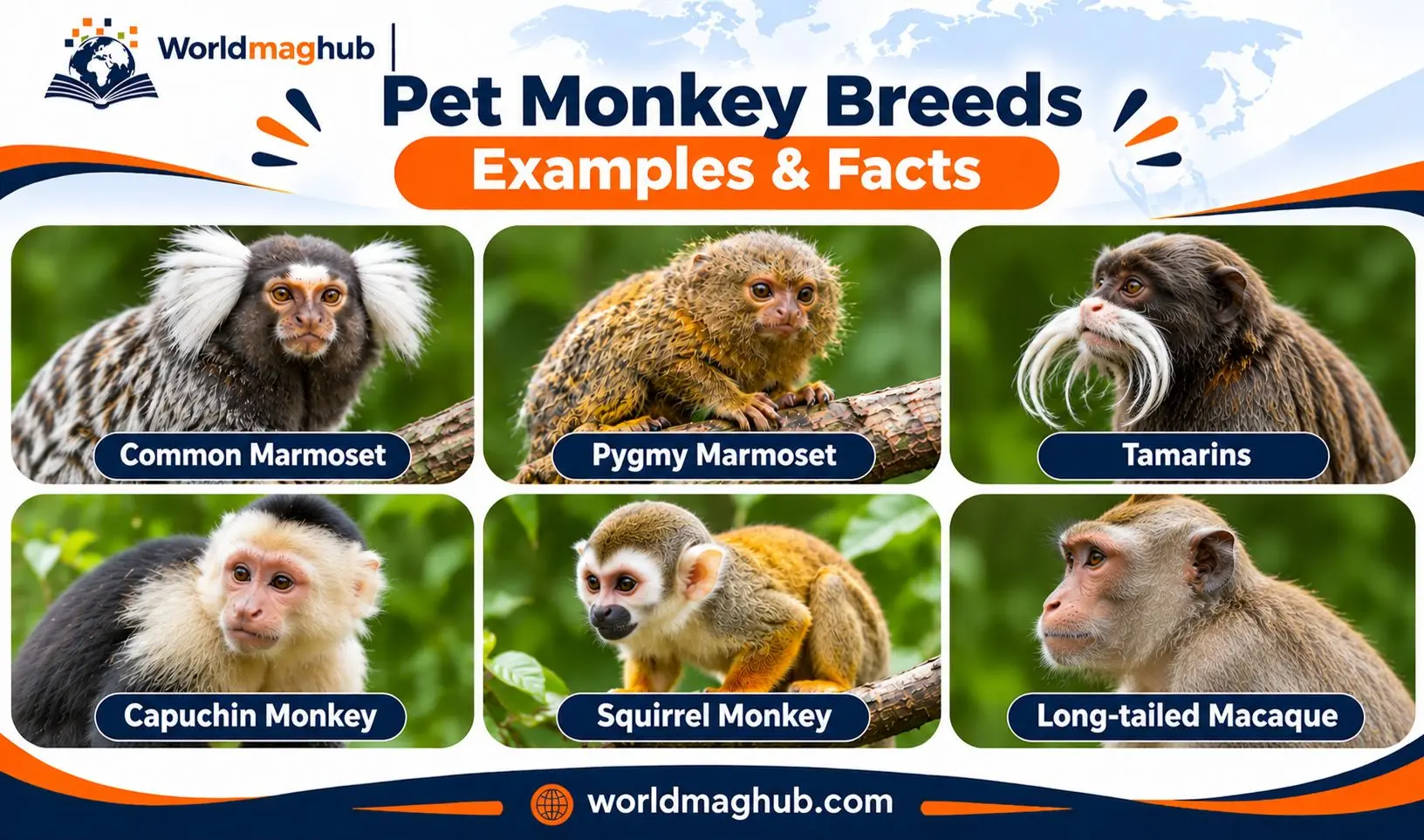
Common marmosets, pygmy marmosets, tamarins, capuchins, squirrel monkeys, macaques, and vervet monkeys are among the primates associated with exotic pet keeping or wildlife trade.
However, there are no domesticated pet monkey breeds comparable to dog or cat breeds. These are wild monkey species with complex social, dietary, behavioral, and environmental needs.
Some are small enough to fit in an adult’s hand, while others are strong, intelligent primates that require considerable space and social interaction. Their appearance or presence in pet advertisements does not make them suitable household animals.
Here are seven documented monkey species or groups associated with private keeping or exotic animal trade, including their distinctive features, natural habitats, and main ownership challenges.
7 Monkey Species Associated With Pet Keeping
The following examples have appeared in pet-keeping discussions, wildlife trade research, or captivity records. They are not ranked by popularity or recommended for private ownership.
| Monkey Species or Group | Native Region | Distinguishing Feature | Main Ownership Challenge |
|---|---|---|---|
| Common Marmoset | Brazil | White ear tufts and small body | Specialized diet and social needs |
| Pygmy Marmoset | Western Amazon Basin | World’s smallest monkey group | Specialized feeding and environmental needs |
| Tamarins | Central and South America | Small bodies and distinctive facial hair | Social companionship and enrichment |
| Capuchin Monkey | Central and South America | Dexterous hands and problem-solving abilities | Intelligence, strength, and social complexity |
| Squirrel Monkey | Central and South America | Small, agile, and highly active | Large social groups and space requirements |
| Long-tailed Macaque | Southeast Asia | Long tail and adaptable behavior | Strength, complex social behavior, and health risks |
| Vervet Monkey | Eastern and southern Africa | Dark face and gray-green coat | Group-living requirements and behavioral needs |
These monkeys are wild animals, not domesticated pet breeds. Their inclusion does not mean that keeping them is legal, safe, or appropriate in an ordinary home.
1. Common Marmoset
Scientific name: Callithrix jacchus
Native habitat: Forests and wooded environments of Brazil.
The Common Marmoset is a small monkey known for its prominent white ear tufts, gray-brown fur, and long, banded tail.
Adults typically weigh only a few hundred grams, making them among the smaller monkey species associated with private primate keeping.
Common Marmosets are active tree-dwelling animals. They feed on insects, fruits, and tree exudates such as gums, using specialized teeth to access some of these foods.
In natural environments, they live in cooperative family groups, with multiple members helping care for young.
This creates significant challenges in domestic captivity. Appropriate nutrition, social companionship, climbing opportunities, and environmental stimulation are essential.
Research on private primate keeping in England and the United States has identified marmosets among the monkey groups encountered in captivity or pet advertisements.
Main ownership challenge: Meeting their specialized dietary, social, and environmental needs.
2. Pygmy Marmoset
Scientific group: Cebuella spp.
Native habitat: Tropical forests of the western Amazon Basin.
Pygmy Marmosets are the smallest living monkeys, with adults weighing approximately 100–140 grams.
They are sometimes advertised using informal names such as finger monkeys, pocket monkeys, or miniature monkeys.
However, these marketing terms can create a misleading impression that the animals are easy to keep.
Pygmy Marmosets use specialized teeth to make holes in tree bark and feed on gums and other plant exudates. They also consume insects and live in social family groups.
Their extremely small size does not reduce their need for appropriate nutrition, companionship, movement, and a suitable environment.
Modern primate taxonomy recognizes Western and Eastern Pygmy Marmosets as separate species in the genus Cebuella.
Pygmy marmosets are not the only monkeys that remain small as adults. Several marmosets and tamarins have naturally miniature bodies, despite their complex biological needs. Explore our guide to small monkey breeds and species to compare their adult sizes, habitats, and distinguishing features.
Main ownership challenge: Specialized feeding, social needs, and sensitivity to unsuitable household conditions.
3. Tamarins
Scientific groups: Several genera, including Saguinus and Leontopithecus.
Native habitat: Forests of Central and South America.
Tamarins are small New World monkeys recognized for their agility, long tails, and distinctive appearances.
Emperor Tamarins have prominent white mustaches, while Cotton-top Tamarins are known for their dramatic white crests.
Different tamarin species have appeared in exotic primate trade records, but they are not interchangeable. Their diets, conservation status, and social behavior vary.
Many live in cooperative family groups and depend on regular interaction with other monkeys.
Their diets may include fruits, insects, nectar, and plant exudates, depending on the species.
Keeping tamarins in ordinary household conditions creates significant challenges because their natural behaviors require complex environments and appropriate social relationships.
Main ownership challenge: Species-specific social companionship, natural foraging, and environmental enrichment.
4. Capuchin Monkey
Scientific groups: Cebus and Sapajus.
Native habitat: Forests of Central and South America.
Capuchin Monkeys are known for their intelligence, dexterous hands, and remarkable problem-solving abilities.
They can manipulate objects, explore complex environments, and learn through observation.
These characteristics have contributed to their appearance in private captivity and exotic animal trade.
However, capuchins are strong, active, socially complex primates. Their intelligence creates demanding needs for learning, stimulation, and environmental interaction.
As they mature, natural social, reproductive, and competitive behaviors can become increasingly difficult to manage in domestic environments.
A 2021 peer-reviewed study of online primate advertisements in the United States identified capuchins among the monkey groups repeatedly advertised for sale.
Their ability to interact with humans should not be confused with domestication.
Main ownership challenge: High cognitive demands, physical strength, and complex long-term social needs.
5. Squirrel Monkey
Scientific group: Saimiri spp.
Native habitat: Tropical forests of Central and South America.
Squirrel Monkeys are small, agile primates recognized by their expressive facial markings, slender bodies, and long tails.
They spend substantial time moving through trees, searching for fruit, insects, and other available foods.
In natural environments, some squirrel monkey species live in large social groups.
Their daily activities involve movement, communication, foraging, and regular interaction with other monkeys.
These behaviors are difficult to accommodate in ordinary domestic settings, particularly when animals are kept alone or in restricted enclosures.
In a 2021 study of U.S. online primate advertisements, squirrel monkeys accounted for approximately 10.5% of the sampled advertisements.
That figure describes the study sample, not worldwide ownership or completed sales.
Main ownership challenge: High activity levels, social companionship, and substantial space requirements.
6. Long-tailed Macaque
Scientific name: Macaca fascicularis
Native habitat: Forests, coastal areas, and human-modified environments of Southeast Asia.
The Long-tailed Macaque, also called the Crab-eating Macaque, is an adaptable monkey with a long tail, strong jaws, and complex social behavior.
These monkeys live in groups where grooming, communication, competition, and dominance relationships influence daily life.
Long-tailed Macaques have appeared in international wildlife trade records. However, much of their documented international trade is associated with biomedical research rather than private pet keeping.
The two markets should not be treated as identical.
Macaques can bite or scratch, and close contact between humans and nonhuman primates can involve health risks.
Their natural group behavior and physical strength make household management especially difficult.
Main ownership challenge: Social complexity, physical strength, behavioral needs, and risks associated with close human contact.
7. Vervet Monkey
Scientific name: Chlorocebus pygerythrus
Native habitat: Savannas, woodlands, and other habitats of eastern and southern Africa.
Vervet Monkeys are medium-sized African primates recognized by their gray-green fur, black faces, and long tails.
They inhabit social groups with complex relationships involving grooming, play, communication, and competition.
Their diet includes fruits, seeds, leaves, insects, and other available foods.
Vervets and related African green monkeys have appeared in wildlife trade and captivity records. However, this does not establish that vervets are commonly kept as household pets worldwide.
Their strong social needs, active behavior, and potential for conflict with humans make them difficult to manage in domestic environments.
Main ownership challenge: Providing appropriate group-living conditions while managing the needs of an active wild primate.
Do Monkeys Make Good Pets?
Monkeys are generally unsuitable as conventional household pets. They are not domesticated animals, and even individuals raised by humans retain natural behaviors and specialized care requirements.
Their most important needs include:
- Social companionship: Many monkey species depend on complex relationships with other monkeys. Human attention cannot fully replace appropriate social groups.
- Space and enrichment: Primates need opportunities to climb, explore, forage, play, and engage in natural behavior.
- Specialized nutrition: Different species have different feeding requirements. Marmosets, for example, naturally consume tree gums and insects alongside other foods.
- Adult behavior: A young monkey may behave differently from a mature animal. Territorial, reproductive, competitive, and defensive behaviors can become more pronounced with age.
- Healthcare and safety: Primates require specialist veterinary care. Some infections can pass between monkeys and humans, and bites or scratches can cause injuries.
The World Organisation for Animal Health advises veterinary authorities against authorizing the importation of nonhuman primates for pet keeping because of public-health, animal-welfare, and wildlife-disease concerns.
A monkey’s small size, intelligence, or familiarity with people does not mean it is domesticated or suitable for ordinary household ownership.
Is It Legal to Own a Pet Monkey?
The legality of keeping a monkey depends on the country, state, province, and local jurisdiction. Some locations prohibit private primate ownership, while others require special licenses and strict welfare conditions.
England: Since April 6, 2026, keeping primates privately has been subject to a licensing framework requiring strict welfare standards comparable to those expected in professional facilities. Legal exceptions apply to certain licensed institutions.
United States: Federal rules prohibit importing nonhuman primates for use as pets. However, laws governing possession of monkeys already within the country differ by state and locality.
Other countries: Domestic wildlife legislation, conservation protections, animal-welfare requirements, and international trade restrictions may apply. Rules also differ between monkey species.
Legal possession does not necessarily mean that a household can meet a primate’s biological and welfare needs.
Anyone seeking information about an existing captive primate should consult the relevant government wildlife authority and qualified veterinary professionals for current requirements.
Frequently Asked Questions
What Is the Smallest Monkey Associated With the Pet Trade?
Pygmy Marmosets are the smallest living monkeys and have appeared in exotic pet trade discussions. They are sometimes marketed as finger monkeys or pocket monkeys, but these are informal names rather than domesticated breeds. Their small size does not make them suitable household pets.
Are Capuchin Monkeys Good Pets?
Capuchins are intelligent, physically strong, and socially complex wild primates. They require extensive enrichment, appropriate companionship, and specialist care. These needs make them unsuitable as conventional household pets.
Can Pet Monkeys Be Dangerous to Humans?
Yes. Monkeys can bite, scratch, and cause injuries, particularly when frightened, stressed, or competing for resources. Some infections can also pass between humans and nonhuman primates. The risks vary by species, health status, and circumstances.
How Long Do Monkeys Live in Captivity?
Lifespan varies considerably by species. Some small marmosets can live into their teens in managed care, while capuchins may live for several decades. Their potentially long lifespans make primate care a substantial long-term responsibility.
How Does the Pet Monkey Trade Affect Wild Populations?
The primate trade can encourage illegal capture, disrupt wild social groups, and expose animals to stressful transport and unsuitable captivity.
A 2026 investigation by World Wildlife Fund, the Association of Zoos and Aquariums, and the International Fund for Animal Welfare identified more than 1,600 primates advertised online during a six-week period in 2025.
These figures represent advertised animals rather than confirmed completed sales, but they highlight ongoing animal-welfare and conservation concerns.
What Is the Difference Between a Pet Monkey Breed and a Monkey Species?
There are no domesticated pet monkey breeds comparable to dog breeds. Marmosets, capuchins, tamarins, macaques, and vervets are wild monkey species or species groups. Captive breeding or human handling does not make these animals domesticated.
Sources and Further Reading
This article presents seven documented monkey species or groups associated with exotic pet keeping, trade, or captivity records. Their inclusion does not mean that they are recommended or legally available as household pets.
The following research and institutional references support the key information about primate trade, species characteristics, animal welfare, and ownership laws.
- Pet Primates for Sale in the United States — Peer-Reviewed Study (2021) — Research on online primate advertisements, including marmosets, capuchins, and squirrel monkeys.
- WWF, AZA & IFAW — Primates for Purchase (2026) — Investigation of more than 1,600 primates advertised online during six weeks in 2025.
- World Organisation for Animal Health — Nonhuman Primates — Guidance on primate importation, public health, and animal welfare.
- GOV.UK — Licensing Process for Keeping Primates — England’s licensing requirements effective from April 6, 2026.
- U.S. CDC — Bringing a Nonhuman Primate Into the United States — Federal import restrictions and public-health requirements.
- U.S. CDC — Bringing an Animal Into the United States — Importation rules covering nonhuman primates and other animals.
- Wisconsin National Primate Research Center — Primate Factsheets — Species information, natural behavior, anatomy, and social organization.
- San Diego Zoo Wildlife Alliance — Monkey — General monkey biology, behavior, social structures, and natural habitats.