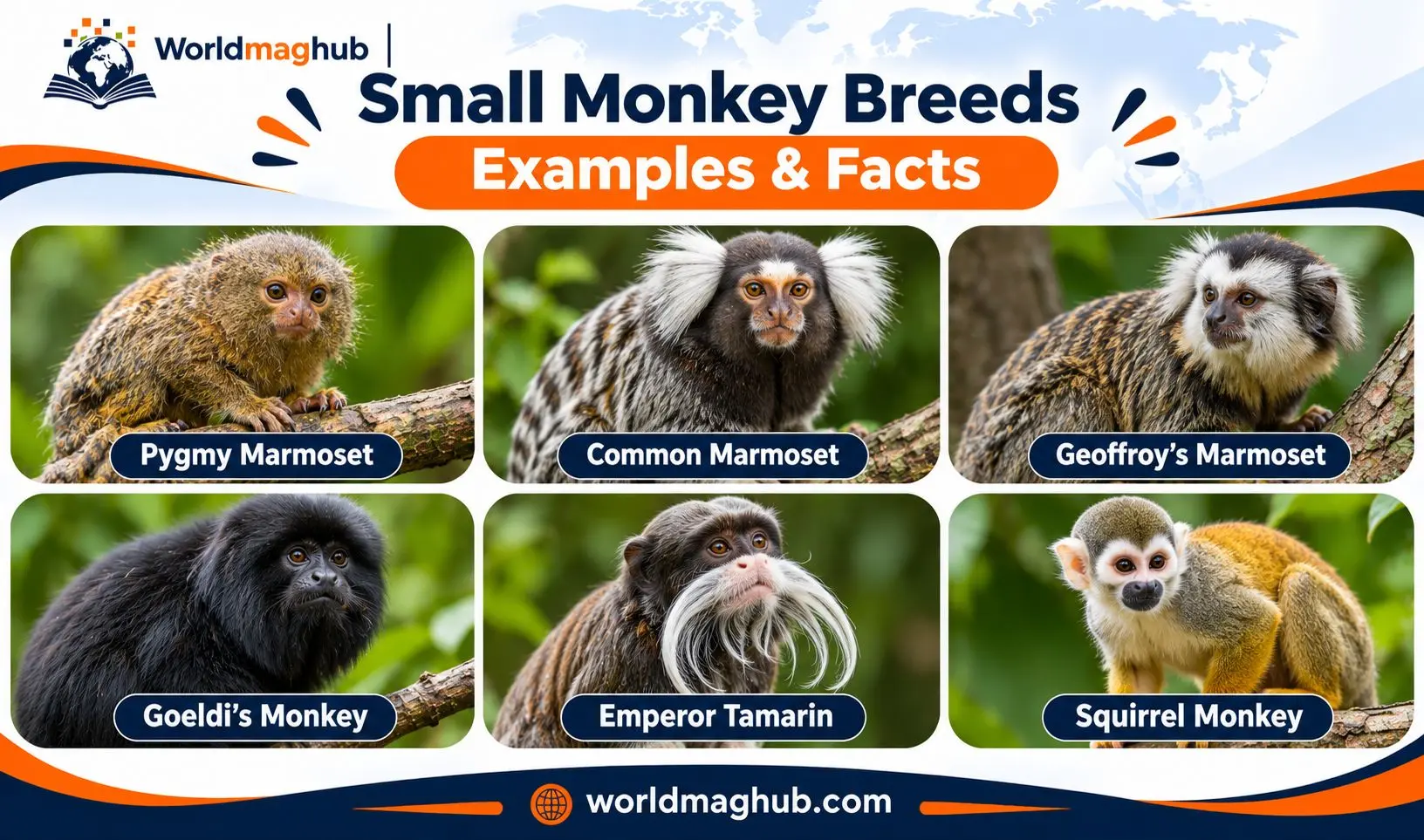
Some monkeys are so small that they can fit comfortably in an adult’s hand. Others have tiny faces, long tails, colorful fur, or unusual features that make them look like miniature versions of larger primates.
Small monkey breeds, more accurately called small monkey species, include pygmy marmosets, common marmosets, cotton-top tamarins, emperor tamarins, golden lion tamarins, and squirrel monkeys. The smallest living monkeys are pygmy marmosets, which typically measure about 12–16 cm (4.7–6.3 inches) in head-and-body length, excluding the tail.
Unlike dog breeds, these are naturally occurring wild primates rather than domesticated breeds.
Most of the tiniest monkey species inhabit tropical forests of Central and South America, although small monkeys also live in Africa.
Here are 10 research-supported examples of little monkey species, including their approximate adult weights, natural habitats, and features that help identify them.
10 Types of Small Monkeys Around the World
These monkeys differ considerably in size. Some weigh little more than 100 grams as adults, while others can exceed 1 kilogram.
| Small Monkey | Scientific Name or Group | Approximate Adult Weight | Native Region |
|---|---|---|---|
| Pygmy Marmoset | Cebuella spp. | 100–140 g | Western Amazon Basin |
| Common Marmoset | Callithrix jacchus | 230–260 g | Brazil |
| Geoffroy’s Marmoset | Callithrix geoffroyi | 260–380 g | Southeastern Brazil |
| Goeldi’s Monkey | Callimico goeldii | 350–370 g | Western Amazon Basin |
| Cotton-top Tamarin | Saguinus oedipus | 400–430 g | Northwestern Colombia |
| Emperor Tamarin | Saguinus imperator | Around 400–500 g | Western Amazon Basin |
| Golden-headed Lion Tamarin | Leontopithecus chrysomelas | 550–600 g | Eastern Brazil |
| Golden Lion Tamarin | Leontopithecus rosalia | Around 620 g | Southeastern Brazil |
| Squirrel Monkey | Saimiri spp. | 550–1,250 g | Central and South America |
| Southern Talapoin | Miopithecus talapoin | 750–1,300 g | Central Africa |
These weights are approximate published averages or representative ranges, not exact limits for every adult. Body mass varies with species, sex, age, and population. The entries are arranged approximately by size, not as a definitive scientific ranking.
1. Pygmy Marmoset — The World’s Smallest Monkey
Scientific group: Cebuella spp.
Approximate adult weight: 100–140 grams.
Pygmy marmosets are the smallest living monkeys, with adult head-and-body lengths of approximately 12–16 cm (4.7–6.3 inches).
Despite their tiny bodies, their tails are usually longer than their heads and bodies combined, helping them maintain balance while moving through trees.
They inhabit Amazonian forests, where they use specialized lower incisors to make small holes in tree bark and feed on gum and other plant exudates. They also consume insects.
Modern taxonomy distinguishes the Western Pygmy Marmoset (Cebuella pygmaea) from the Eastern Pygmy Marmoset (Cebuella niveiventris).
Identification clue: An exceptionally tiny brownish monkey with a rounded face, claw-like nails, and a long tail.
2. Common Marmoset
Scientific name: Callithrix jacchus
Approximate adult weight: 230–260 grams.
The Common Marmoset is a small Brazilian monkey recognized by its prominent white ear tufts, gray-brown fur, and long, banded tail.
It has specialized claw-like nails that help it cling to vertical tree trunks.
Like pygmy marmosets, Common Marmosets feed on tree gums and other plant exudates, supplementing their diet with insects, fruit, and additional foods.
They live in social family groups, often with several members helping care for young monkeys.
The Wisconsin National Primate Research Center reports average adult weights of approximately 256 grams for males and 236 grams for females.
Identification clue: Large white ear tufts, a striped tail, and a small gray-brown body.
3. Geoffroy’s Marmoset
Scientific name: Callithrix geoffroyi
Approximate adult weight: 260–380 grams.
Geoffroy’s Marmoset is a small Brazilian monkey recognized by its pale face, dark ear tufts, and long tail.
According to the Smithsonian’s National Zoo, adults measure approximately 20 cm (8 inches) in head-and-body length, with an additional tail measuring about 29 cm (11 inches).
These monkeys inhabit forest environments and feed on tree gums, fruits, insects, and other available foods.
Their contrasting facial markings are particularly useful for distinguishing them from Common Marmosets.
Identification clue: A pale face surrounded by dark ear tufts and a small, agile body.
4. Goeldi’s Monkey
Scientific name: Callimico goeldii
Approximate adult weight: 350–370 grams.
Goeldi’s Monkey, also known as the callimico, is a small rainforest primate with thick, dark fur and a long tail.
It occurs in the western Amazon Basin and moves through forest vegetation using agile climbing and jumping movements.
Its diet includes fruits, insects, fungi, and other forest foods.
One unusual feature is its reproduction. Unlike many marmosets and tamarins that frequently give birth to twins, Goeldi’s Monkeys generally produce a single infant.
The Wisconsin National Primate Research Center reports average adult weights of approximately 366 grams for males and 355 grams for females.
Identification clue: A small monkey with mostly dark fur, a rounded head, and a long tail.
5. Cotton-top Tamarin
Scientific name: Saguinus oedipus
Approximate adult weight: 400–430 grams.
The Cotton-top Tamarin is one of the most distinctive small monkeys because of the dramatic white crest covering the top of its head.
Native to northwestern Colombia, this monkey has a small body, dark facial skin, and a flowing white mane that extends toward its shoulders.
Cotton-top Tamarins live in social groups and feed on fruits, insects, nectar, and other available forest foods.
Their limited natural distribution and continuing habitat pressures make conservation particularly important.
Published reference weights are approximately 411 grams for males and 430 grams for females.
Identification clue: A tiny monkey with a large, flowing white crest and dark face.
6. Emperor Tamarin
Scientific name: Saguinus imperator
Approximate adult weight: Around 400–500 grams.
The Emperor Tamarin is a small South American monkey famous for its exceptionally long white mustache.
Its grayish body, reddish-orange tail, and distinctive facial hair make it easy to recognize.
Emperor Tamarins inhabit Amazonian forests in parts of Brazil, Peru, and Bolivia, where they feed on fruits, insects, nectar, and other available foods.
They live in social groups, and adult males often help carry and care for infants.
Identification clue: A miniature monkey with a long, curved white mustache and a reddish tail.
7. Golden-headed Lion Tamarin
Scientific name: Leontopithecus chrysomelas
Approximate adult weight: 550–600 grams.
The Golden-headed Lion Tamarin is a small monkey native to Brazil’s Atlantic Forest.
It has a striking appearance: mostly dark fur contrasted with brilliant golden-orange hair around its head and shoulders.
These monkeys move through trees while searching for insects, fruit, and other foods. Their slender fingers help them investigate small openings in bark and vegetation.
The Wisconsin National Primate Research Center reports mean weights of approximately 550 grams for wild males and 591 grams for females in limited samples.
Identification clue: A dark-bodied monkey with a bright golden head and mane.
8. Golden Lion Tamarin
Scientific name: Leontopithecus rosalia
Average adult weight: Approximately 620 grams.
The Golden Lion Tamarin is a small Brazilian monkey known for its brilliant reddish-gold fur and mane-like hair around the face.
It inhabits the Atlantic Forest, where it searches trees for fruits, insects, and other available food.
Golden Lion Tamarins live in family groups that cooperate in raising young monkeys.
The species has also become an important example of primate conservation through habitat protection, breeding programs, and reintroduction.
Identification clue: Bright golden fur covering most of the body, with longer hair around the face resembling a miniature lion’s mane.
9. Squirrel Monkey
Scientific group: Saimiri spp.
Approximate adult weight: 550–1,250 grams, depending on species.
Squirrel Monkeys are small, agile primates native to tropical forests of Central and South America.
They have relatively small heads, pale facial markings, darker muzzles, slender bodies, and long tails that help with balance.
Unlike several marmoset species that live in smaller family groups, squirrel monkeys may gather in much larger social groups.
They spend much of their active time climbing through vegetation and searching for fruits, insects, and other food sources.
The reported weight range represents multiple squirrel monkey species rather than one universal adult measurement.
Identification clue: A small monkey with a pale face, darker muzzle, slender body, and long balancing tail.
10. Southern Talapoin Monkey
Scientific name: Miopithecus talapoin
Approximate adult weight: 750–1,300 grams.
The Southern Talapoin is one of Africa’s smallest monkeys, providing an interesting contrast to the South American species in this list.
It has olive-greenish fur, a pale underside, a small face, and a relatively long tail.
Southern Talapoins inhabit forested environments near rivers, wetlands, and other waterways in Central Africa.
They are agile climbers and feed on fruits, insects, and other plant and animal foods.
San Diego Zoo identifies the Southern Talapoin as the lightest guenon, with adults weighing approximately 0.75–1.3 kilograms.
Identification clue: A small, olive-colored African monkey with a pale underside and a slender tail.
After exploring the animals featured here, you can find another animal to learn about through our interactive generator.
Frequently Asked Questions
What Is the Smallest Monkey in the World?
Pygmy marmosets are the smallest living monkeys. Adults typically measure approximately 12–16 cm (4.7–6.3 inches) in head-and-body length and weigh around 100–140 grams. However, the smallest living primates are mouse lemurs, which are not monkeys.
What Is a Finger Monkey?
Finger monkey is an informal nickname commonly used for pygmy marmosets because of their exceptionally small size. It is not a separate scientifically recognized monkey breed. Pygmy marmosets remain tiny even after reaching adulthood.
What Is the Smallest Monkey in Africa?
Talapoins are among the smallest monkeys native to Africa. The Southern Talapoin (Miopithecus talapoin) weighs approximately 0.75–1.3 kilograms, making it small for an Old World monkey but considerably heavier than a pygmy marmoset.
Are Marmosets and Tamarins the Same?
No. Marmosets and tamarins are closely related groups of small New World monkeys, but they differ in aspects of their teeth, feeding adaptations, physical appearance, and evolutionary classification. Both groups contain several species.
What Animals Eat Small Monkeys?
Eagles, large snakes, wild cats, and other rainforest predators may hunt small monkeys. The threats depend on the monkey species and location. Harpy Eagles hunt monkeys in Central and South America, while African Crowned Eagles prey on monkeys in African forests.
For documented examples of these predator–prey relationships, explore our guide to animals that eat monkeys.
Can Small Monkeys Be Kept as Pets?
Small monkeys are wild primates, not domesticated pet breeds. They require specialized diets, appropriate social groups, environmental enrichment, suitable habitats, and expert veterinary care. Private ownership raises serious welfare and disease concerns, and laws differ by location. Wildlife and veterinary organizations generally discourage keeping monkeys as household pets.
For a more detailed explanation of species associated with private keeping, welfare concerns, and ownership restrictions, read our guide to pet monkey breeds and ownership challenges.
Sources and Further Reading
This article presents 10 research-supported examples of naturally small monkey species or species groups. The weights and physical characteristics are drawn from institutional primate references and published zoological research.
Measurements represent published averages or ranges, not exact values for every individual. Several references are historical biological factsheets, and primate taxonomy may change as new research becomes available.
- San Diego Zoo — Pygmy Marmoset — Smallest-monkey status, body length, habitat, and feeding adaptations.
- Wisconsin National Primate Research Center — Pygmy Marmoset — Average adult weight and body measurements.
- Peer-reviewed Pygmy Marmoset Taxonomy Research — Scientific evidence distinguishing Western and Eastern Pygmy Marmosets.
- Wisconsin National Primate Research Center — Common Marmoset — Adult weights, physical characteristics, and feeding adaptations.
- Smithsonian’s National Zoo — Geoffroy’s Marmoset — Body and tail lengths, weight, and identification.
- Wisconsin National Primate Research Center — Goeldi’s Monkey — Published weights, anatomy, and behavior.
- Wisconsin National Primate Research Center — Cotton-top Tamarin — Adult weights and distinctive appearance.
- Perth Zoo — Emperor Tamarin — Natural behavior, habitat, and physical characteristics.
- Wisconsin National Primate Research Center — Golden-headed Lion Tamarin — Body mass and identification.
- Wisconsin National Primate Research Center — Golden Lion Tamarin — Average body mass, anatomy, and natural behavior.
- Animal Diversity Web — Cebidae — Squirrel monkey body-weight ranges and characteristics.
- San Diego Zoo — Guenons — Southern Talapoin adult weight and comparative size.
- World Wildlife Fund — Why Primates Do Not Make Good Pets — Animal welfare, health, and private ownership concerns.