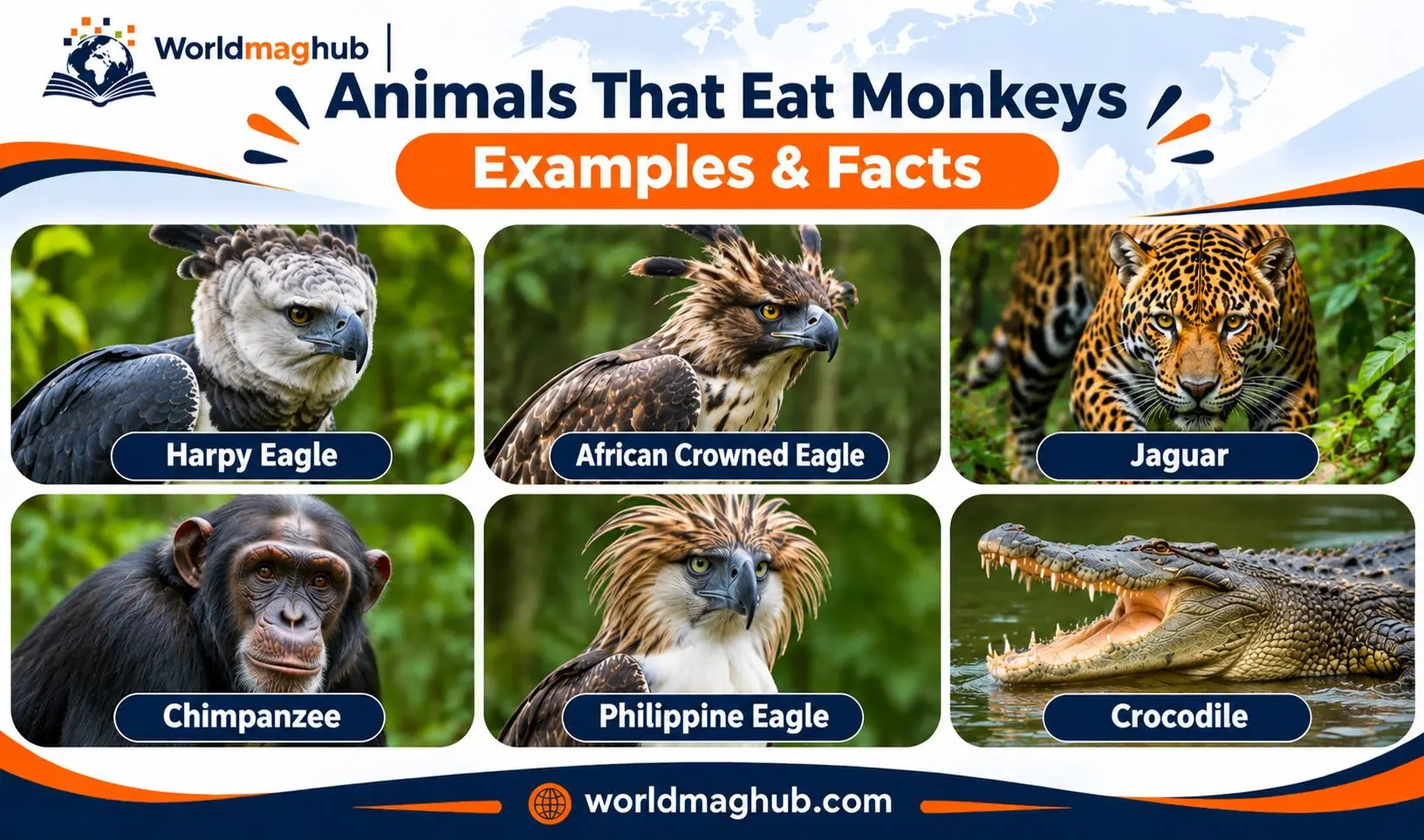
Eagles, leopards, jaguars, large snakes, crocodiles, and chimpanzees are among the animals that eat monkeys. Other documented monkey predators include Philippine Eagles, Sunda Clouded Leopards, and Pumas.
The main predators of monkeys depend on where they live. Harpy Eagles and jaguars prey on monkeys in the Americas, African Crowned Eagles and leopards hunt monkeys in Africa, while pythons, crocodiles, and clouded leopards can threaten monkeys in Asian forests.
Some predators regularly hunt particular monkey species, while others consume monkeys only occasionally. A predator’s size, hunting behavior, habitat, and the monkey’s ability to escape all influence the outcome.
Here are 11 research-supported examples of animals documented hunting or consuming monkeys, including the monkey species recorded as prey and how these predators obtain food.
11 Animals That Eat Monkeys
The following list includes birds of prey, wild cats, reptiles, and a great ape. It is not a ranking of the world’s most frequent monkey predators.
| Predator | Monkeys Recorded as Prey | Main Region |
|---|---|---|
| Harpy Eagle | Capuchins, bearded sakis, and other monkeys | Central and South America |
| African Crowned Eagle | Red-tailed monkeys, colobus monkeys | Sub-Saharan Africa |
| Leopard | Red-tailed monkeys, vervets, langurs, and macaques | Africa and Asia |
| Jaguar | Spider monkeys, howler monkeys | Central and South America |
| Chimpanzee | Red colobus and other monkeys | Tropical Africa |
| Large Pythons | Various monkey species, including macaques | Africa and Asia |
| Crocodile | Crab-eating macaques, proboscis monkeys | Tropical waterways |
| Philippine Eagle | Macaques and other vertebrate prey | Philippines |
| Sunda Clouded Leopard | Proboscis monkeys | Borneo and Sumatra |
| Puma | Spider monkeys, howler monkeys | Americas |
| Cheetah | Vervet monkeys, yellow baboons recorded in diet research | Africa |
These are documented predator–prey relationships, but the evidence differs. Some hunting events have been observed directly, while other cases are established through prey remains or dietary analysis. Finding monkey remains in a predator’s diet does not always reveal exactly how the animal obtained them.
1. Harpy Eagle
Scientific name: Harpia harpyja
Habitat: Tropical forests of Central and South America.
The Harpy Eagle is one of the most powerful aerial predators of forest-dwelling monkeys.
Its strong legs and large talons allow it to capture mammals moving through the rainforest canopy. Monkeys and sloths are important components of its diet in studied populations.
Research published in the American Journal of Primatology examined prey remains collected from Harpy Eagle nests in the Brazilian Amazon. Capuchin and bearded saki monkeys were among the most prominent prey identified.
Monkeys vary considerably in body size, from larger howler monkeys to tiny marmosets and tamarins. For a closer look at these smaller primates, explore our guide to small monkey breeds and species, including their adult sizes and distinctive features.
Harpy Eagles can capture relatively large arboreal mammals, making them important predators in tropical forest food webs.
How it hunts: It approaches prey in the forest canopy and captures monkeys using powerful talons.
2. African Crowned Eagle
Scientific name: Stephanoaetus coronatus
Habitat: Forests and wooded landscapes of sub-Saharan Africa.
The African Crowned Eagle is a powerful forest raptor known for preying on monkeys and other mammals.
Its exceptionally strong legs and talons help it capture prey among branches and dense vegetation.
Research from Tanzania’s Mahale Mountains found that Red-tailed Monkeys were particularly important prey for Crowned Eagles in the study area.
Other research has documented Crowned Eagles feeding on colobus monkeys and additional forest primates.
How it hunts: It ambushes monkeys in wooded habitats and captures them using powerful talons.
3. Leopard
Scientific name: Panthera pardus
Habitat: Forests, savannas, woodlands, and rocky landscapes across parts of Africa and Asia.
Leopards are among the best-documented mammalian predators of monkeys.
These agile cats can hunt on the ground and in trees. Their prey includes a wide variety of mammals, including monkeys in habitats where the two occur together.
In Tanzania’s Issa Valley, researchers directly observed a leopard chasing a Red-tailed Monkey into a tree and capturing it above the ground.
Leopards also consume Asian monkeys, including some macaques and langurs.
However, monkey predation varies by location and the availability of other prey.
How it hunts: Leopards stalk monkeys and may pursue them into trees when an opportunity arises.
4. Jaguar
Scientific name: Panthera onca
Habitat: Tropical forests, wetlands, and other habitats across Central and South America.
Jaguars are powerful predators that feed on many types of mammals, reptiles, and other vertebrates.
Monkeys can also form part of their diet, although their importance varies between habitats.
Research in southern Mexico identified Spider Monkey and Howler Monkey remains in jaguar dietary samples.
These findings confirm that jaguars consume monkeys, but dietary evidence alone does not establish how every animal was captured.
Studies from other locations have found much lower monkey consumption, indicating that primates are not equally important prey for all jaguar populations.
How it obtains monkeys: Jaguars can capture prey through stealth and powerful bites, but the exact circumstances of individual monkey predation events are not always documented.
5. Chimpanzee
Scientific name: Pan troglodytes
Habitat: Tropical forests and woodland environments of Africa.
Chimpanzees are omnivorous great apes that sometimes actively hunt other primates.
Red Colobus Monkeys are particularly well-documented prey at several long-term chimpanzee research sites.
Chimpanzees may hunt cooperatively, with some individuals chasing monkeys through trees while others position themselves along potential escape routes.
Research in Uganda’s Kibale National Park has documented repeated chimpanzee hunting of Red Colobus Monkeys.
Chimpanzees are great apes rather than monkeys, making this an example of one primate group hunting another.
How it hunts: Chimpanzees may pursue monkeys individually or through coordinated group hunting.
6. Large Pythons
Scientific group: Family Pythonidae
Habitat: Forests, wetlands, and wooded environments across Africa and Asia.
Large pythons are constricting snakes capable of capturing monkeys.
African Rock Pythons and Reticulated Pythons are examples of large snakes whose potential prey includes primates.
These snakes seize prey with their mouths and constrict it using muscular coils before swallowing it.
The size of the monkey they can consume depends on the snake’s body size and the dimensions of the prey.
In Central and South America, other large constrictors, including boas and anacondas, may also prey on monkeys. However, these are not pythons and belong to a different snake family.
How it hunts: Large pythons ambush suitable prey and subdue it through constriction.
7. Crocodile
Scientific group: Order Crocodylia
Habitat: Rivers, wetlands, lakes, and tropical waterways.
Crocodiles are aquatic ambush predators that can capture monkeys when they approach or cross water.
Monkeys spending time near riverbanks can be vulnerable even when they normally live in trees.
A published field observation from Borneo documented a crocodile capturing a young Crab-eating Macaque sitting near a riverbank.
Predation on Proboscis Monkeys has also been recorded in Borneo, demonstrating the risks associated with riverside habitats.
The threat varies by crocodilian species, monkey species, and local environmental conditions.
How it hunts: A crocodile waits near or beneath the water’s surface and lunges at a monkey within reach.
8. Philippine Eagle
Scientific name: Pithecophaga jefferyi
Habitat: Tropical forests of the Philippines.
The Philippine Eagle is a large forest raptor historically known as the Monkey-eating Eagle.
Although its former name suggests a monkey-focused diet, it eats a variety of vertebrates.
Documented prey includes mammals such as flying lemurs, squirrels, civets, and monkeys, along with birds and reptiles.
Its powerful talons and strong legs allow it to capture animals in forest habitats.
Monkeys are therefore documented prey, but the species should not be described as feeding exclusively or primarily on monkeys throughout its range.
How it hunts: It attacks forest animals using powerful talons, often from elevated positions.
9. Sunda Clouded Leopard
Scientific name: Neofelis diardi
Habitat: Tropical forests of Borneo and Sumatra.
The Sunda Clouded Leopard is an elusive forest predator with strong climbing abilities.
Its long tail helps with balance, while its muscular limbs allow it to move through branches and dense vegetation.
Scientific observations from Sabah, Malaysian Borneo, have documented Sunda Clouded Leopards killing Proboscis Monkeys in riverside forest habitat.
These observations provide direct evidence of monkey predation rather than simply identifying prey remains.
How it hunts: It uses stealth, climbing ability, and sudden attacks to capture forest mammals, including monkeys.
10. Puma
Scientific name: Puma concolor
Habitat: Forests, mountains, grasslands, and other environments across the Americas.
Pumas, also called Cougars or Mountain Lions, are adaptable predators that mainly hunt mammals.
Although deer and other terrestrial animals are important prey, pumas can also consume monkeys in regions where their habitats overlap.
Research in southern Mexico identified Spider Monkey and Howler Monkey remains in puma dietary samples.
A separate study in Guatemala found that spider and howler monkeys were important components of puma diets in the forests examined.
These findings demonstrate that monkey consumption can be significant locally, although it is not equally common across the puma’s entire range.
How it obtains monkeys: Pumas use stealth to hunt prey, but dietary studies do not always reveal exactly how individual monkeys were captured.
11. Cheetah
Scientific name: Acinonyx jubatus
Habitat: Open grasslands, savannas, and other landscapes of Africa.
Cheetahs are best known for chasing fast-moving terrestrial animals, particularly antelopes.
Monkeys are not typical cheetah prey, but scientific dietary research shows that they occasionally consume primates.
A study from southeastern Kenya identified remains of Vervet Monkeys (Chlorocebus pygerythrus) and Yellow Baboons (Papio cynocephalus) in cheetah scat samples.
This supports occasional primate consumption. However, scat evidence alone does not show whether every animal was actively hunted or acquired in another way.
Feeding relationship: Occasional consumption of monkeys and other primates rather than regular specialized monkey hunting.
What Eats Monkeys in the Rainforest?
Rainforest monkeys face different predators depending on their region, size, and where they move within the forest.
| Rainforest Region | Documented Monkey Predators |
|---|---|
| Africa | African Crowned Eagles, leopards, chimpanzees, and large pythons |
| Central and South America | Harpy Eagles, jaguars, pumas, and large constricting snakes |
| Southeast Asia | Sunda Clouded Leopards, large pythons, and crocodiles near waterways |
| Philippines | Philippine Eagles, which include monkeys among their recorded prey |
Predators also use different hunting environments. Eagles capture monkeys in trees, wild cats may hunt in the canopy or closer to the ground, and crocodiles threaten monkeys near waterways.
No single predator is the greatest threat to every monkey species. The risks depend on the local predator population, forest structure, and the monkey’s behavior.
If you’re looking for another creature to research, try selecting a random animal from different groups across the animal kingdom.
Frequently Asked Questions
Do Tigers Eat Monkeys?
Yes. Tigers occasionally eat monkeys, including macaques and langurs in regions where their habitats overlap. However, larger mammals such as deer and wild pigs are generally more important in tiger diets.
What Animals Eat Chimpanzees?
Leopards are among the natural predators documented attacking chimpanzees, although confirmed predation is uncommon. Chimpanzees are great apes rather than monkeys, so their predators should be distinguished from those of smaller monkey species.
What Eats Baby Monkeys?
Young monkeys may be vulnerable to eagles, large snakes, wild cats, and other predators capable of capturing small prey. The exact threats depend on the monkey species, its habitat, and the protection provided by adults.
How Do Monkeys Protect Themselves From Predators?
Monkeys use alarm calls, group vigilance, rapid climbing, and defensive behavior to reduce predation risk. Some species respond differently to aerial predators and ground predators, allowing group members to react to particular threats.
Are Monkeys Predators Themselves?
Yes, some monkeys hunt or consume insects, eggs, birds, and small vertebrates. However, most are not specialized large-prey hunters. Chimpanzees, which are great apes rather than monkeys, are particularly well documented hunting other primates.
Sources and Further Reading
This guide presents documented cases of monkey predation and consumption drawn from peer-reviewed research and institutional wildlife references.
The animals are not ranked by how frequently they eat monkeys. Some species are well-documented active monkey hunters, while others have been identified as consumers of monkeys through dietary studies.
- Harpy Eagle Predation on Primates — American Journal of Primatology — Research on prey remains, including capuchin and bearded saki monkeys, collected from Harpy Eagle nests in the Brazilian Amazon.
- African Crowned Eagle Predation — Mahale Mountains Study — Evidence of frequent primate predation, particularly on Red-tailed Monkeys.
- Leopard Predation on a Red-tailed Monkey — Primates — Directly observed leopard hunting and capturing a monkey in Tanzania.
- Jaguar and Puma Predation on Endangered Primates — Biotropica — Monkey remains documented in the diets of jaguars and pumas in southern Mexico.
- Crocodile Predation on a Crab-eating Macaque in Borneo — Published observation of crocodile predation near a riverbank.
- Sunda Clouded Leopard Predation on Proboscis Monkeys — Direct observations of monkey predation in Sabah, Malaysia.
- Philippine Eagle — Animal Diversity Web — Diet, habitat, and documented mammalian prey.
- Cheetah Diet in Southeastern Kenya — Ecology and Evolution — Dietary evidence involving Vervet Monkeys and Yellow Baboons.
- Vertical Hunting Helps Wild Cats Coexist — Oregon State University — Research on prey differences among jaguars, pumas, and other wild cats, including monkey consumption.