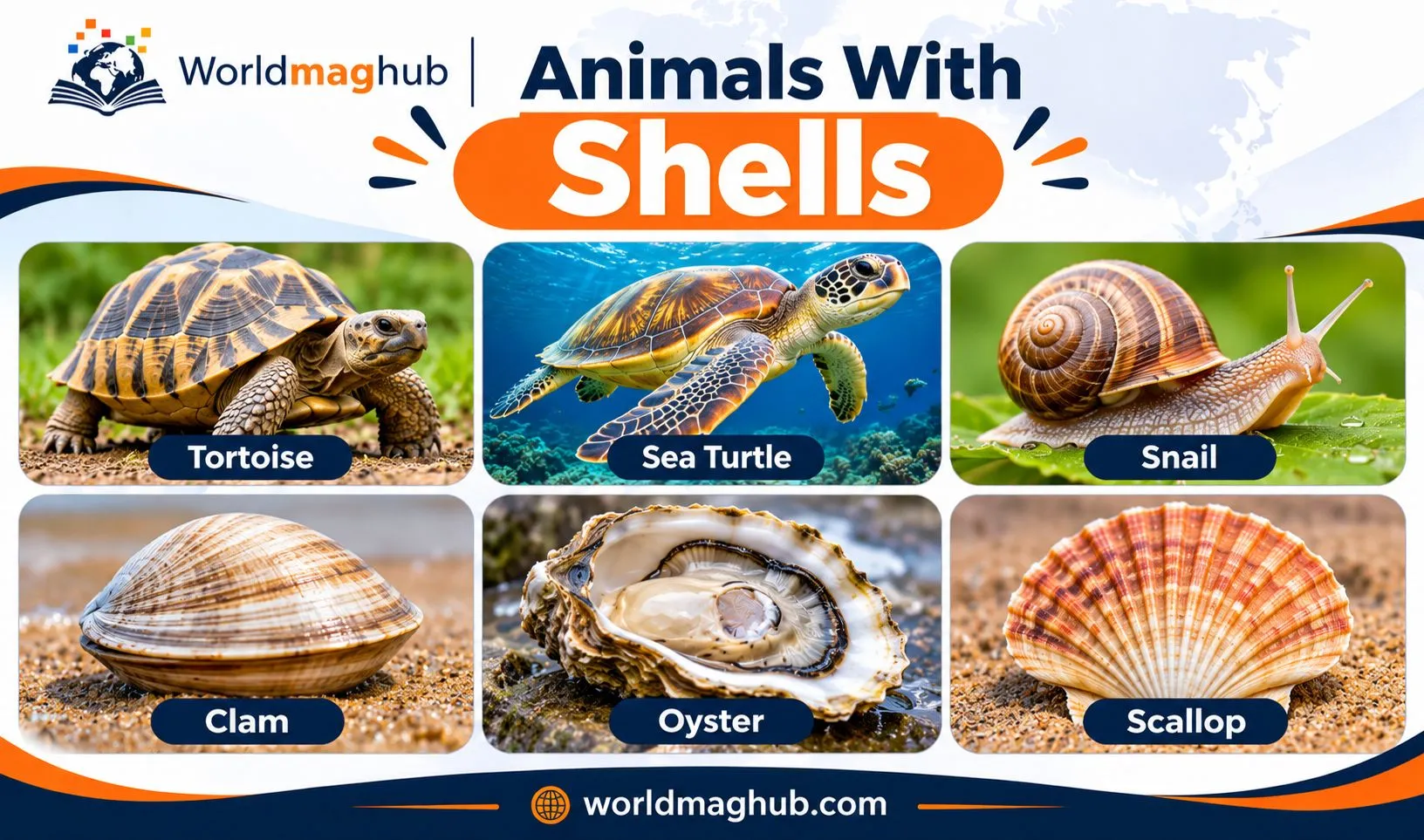
Turtles, tortoises, snails, clams, oysters, crabs, and lobsters are some of the most familiar animals with shells. Other remarkable examples include the chambered nautilus, chiton, horseshoe crab, sea urchin, armadillo, and pill bug.
These animals use hard coverings to protect their bodies, but their shells are not all built the same way. Tortoises have bony shells, snails produce calcium carbonate shells, and crabs have hardened external skeletons. Hermit crabs are especially unusual because many live inside empty shells originally made by other animals.
Not all shelled animals have true shells in the same anatomical sense. Some possess protective exoskeletons, segmented armor, or borrowed shells.
Here are 15 documented examples of animals with shells or shell-like coverings, including their habitats, protective features, and the differences between their body structures.
15 Animals With Hard or Protective Shells
The following animals include reptiles, mollusks, crustaceans, echinoderms, and mammals. Their coverings serve different purposes and have different biological origins.
| Animal | Shell or Protective Covering | Habitat |
|---|---|---|
| Tortoise | Permanent bony shell with protective scutes | Land |
| Sea Turtle | Bony shell; outer covering varies by species | Ocean |
| Snail | Usually a coiled calcium carbonate shell | Land and water |
| Clam | Two hinged calcium carbonate shells | Freshwater and ocean |
| Oyster | Two thick, irregular mineral shell valves | Marine and brackish water |
| Scallop | Two hinged, often ribbed shell valves | Ocean |
| Chambered Nautilus | Spiral shell with internal chambers | Ocean |
| Chiton | Eight overlapping mineral shell plates | Rocky marine habitats |
| Crab | Hardened external skeleton | Land and water |
| Lobster | Segmented, jointed exoskeleton | Ocean |
| Hermit Crab | Borrowed shell protecting its soft abdomen | Land and water |
| Horseshoe Crab | Broad, hard exoskeletal shield | Coastal waters |
| Sea Urchin | Rigid mineral test covered with spines | Ocean |
| Armadillo | Bony armor embedded in the skin | Land |
| Pill Bug | Segmented exoskeleton | Damp terrestrial habitats |
This is a selection of representative shelled and armored animals, not a scientific ranking of shell strength.
1. Tortoise
Tortoises are among the most recognizable shelled animals. Their hard, usually dome-shaped shells protect their bodies from physical injury and potential predators.
A tortoise’s shell is a permanent part of its skeleton. It consists of two main sections: the carapace, which covers the back, and the plastron, which protects the underside.
In most species, the outer surface is covered with keratin plates called scutes. The underlying bony structure is connected to the ribs and spine.
Unlike a hermit crab, a tortoise cannot leave its shell because the covering is integrated into its body.
Tortoises are also well known for their slow, steady walking. Their sturdy limbs support a heavy body and protective shell, making them a familiar example of slow-moving reptiles. Discover more examples in our guide to slow-moving animals.
Shell feature: A permanent bony shell that protects the body.
2. Sea Turtle
Sea turtles are marine reptiles with protective shells adapted to life in the ocean.
Most species have hard upper shells covered with keratin scutes. Their streamlined bodies and flipper-shaped limbs allow them to swim efficiently.
Unlike many land turtles, sea turtles generally cannot withdraw their heads and flippers completely into their shells.
The Leatherback Sea Turtle is an important exception. Instead of large, hard surface scutes, its upper shell contains numerous small bones beneath firm, leathery skin.
These differences show how shell structure varies even among closely related reptiles.
Shell feature: A protective shell adapted for swimming, with notable differences among species.
3. Snail
Snails are mollusks known for their hard, often spiral-shaped shells.
Most familiar snail shells are made primarily of calcium carbonate, combined with organic materials. An organ called the mantle produces the materials needed for shell growth.
Many land snails can withdraw into their shells when threatened or during unfavorable environmental conditions.
Their shells provide physical protection and can help reduce moisture loss.
As the snail grows, it adds new material around the shell’s opening, allowing the covering to increase in size.
Shell feature: A mineral shell that often grows in a spiral.
4. Clam
Clams are bivalve mollusks with two hard shell halves called valves.
The valves are connected by a hinge and protect the soft animal inside. Strong muscles allow a clam to close its shell when threatened.
Many clams live buried in sand or mud, where they extend specialized structures called siphons to exchange water and collect food.
Their shells are made mainly of calcium carbonate and grow as the animal develops.
Unlike a snail’s single coiled shell, a clam has two protective sections that open and close.
Shell feature: Two hinged mineral valves enclosing a soft body.
5. Oyster
Oysters are marine bivalve mollusks with two hard, irregularly shaped shells composed mainly of calcium carbonate.
Many species attach themselves to rocks, reefs, or other hard surfaces.
Their shells protect their soft bodies while they filter food particles from the surrounding water.
Oysters can also form reef-like structures that provide shelter and habitat for other marine organisms.
Because their shells grow against surrounding surfaces and neighboring oysters, they often develop uneven shapes.
Shell feature: Thick, irregular mineral shells made of two hinged valves.
6. Scallop
Scallops are marine mollusks recognizable by their fan-shaped, often strongly ribbed shells.
Like clams and oysters, scallops have two hinged valves that protect their soft bodies.
However, many scallops have an unusual ability: they can swim by rapidly opening and closing their shells.
These movements push water outward, helping propel the scallop away from potential danger.
Scallops also possess numerous small light-sensitive eyes along the edge of their mantle.
Shell feature: Ribbed, hinged shells that provide protection and can assist with swimming.
7. Chambered Nautilus
The Chambered Nautilus is a marine mollusk with a distinctive coiled shell divided into internal chambers.
The living animal occupies the largest outer chamber, while older chambers help regulate buoyancy.
By controlling the balance of gas and liquid within its chamber system, the nautilus can influence its position in the water.
Unlike most living octopuses and squids, which lack a comparable external shell, the nautilus retains a conspicuous protective covering.
Its spiral shell is primarily made of mineral material and grows as the animal becomes larger.
Shell feature: A spiral, chambered shell used for protection and buoyancy regulation.
8. Chiton
Chitons are unusual marine mollusks whose shells consist of eight overlapping plates along their backs.
These plates are held together by a tough surrounding band of tissue called the girdle.
Unlike a single rigid shell, the overlapping arrangement provides flexibility while protecting the animal’s upper body.
Chitons use a broad muscular foot to cling firmly to rocks, particularly in coastal areas exposed to waves.
Their shell plates help them conform to uneven surfaces while remaining protected.
Shell feature: Eight overlapping mineral plates that combine protection with flexibility.
9. Crab
Crabs are crustaceans with hard external skeletons that protect and support their bodies.
The broad upper covering is called the carapace. Unlike a tortoise’s bony shell, a crab’s exoskeleton consists mainly of chitin-based materials, often strengthened by calcium compounds.
Crabs have jointed legs and movable claws that allow them to walk, feed, and defend themselves.
Because their rigid exoskeletons cannot expand continuously, crabs must periodically shed them through a process called molting.
Shell feature: A hardened exoskeleton that provides protection and must be shed during growth.
10. Lobster
Lobsters are marine crustaceans with hard, segmented exoskeletons.
Their outer coverings protect their bodies while flexible joints allow movement of the legs, claws, and abdomen.
Like crabs, lobsters have exoskeletons made from chitin-based material reinforced with minerals.
As a lobster grows, it must periodically shed its old covering and form a larger one.
The new exoskeleton is initially softer and gradually hardens after molting.
Shell feature: A protective, segmented exoskeleton that must be shed during growth.
11. Hermit Crab
Hermit crabs are particularly interesting because the familiar spiral shells they carry are usually not produced by the crabs themselves.
Many hermit crab species occupy empty shells left behind by marine snails.
These borrowed coverings protect their soft, vulnerable abdomens, while the front portions of their bodies have their own exoskeletons.
As a hermit crab grows, it may need to find a larger shell.
Some species carefully inspect available shells before moving into a new one.
Shell feature: A borrowed mollusk shell that protects the crab’s soft abdomen.
12. Horseshoe Crab
Horseshoe crabs are marine arthropods with broad, horseshoe-shaped protective coverings.
Despite their common name, they are not true crabs. They belong to a different arthropod lineage and are more closely related to arachnids than to crustaceans.
Their hard upper shield protects much of the body, while multiple pairs of jointed legs allow movement along the seafloor.
A long, pointed tail called the telson helps a horseshoe crab right itself if overturned.
Shell feature: A broad, rigid exoskeletal shield rather than a mollusk-style shell.
13. Sea Urchin
Sea urchins are marine invertebrates with rounded or flattened bodies covered in movable spines.
Beneath these spines is a rigid structure called the test, made from fused calcium carbonate plates.
The test supports and protects the animal’s internal organs, while the spines provide additional defense.
Unlike a snail’s spiral shell, a sea urchin’s protective structure surrounds much of its body without a large opening for withdrawal.
Sea urchins are echinoderms, making them relatives of sea stars and sand dollars.
Shell feature: A rigid calcium carbonate test covered with movable spines.
14. Armadillo
Armadillos are unusual mammals because their bodies are covered with strong, shell-like armor.
Their protective coverings contain bony plates embedded in the skin, with keratinized material covering the surface.
Many species have movable bands that provide flexibility while walking and digging.
Some armadillos can curl their bodies for protection. However, the ability to form a nearly complete defensive ball is especially associated with three-banded armadillos.
Their armor differs from a turtle’s integrated shell and from the mineral shells produced by mollusks.
Shell feature: Bony protective armor incorporated into the skin.
15. Pill Bug
Pill bugs, also called roly-polies, are small terrestrial crustaceans with segmented external armor.
Their bodies are covered by overlapping exoskeletal plates that protect while allowing movement.
Some species, including the Common Pill Bug (Armadillidium vulgare), can roll into a tight ball when disturbed.
This behavior helps protect vulnerable body parts and can reduce moisture loss.
Unlike snails or clams, pill bugs do not produce a separate mineral shell. Their protective covering is part of their external skeleton.
Shell feature: Segmented exoskeletal armor that allows certain species to curl into a protective ball.
Why Do Animals Have Shells?
Animals have shells and other hard protective coverings primarily for defense, but these structures can serve additional functions.
- Protection from predators: Tortoises, snails, and clams use their shells to protect vulnerable body parts.
- Structural support: Crabs and lobsters have exoskeletons that support their bodies and provide attachment points for muscles.
- Reducing water loss: Many land snails can withdraw into their shells to limit drying out.
- Buoyancy regulation: Chambered nautiluses use their internal shell chambers to help regulate buoyancy.
- Flexible defense: Chitons have overlapping shell plates, while pill bugs possess segmented armor that allows some species to roll into a ball.
Not every shell performs all these functions. Its structure, strength, and purpose depend on the animal’s anatomy and environment.
After finishing this list, try the World Mag Hub wildlife picker to discover a species you may not have encountered before.
Frequently Asked Questions
What Are Animals With Hard Shells Called?
There is no single scientific name for all animals with hard shells because they belong to different biological groups. Shelled mollusks include snails and clams, while turtles and tortoises are reptiles with bony shells. Crabs and lobsters are arthropods with protective exoskeletons.
Which Animals Have Spiral Shells?
Snails, conchs, whelks, and chambered nautiluses are examples of animals with spiral shells. Their shells are mainly made of calcium carbonate, although their internal structures and shapes vary by species.
What Are Animal Shells Made Of?
Animal shells and protective coverings contain different materials. Turtles and tortoises have bony shells, often covered with keratin scutes. Snails, clams, and nautiluses produce shells mainly from calcium carbonate. Crabs and lobsters have chitin-based exoskeletons, while armadillos possess bony armor embedded in their skin.
Which Animals Have Hard Shells and Several Pairs of Legs?
Crabs, lobsters, and horseshoe crabs are examples of animals with hard protective exoskeletons and multiple pairs of jointed legs. Crabs and lobsters are crustaceans, while horseshoe crabs belong to a different arthropod group.
Are Seashells Made by Animals?
Yes. Most familiar seashells are produced by marine mollusks, including sea snails, clams, oysters, and scallops. Their mantles secrete minerals and organic materials that form the shell. After an animal dies, its durable shell may remain underwater or wash ashore.
Do Hermit Crabs Make Their Own Shells?
No. Most shell-dwelling hermit crabs use empty snail shells rather than producing those shells themselves. They have their own exoskeletons, but the borrowed shells protect their softer abdomens. As they grow, they may move into larger shells.
Sources and Further Reading
This guide presents documented examples of animals with true shells, protective exoskeletons, borrowed shelters, or shell-like armor. These structures differ in composition and evolutionary origin, so the animals are not classified as having identical shell types.
The following zoological and educational sources support the main anatomical and biological explanations:
- American Museum of Natural History — Turtle Shells — Bony shell structure, carapace, plastron, and scutes.
- Smithsonian Ocean — Sea Turtles — Shell anatomy, marine adaptations, and differences among sea turtles.
- NOAA Fisheries — Leatherback Turtle — The leatherback’s leathery covering and distinctive shell structure.
- Smithsonian Ocean — A Shell’s Story — Formation of mineral shells by mollusks.
- Queensland Museum — Chitons — Eight shell plates, muscular girdle, and protective function.
- OpenStax Biology 2e — Arthropods — Chitin-based exoskeletons, jointed appendages, and molting.
- Smithsonian’s National Zoo — Land Hermit Crab — Borrowed shells and protection of the soft abdomen.
- Smithsonian’s National Zoo — Three-banded Armadillo — Bony armor and defensive curling behavior.