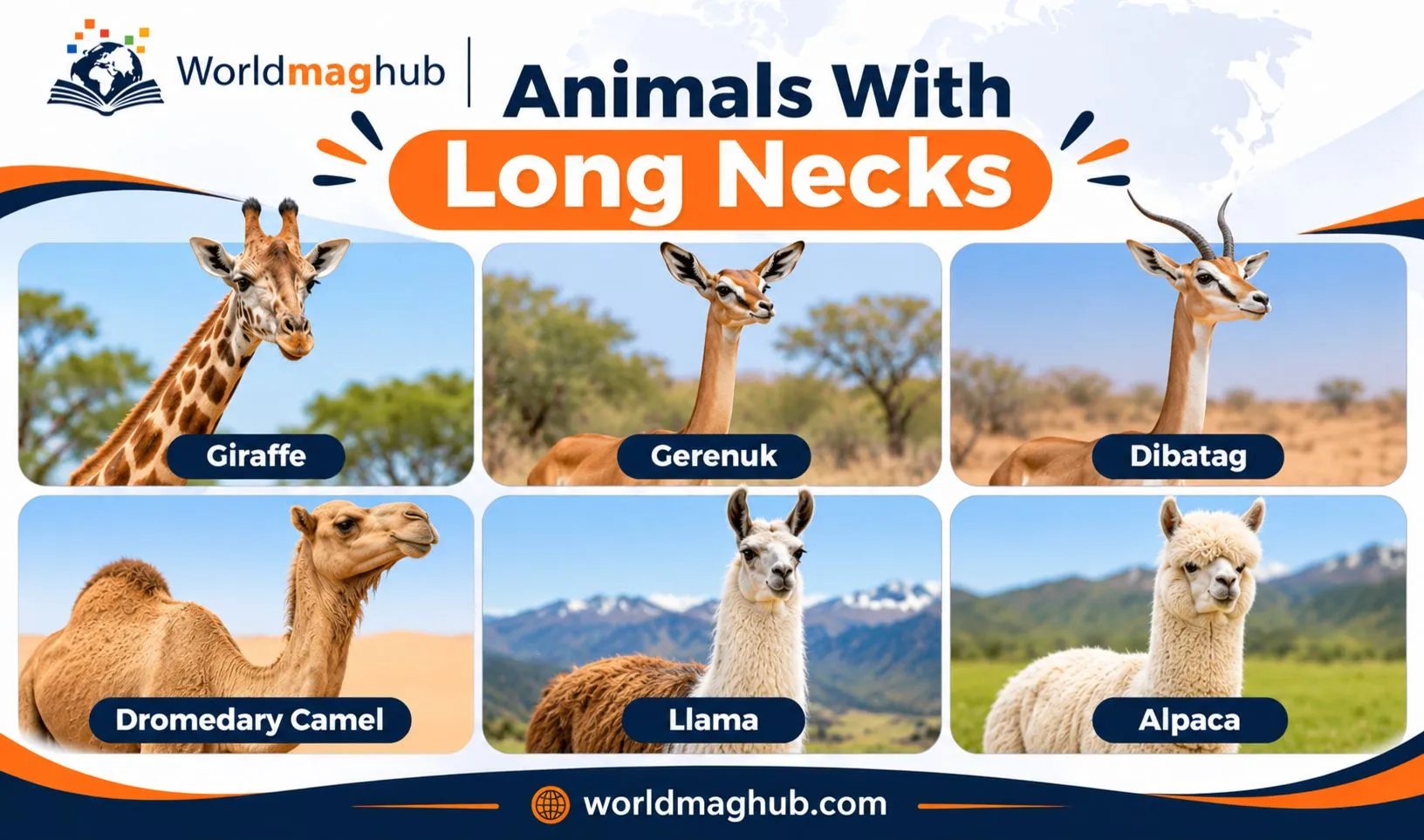
Giraffes, camels, llamas, alpacas, ostriches, swans, and flamingos are some of the most recognizable animals with long necks. Other remarkable examples include the gerenuk, dibatag, guanaco, anhinga, and Eastern Snake-necked Turtle.
These animals have elongated necks for different reasons. Giraffes and gerenuks reach vegetation above the ground, herons and anhingas use their necks to catch prey, and swans extend theirs underwater to reach food.
Which animal has the longest neck? The giraffe has the longest neck of any living animal. In large adult males, it can reach approximately 2.4 meters (7.9 feet), according to published anatomical research.
Here are 15 documented examples of long-necked animals from around the world, including their identifying features, habitats, and adaptations.
15 Long-Necked Animals Around the World
These examples include mammals, birds, and a reptile with noticeably elongated necks. They are not ranked by exact neck length.
| Animal | Scientific Name or Group | Main Region | Distinctive Neck Feature |
|---|---|---|---|
| Giraffe | Giraffa spp. | Africa | Longest neck among living animals |
| Gerenuk | Litocranius walleri | East Africa | Long, slender browsing neck |
| Dibatag | Ammodorcas clarkei | Horn of Africa | Elongated neck and slender body |
| Dromedary Camel | Camelus dromedarius | Africa, Asia; feral in Australia | Long, curved neck |
| Bactrian Camel | Camelus bactrianus | Central Asia | Long, flexible neck |
| Llama | Lama glama | South America; domesticated worldwide | Upright, elongated neck |
| Alpaca | Vicugna pacos | South America; domesticated worldwide | Long neck covered in fleece |
| Guanaco | Lama guanicoe | South America | Slender neck and alert posture |
| Ostrich | Struthio camelus | Africa | Longest neck among living birds |
| Emu | Dromaius novaehollandiae | Australia | Elongated neck with relatively sparse feathers |
| Flamingo | Family Phoenicopteridae | Several continents | Long, flexible, curved neck |
| Swan | Cygnus spp. | Several continents | Long, often S-shaped neck |
| Heron | Family Ardeidae | Worldwide | Flexible neck that folds and extends |
| Anhinga | Anhinga anhinga | Americas | Thin, snake-like neck |
| Eastern Snake-necked Turtle | Chelodina longicollis | Australia | Neck approximately half its shell length |
The scientific-name column includes both individual species and broader animal groups. Neck proportions and appearances vary between species, individuals, and ages.
1. Giraffe
Scientific name: Giraffa spp.
The giraffe is the tallest living land mammal and is best known for its exceptionally long neck.
Its neck allows it to browse leaves from tall trees, particularly acacias and other woody plants. Large adult males can have necks up to about 2.4 meters (7.9 feet) long.
Despite its extraordinary length, a giraffe’s neck contains seven cervical vertebrae, the same number found in most mammals. These bones are much longer than those of shorter-necked animals.
Giraffes also use their necks during vigilance and interactions between males, including contests involving head and neck movements.
Long necks are often accompanied by distinctive body proportions, and some species also have remarkably slender frames. Discover more examples of animals with naturally slender bodies.
Habitat: African savannas, grasslands, and open woodlands.
Identification clue: An exceptionally tall, spotted mammal with long legs, a small head, and an extraordinarily long upright neck.
2. Gerenuk
Scientific name: Litocranius walleri
The gerenuk is a slender antelope from East Africa, sometimes called the giraffe gazelle because of its remarkably elongated neck.
Unlike many grazing antelopes, gerenuks feed primarily on leaves, shoots, and other vegetation from bushes and small trees.
They can stand upright on their hind legs while extending their necks to reach food above the height accessible to many other browsing animals.
Their narrow heads, large ears, and thin necks create a distinctive appearance.
Habitat: Dry bushlands and scrublands of East Africa.
Identification clue: A slender, long-necked antelope with large ears that may stand on its hind legs to browse vegetation.
3. Dibatag
Scientific name: Ammodorcas clarkei
The dibatag is a relatively little-known antelope native to the Horn of Africa.
It has a slender body, long legs, and an unusually elongated neck that resembles the proportions of the gerenuk.
Like gerenuks, dibatags can rise on their hind legs to reach leaves and shoots growing above the ground.
Their neck length is especially noticeable when they stretch upward to browse in dry scrubland.
Habitat: Arid and semi-arid scrublands of the Horn of Africa, particularly parts of Ethiopia and Somalia.
Identification clue: A slim antelope with a long neck, narrow body, and elongated legs.
4. Dromedary Camel
Scientific name: Camelus dromedarius
The Dromedary Camel is recognized by its single hump, long legs, and noticeably curved neck.
Its flexible neck allows it to lower its head to graze and reach shrubs or other vegetation at different heights.
Camels also have mobile, divided upper lips that help them select leaves and shoots, including plants with tough or thorny surfaces.
The combination of a long neck, elevated body, and specialized feeding structures makes dromedaries well suited to browsing in dry environments.
Habitat: Arid regions of Africa and Asia, with feral populations in Australia.
Identification clue: A tall camel with one hump and a long, gently curved neck.
5. Bactrian Camel
Scientific name: Camelus bactrianus
Bactrian Camels have two humps, sturdy bodies, thick coats, and long, flexible necks.
Their necks help them reach vegetation while browsing and lower their heads when feeding from the ground.
Compared with dromedaries, domestic Bactrian Camels generally have heavier builds and thicker coats suited to the cold, dry conditions of Central Asia.
Although their necks are less extreme than those of giraffes, they remain a distinctive feature of the camel’s overall body structure.
Habitat: Deserts, steppes, and dry grasslands of Central Asia, primarily in domesticated herds.
Identification clue: A heavy-bodied, two-humped camel with a thick coat and elongated neck.
6. Llama
Scientific name: Lama glama
Llamas are domesticated South American camelids recognized by their elongated necks, upright ears, and relatively slender legs.
Their long necks create a tall silhouette, especially when they raise their heads to observe their surroundings.
Llamas feed on grasses and other vegetation, using their flexible necks to lower their heads while grazing.
They are closely related to wild guanacos and share similar body proportions.
Habitat: Originally domesticated in the Andes of South America; now raised in many parts of the world.
Identification clue: A woolly, long-necked camelid with an upright posture and distinctive banana-shaped ears.
7. Alpaca
Scientific name: Vicugna pacos
Alpacas are smaller relatives of llamas, known for their soft fleece and noticeably elongated necks.
Their necks are usually covered in thick wool, which can make their underlying shape less obvious.
Alpacas have compact bodies, relatively small heads, and upright ears. Their long necks help create a distinctive appearance when standing or moving through open pasture.
Unlike giraffes and gerenuks, which use their long necks extensively for elevated browsing, alpacas primarily graze on low-growing vegetation.
Habitat: Andean highlands of South America and farms worldwide.
Identification clue: A small, woolly camelid with a long fleece-covered neck and compact body.
8. Guanaco
Scientific name: Lama guanicoe
The guanaco is a wild South American camelid with a slender body, long legs, and an elongated neck.
Its neck creates a graceful upright appearance, particularly when the animal raises its head to watch its surroundings.
Guanacos live in open landscapes where they graze and browse on available vegetation.
They are closely related to domesticated llamas but generally have a more slender wild appearance.
Habitat: Grasslands, shrublands, mountains, and open plains across parts of South America.
Identification clue: A slender, tan-and-white wild camelid with long legs and an upright neck.
9. Ostrich
Scientific name: Struthio camelus
The Ostrich is the largest living bird and has the longest neck of any living bird.
According to Guinness World Records, the neck of an adult ostrich averages approximately 90 cm (35 inches or about 3 feet) from its base to the top of the head.
Its long, mostly bare neck helps it observe open landscapes and lower its head to collect seeds, leaves, and other foods.
Ostriches cannot fly, but their powerful legs allow them to run rapidly across African grasslands.
Habitat: African savannas, grasslands, and semi-arid regions.
Identification clue: An enormous flightless bird with a long upright neck, small head, and powerful legs.
10. Emu
Scientific name: Dromaius novaehollandiae
The Emu is Australia’s largest native bird and another recognizable example of an animal with an elongated neck.
Its relatively small head, tall legs, and flexible neck create a distinctive silhouette.
Emus use their necks to reach food on the ground and raise their heads to observe their surroundings.
Although shorter than an ostrich’s neck, an emu’s neck is noticeably long compared with its head and remains an important part of its appearance.
Habitat: Australian grasslands, open woodlands, and shrublands.
Identification clue: A large, shaggy brown flightless bird with long legs, a small head, and an upright neck.
11. Flamingo
Scientific group: Family Phoenicopteridae
Flamingos are recognizable by their pink plumage, long legs, and slender, flexible necks.
Their elongated necks allow them to lower their heads and position their specialized bills in shallow water while feeding.
Flamingos often hold their heads upside down, using their filtering bills to collect small aquatic organisms and other food particles.
Their necks can form pronounced curves, creating one of the most recognizable silhouettes among waterbirds.
Habitat: Salt lakes, lagoons, wetlands, and shallow coastal waters across several continents.
Identification clue: A tall pink wading bird with a long, curved neck and sharply bent bill.
12. Swan
Scientific group: Cygnus spp.
Swans are large waterbirds known for their elongated, often gracefully curved necks.
Their necks help them reach aquatic vegetation beneath the water’s surface while swimming.
Some species, such as the Mute Swan, frequently display a pronounced S-shaped neck posture. Other swans may hold their necks more upright.
Unlike herons, which commonly use rapid neck movements to capture animals, swans generally use their long necks to reach plants underwater.
Habitat: Lakes, rivers, wetlands, and other aquatic environments across multiple continents.
Identification clue: A large floating waterbird with a long neck, broad body, and relatively short legs.
13. Heron
Scientific group: Family Ardeidae
Herons are long-legged wading birds with elongated, flexible necks.
Their neck anatomy is especially useful when hunting fish, frogs, and other aquatic animals.
A heron may stand almost motionless before rapidly extending its neck to strike at prey with its pointed bill.
Many herons hold their necks folded into an S-shape while resting or flying, which can make their necks appear shorter than they actually are.
Habitat: Wetlands, rivers, marshes, lakes, and coastal areas worldwide.
Identification clue: A long-legged wading bird with a pointed bill and a flexible neck that often folds into an S-shape.
14. Anhinga
Scientific name: Anhinga anhinga
The Anhinga is a waterbird known for its extremely slender, snake-like neck.
When swimming, much of its body may remain underwater, leaving only its head and neck visible above the surface.
This unusual appearance gives the bird its common nickname, snakebird.
Anhingas use their long necks and pointed bills to catch fish underwater. Their neck structure supports rapid striking movements when pursuing prey.
After swimming, they often perch with their wings spread to dry.
Habitat: Freshwater lakes, marshes, swamps, and slow-moving waterways in warmer parts of the Americas.
Identification clue: A dark waterbird with a thin, snake-like neck, pointed bill, and frequently spread wings.
15. Eastern Snake-necked Turtle
Scientific name: Chelodina longicollis
The Eastern Snake-necked Turtle is a freshwater reptile from Australia with an exceptionally long, slender neck.
According to the Australian Museum, its neck is usually about half the length of its upper shell, making it unusually long relative to its body size.
Unlike many turtles that retract their heads straight backward, this species folds its neck sideways beneath the edge of its shell.
Its elongated neck also helps it reach and capture aquatic prey, including small fish, tadpoles, and invertebrates.
The eastern snake-necked turtle is unusual for more than its elongated neck. Like other turtles, it also has a protective bony shell. Shells occur in many different animal groups, from reptiles to mollusks and crustaceans, although their structures are not all the same.
Habitat: Freshwater wetlands, ponds, lakes, and slow-moving waterways in eastern and southeastern Australia.
Identification clue: A freshwater turtle with a long, snake-like neck that can extend far beyond its shell.
Why Do Animals Have Long Necks?
Animals have evolved long necks for different feeding, hunting, and survival needs.
- Reaching food: Giraffes, gerenuks, and dibatags use elongated necks to reach vegetation at different heights.
- Catching prey: Herons, anhingas, and snake-necked turtles use their flexible necks to reach or strike at aquatic animals.
- Feeding underwater: Swans extend their necks to reach submerged vegetation, while flamingos position their heads and bills for filter feeding.
- Watching for danger: Giraffes, ostriches, and other tall animals can raise their heads to observe surrounding landscapes.
Long necks evolved independently in different animal groups. Their length, flexibility, and function vary according to each species’ anatomy and environment.
If this collection has sparked your interest in wildlife, our animal generator with species information offers another way to continue exploring.
Frequently Asked Questions
Which Animal Has the Longest Neck in the World?
The giraffe has the longest neck of any living animal. In large adult males, neck length can reach approximately 2.4 meters (7.9 feet). Giraffes use their long necks to reach elevated vegetation and during interactions between males.
What Small Animal Has a Long Neck?
The Eastern Snake-necked Turtle is a relatively small reptile with a neck measuring about half the length of its shell. The gerenuk is another example of a smaller long-necked mammal compared with giraffes and camels.
Which Animal Has a Long Neck and Fur?
Llamas, alpacas, guanacos, and camels are long-necked mammals with hair or woolly coats. Alpacas are particularly recognizable because their long necks are covered in dense fleece.
Are Giraffes the Only Mammals With Long Necks?
No. Camels, llamas, alpacas, guanacos, gerenuks, and dibatags also have noticeably elongated necks, although none approaches the giraffe’s exceptional neck length.
Do Long-Necked Animals Have More Neck Bones?
Not necessarily. Giraffes have seven neck vertebrae, like most mammals, but their vertebrae are greatly elongated. Birds have more variable numbers of cervical vertebrae, allowing different neck shapes and degrees of flexibility.
Which Bird Has the Longest Neck?
The Ostrich has the longest neck among living birds. According to Guinness World Records, an adult ostrich’s neck averages approximately 90 cm (35 inches or about 3 feet). Swans and flamingos are also well known for their long necks.
Sources and Further Reading
This guide presents documented living animals with elongated necks. The examples are supported by established zoological references, anatomical research, and institutional species profiles. They are not ranked by a single neck-length measurement.
- PeerJ — Why Sauropods Had Long Necks; and Why Giraffes Have Short Necks — Comparative neck anatomy and reported giraffe neck measurements.
- Zoological Journal of the Linnean Society — Giraffe Cervical Vertebral Column — Anatomical research on giraffe neck vertebrae.
- San Diego Zoo Wildlife Alliance — Antelope — Gerenuk and dibatag anatomy and upright browsing behavior.
- San Diego Zoo Wildlife Alliance — Giraffe — Physical characteristics, feeding, and behavior.
- Guinness World Records — Longest Neck for a Living Bird — Verified ostrich neck-length record.
- Australian Museum — Eastern Snake-necked Turtle — Neck proportions, distribution, and feeding behavior.
- Smithsonian’s National Zoo — Australian Snake-necked Turtle — Identification and anatomical characteristics.