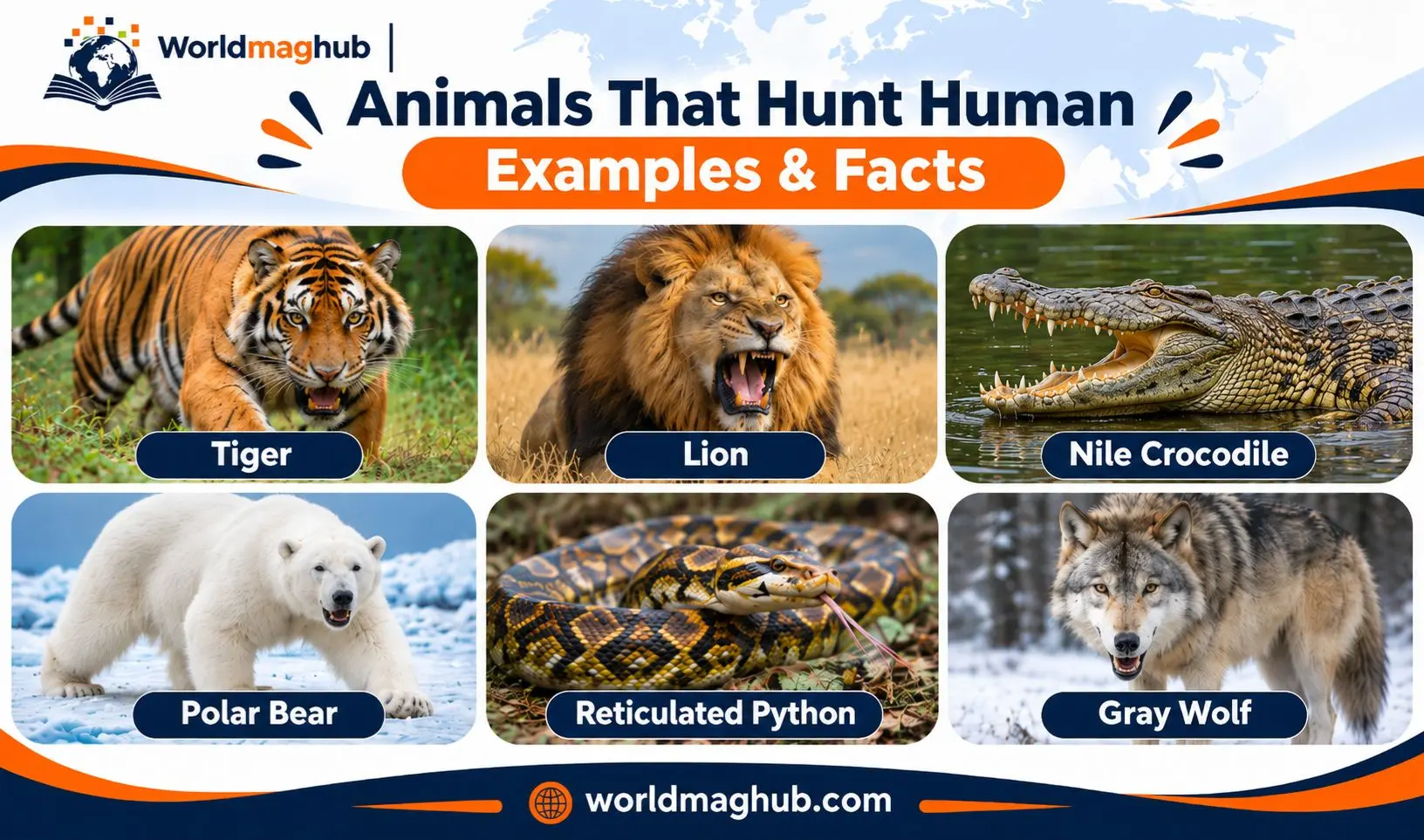
Tigers, lions, leopards, Nile crocodiles, saltwater crocodiles, and polar bears are among the animals with documented cases of hunting humans as potential prey. Rare predatory incidents have also been recorded involving Reticulated Pythons, Gray Wolves, and Cougars.
However, most wild predators do not routinely hunt humans. Their usual prey consists of other animals, and the circumstances behind attacks vary considerably.
Not every animal attack is an attempt to obtain food. Some animals attack defensively when surprised, threatened, or protecting their young. Others have been documented stalking, capturing, or attempting to consume people.
This guide examines nine animals with evidence of human predation, where incidents have occurred, and what scientific research reveals about their behavior.
9 Animals Known to Hunt or Prey on Humans
These species have documented predatory incidents involving humans, but their frequency and typical behavior differ substantially.
| Animal | Scientific Name | Main Region | Evidence of Human Predation |
|---|---|---|---|
| Tiger | Panthera tigris | Asia | Predatory incidents documented in the Sundarbans |
| Lion | Panthera leo | Sub-Saharan Africa | Historical human-predation cases in parts of Africa |
| Leopard | Panthera pardus | Africa and Asia | Predatory incidents recorded in specific regional populations |
| Nile Crocodile | Crocodylus niloticus | Africa | Documented attacks involving humans as potential prey |
| Saltwater Crocodile | Crocodylus porosus | South and Southeast Asia, northern Australia | Documented predatory attacks near waterways |
| Polar Bear | Ursus maritimus | Arctic | Rare but documented predatory attacks |
| Reticulated Python | Malayopython reticulatus | South and Southeast Asia | Rare documented human predation and consumption |
| Gray Wolf | Canis lupus | Northern Hemisphere | Rare predatory incidents varying by region |
| Cougar | Puma concolor | Americas | Rare documented predatory attacks |
These are documented examples, not a ranking by the number of people killed or consumed. An animal’s ability to attack humans does not mean humans are its normal or preferred prey.
1. Tiger
Scientific name: Panthera tigris
Habitat: Forests, grasslands, wetlands, and other habitats across parts of Asia.
Tigers are powerful solitary predators that normally hunt mammals such as deer and wild pigs. However, some individual tigers have attacked humans as potential prey.
The Sundarbans mangrove forests of India and Bangladesh are particularly well known for human-tiger conflict. People entering these forests for fishing, honey collection, and other livelihood activities may encounter tigers.
A 2023 worldwide study of large-carnivore attacks, published in PLOS Biology, found that tiger attacks in the Sundarbans were predominantly predatory. In contrast, many recorded tiger attacks in Russia were defensive.
This difference shows why tiger behavior cannot be generalized across every population.
Key distinction: Tigers have documented histories of human predation in certain regions, but humans are not their usual prey.
2. Lion
Scientific name: Panthera leo
Habitat: Savannas, grasslands, and open woodlands, mainly in sub-Saharan Africa.
Lions are social predators that normally hunt antelope, zebra, wildebeest, buffalo, and other mammals.
However, human predation has been documented in certain regions, particularly where people and lions share landscapes.
A 2005 study published in Nature examined lion attacks in Tanzania and reported that lions had killed more than 563 people and injured at least 308 since 1990, during the period studied.
These are historical figures from Tanzania, not current annual worldwide totals. They also should not be interpreted as a count of confirmed human consumption events.
Researchers have examined how ecological conditions, human settlement patterns, and changes in prey availability may influence lion-human conflict.
Key distinction: Lions have well-documented cases of human predation, but this behavior varies considerably across populations.
3. Leopard
Scientific name: Panthera pardus
Habitat: Forests, grasslands, rocky landscapes, and other habitats across parts of Africa and Asia.
Leopards are adaptable solitary predators that normally hunt antelope, monkeys, and smaller mammals.
Their ability to live in forests and landscapes near human settlements sometimes brings them into contact with people.
Predatory attacks have been documented in parts of India and neighboring regions.
The 2023 worldwide carnivore study found that leopard attacks in the Kashmir region were predominantly predatory, while attacks recorded in several other areas of India were more often defensive.
This regional difference is important because the presence of a leopard near people does not automatically mean it is hunting them.
Key distinction: Leopards have documented predatory attacks on humans, but many encounters and attacks have different causes.
4. Nile Crocodile
Scientific name: Crocodylus niloticus
Habitat: Rivers, lakes, wetlands, and other freshwater environments across much of sub-Saharan Africa.
Nile Crocodiles are large ambush predators that capture animals near or in water.
Their natural prey includes fish, birds, and mammals. Large individuals can capture substantial animals, including humans.
Predatory incidents may occur when people swim, fish, collect water, or carry out other activities near crocodile-inhabited waterways.
Research published in Oryx examined Nile Crocodile attacks in South Africa and Eswatini, including the locations and circumstances surrounding encounters.
Unlike a defensive attack, an incident in which a crocodile attempts to capture and consume a person may represent predatory feeding behavior.
Key distinction: Nile Crocodiles are documented predators of humans, particularly during encounters near water.
5. Saltwater Crocodile
Scientific name: Crocodylus porosus
Habitat: Coastal rivers, estuaries, wetlands, and waterways across parts of South and Southeast Asia and northern Australia.
Saltwater Crocodiles are among the largest living reptiles and are powerful ambush predators.
They can capture large animals entering or approaching the water, including people.
The IUCN Crocodile Specialist Group maintains information on crocodilian attacks, with substantial records available for Saltwater Crocodiles in Australia.
A scientific study examining 87 attacks over 42 years in Australia identified two particularly important factors influencing survival: the crocodile’s size relative to the victim and the victim’s position in relation to water.
These findings help explain why encounters with large crocodiles in or near water can be especially dangerous.
Key distinction: Saltwater Crocodiles have documented predatory attacks involving humans, particularly near occupied waterways.
6. Polar Bear
Scientific name: Ursus maritimus
Habitat: Arctic sea ice, coastal environments, and nearby northern landscapes.
Polar Bears primarily hunt seals, which provide the energy-rich food needed to survive in Arctic conditions.
Although encounters with people are relatively uncommon, some Polar Bears have approached and attacked humans as potential prey.
A scientific review published in Wildlife Society Bulletin documented 73 attacks by wild Polar Bears between 1870 and 2014 across Canada, Greenland, Norway, Russia, and the United States.
The reviewed incidents resulted in 20 human deaths and 63 injuries.
Researchers judged most attacks in their records to be predatory and identified nutritionally stressed adult males as a particular concern.
These historical cases do not mean Polar Bears routinely seek humans as food.
Key distinction: Human predation by Polar Bears is rare but scientifically documented.
7. Reticulated Python
Scientific name: Malayopython reticulatus
Habitat: Tropical forests, wetlands, agricultural areas, and other environments across South and Southeast Asia.
The Reticulated Python is among the world’s longest snakes and captures prey through constriction.
It normally feeds on mammals and birds. Exceptionally large individuals are capable of swallowing human-sized prey.
A published study examining reports from Indonesia between 1927 and 2025 documents cases of human predation and attempted predation involving Reticulated Pythons.
Such incidents are exceptionally rare and do not establish that humans are a regular food source.
Unlike a snake biting defensively, an incident involving constriction followed by attempted consumption can provide stronger evidence of predatory intent.
Key distinction: Reticulated Pythons have rare documented cases of consuming humans, but human predation is not typical behavior.
8. Gray Wolf
Scientific name: Canis lupus
Habitat: Forests, grasslands, tundra, and mountainous regions across parts of the Northern Hemisphere.
Gray Wolves are social predators that generally hunt wild ungulates such as deer, elk, and moose.
They typically avoid people, and predatory attacks are uncommon in much of their modern range.
However, historical records and scientific studies document incidents in which wolves attacked humans as potential prey.
The 2023 worldwide carnivore study found that very few wolf attacks occurred in Europe and North America during the study period. Many of the recorded predatory or unprovoked incidents in those regions involved wolves conditioned to human food.
Food conditioning can change an animal’s behavior around people, but it does not mean every wolf approaching a person is attempting predation.
Key distinction: Human predation by Gray Wolves is documented but rare and highly dependent on circumstances.
9. Cougar
Scientific name: Puma concolor
Habitat: Forests, mountains, grasslands, and other environments across the Americas.
Cougars, also called Mountain Lions or Pumas, are solitary predators that mainly hunt deer and other mammals.
They typically avoid humans, although rare predatory attacks have occurred.
Some documented incidents involve cougars stalking or pursuing people, behavior that may indicate an attempted predatory encounter.
The 2023 worldwide carnivore study included 135 reported Cougar attacks between 1950 and 2019 across the study regions.
However, this figure includes attacks with different causes and must not be interpreted as 135 confirmed attempts to consume humans.
Key distinction: Cougars have documented predatory incidents involving people, but such behavior is uncommon.
If you enjoy discovering unfamiliar creatures, our animal discovery tool at World Mag Hub can introduce you to a different species.
Frequently Asked Questions
Which Animal Eats the Most Humans?
There is no reliable worldwide ranking based specifically on confirmed human consumption. Nile Crocodiles, lions, and tigers have documented histories of predatory attacks, but studies differ in their reporting periods, geographic coverage, and definitions. Fatal attacks should not automatically be counted as cases of animals eating humans.
Do Animals Hunt Humans for Fun or Sport?
There is no convincing scientific evidence that wild predators deliberately hunt humans for entertainment or sport. Attacks can involve feeding behavior, defense, surprise encounters, or other circumstances. An animal’s motivation should be assessed through evidence rather than human assumptions.
Do Sharks Hunt Humans for Food?
Some large sharks can fatally bite humans, and rare incidents may involve predatory behavior. However, many shark bites are not confirmed attempts to consume people. Investigative biting and mistaken identification are possible explanations for some incidents, so a shark attack is not automatically evidence of deliberate human hunting.
Do Hyenas Hunt Humans?
Hyenas can attack humans, and suspected or documented predatory cases exist. However, feeding behavior varies among species and populations. Finding a hyena consuming human remains does not establish that it killed the person for food.
Can Komodo Dragons Eat Humans?
Komodo Dragons are capable of inflicting fatal injuries and consuming large animal prey. Rare serious attacks involving humans have been reported, but humans are not established as regular prey. An attack or the consumption of remains should not automatically be interpreted as deliberate human hunting.
Sources and Further Reading
This article presents nine animals with documented predatory incidents involving humans. It draws on peer-reviewed wildlife research and institutional records.
The examples are not ranked by the number of people killed or eaten. Predatory, defensive, and other attacks must be distinguished when interpreting wildlife incidents.
- Bombieri et al. (2023) — A Worldwide Perspective on Large Carnivore Attacks on Humans, PLOS Biology — Worldwide analysis of large-carnivore attacks between 1950 and 2019, including regional differences in predatory and defensive behavior.
- Packer et al. (2005) — Lion Attacks on Humans in Tanzania, Nature — Historical human-lion conflict, attack patterns, and documented fatalities.
- Powell et al. — Nile Crocodile Attacks in South Africa and Eswatini, Oryx — Research on crocodile attacks, geographic context, and contributing conditions.
- Fukuda et al. (2015) — Survival During Saltwater Crocodile Attacks, PLOS ONE — Analysis of 87 Australian attacks and factors influencing survival.
- IUCN Crocodile Specialist Group — Crocodilian Attacks — Attack records and limitations in crocodile incident reporting.
- Wilder et al. (2017) — Polar Bear Attacks on Humans, U.S. Geological Survey — Review of 73 historical attacks and their causes.
- Iqbal et al. (2025) — Humans as Prey of Reticulated Pythons in Indonesia — Reported incidents of human predation and attempted predation between 1927 and 2025.
- Florida Museum — International Shark Attack File Case Classifications — Distinguishing shark bites, predatory incidents, and scavenging.
- Smithsonian’s National Zoo — How Dangerous Are Komodo Dragons? — Komodo Dragon behavior and human-encounter risks.